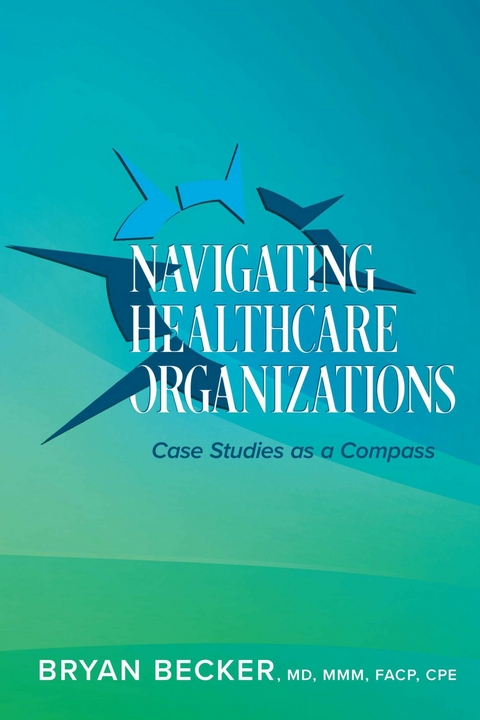
Navigating Healthcare Organizations (eBook)
112 Seiten
Bookbaby (Verlag)
979-8-3509-8199-5 (ISBN)
Bryan Becker, MD, MMM, FACP, CPE is a seasoned physician executive with a 25-year track record in successfully leading healthcare transformations. Specializing in organizational change, operations, and financial turnarounds, his leadership has been instrumental in enhancing patient-centered care and physician engagement. Bryan excels in strategic partnerships and data-driven improvement, driving excellence in diverse healthcare environments from academic health systems to community and for-profit delivery systems. With a leadership philosophy anchored in empathy, integrity, accountability, and continuous improvement, he challenges and empowers his team members to develop new skills, try new things and actively participate in shaping organizational direction and success. Bryan has enjoyed a unique and progressive career journey beginning as a faculty nephrologist at the prestigious Vanderbilt University Medical Center and steadily advancing into administrative leadership roles across academic health centers, community health systems, for-profit health system environments, and public health institutions. With a heart and passion for the underserved, Bryan has served in C-level roles and as an Associate Dean and Sr. Associate Dean in two large academic health systems (University of Illinois Hospital & Health Sciences and University of Chicago Medicine) building new medical groups and clinically integrated networks, expanding service offerings, driving improved quality, and enhancing operational performance. He has further displayed his leadership impact and versatility by driving numerous transformational initiatives as a chief medical officer and physician leader for integrated care at DaVita, Inc., as President of a 600-clinician multispecialty group practice within a $1.1B county public safety net health system, and, most recently, as National Medical Director for a national primary care group with responsibility for 116 locations and their team members. Above all, Bryan's career priority has been to be a force for good with the belief that healthcare should emphasize the health part and should be easier for all, saying 'We need to make it work well, we must change how we teach it, how we deliver it, and how we show it is working.' Bryan's selfless nature and servant leadership extends beyond his day-to-day work duties into the community where he engages heavily in volunteer activities that range from board memberships, support of his synagogue, seeing patients with medical students, providing health education for elementary students, to supporting music and sports activities within the community. Bryan lives in Texas with his family and spends a lot of time outside with his dogs.
This book is a series of engaging case studies designed to help leaders in healthcare organizations, from rising leaders to C-suite executives navigate their healthcare organizations and the challenges therein. The cases have many features of real-world situations that readers will recognize as they dive deeper into each of these healthcare situations. Each case study is accompanied by questions throughout and a takeaway summary with some additional prompts to help the reader think through the approach of the key leader in the case, the other leaders in the organization and the organization itself.
Considerations for the case study:
Process Improvement Steps and Missteps in Population Health
The forces of “status quo’ism” can be very strong. Attempting to change the status quo is often a very positive thing for an organization. It is also fraught with organizational and personal risk. It exposes legacy practice. It identifies individuals who have not necessarily performed up to par or who are desirous of maintaining control and squeezing down on any change possibility. Their motives can be varied. One has to heed them, nonetheless.
Knowing that, it is logical to ask, what is the best way to initiate real change in a healthcare organization? How do you size up the power base? How do you choose the right subject to propel the change? What are the change management methodologies that you with to consider applying? When is it time to move forward and when is it time to consolidate your own base to take the next steps? Some of the most influential individuals in healthcare today focus on changing systems of care to improve patient outcomes. If you were faced with a charge to change something significant, how would you go about it?
Highbury Health
Highbury Health consisted of Highbury Hospital, ten Highbury Clinics (HHC), a partnership with Lady of the Lake Hospital in the adjacent county, and an affiliation with Stone School of Medicine as well as an employed medical group. Highbury Health physicians and providers also practiced at White Heart Hospital in the same metropolitan area and at eleven ambulatory clinic locations within twenty-five miles from Highbury. Nearly 50% of all ambulatory visits occurred at the main Highbury Clinic site. Highbury Health was led by Nathan Rudd, MHA, FACHE. Mr. Rudd had been a service line administrator and then hospital administrator in another state prior to coming to Highbury Health four years previously. The leadership team at Highbury Health consisted of Paul Thomas, MBA as Chief Financial Officer and Sr. VP for Finance, Devin Gonzalez, RN, MBA in a combined role as Chief Nursing Office and Sr. VP for Clinical Operations, Salvatore DiPisciligia, MD as Chief Clinical Officer for the system, and Calum Earle, MBA, M.Sc. as Chief Strategy Officer and VP for Strategic Planning.
Highbury Physicians
Highbury Physicians consisted of 353 employed physicians and 576 affiliated physicians who practiced at various Highbury sites. The group was led by Johnna Francona, MD, FACP, FACC. Dr. Francona reported to Dr. Pisciligia. Dr. Francona was a non-invasive cardiologist who was promoted to President of the practice by Mr. Rudd. Dr. Francona had been part of Highbury Health for seven years and practiced at the main Highbury hospital. Brian Rodderidge, MBA as chief administrative officer along with sixty-two staff addressed revenue cycle, contracting, information technology, human resources, and other practice management functions.
Highbury Physicians had a 27-member governing board. Each specialty was assigned to one of seven districts with three representatives elected from each district and six community representatives named to the board. The board committees included Personnel and Compensation, Quality, Operations, Finance, Compliance, and Communications. The Highbury Physicians board determined that there was a need to better manage chronic care to position Highbury Physicians for value-based contracting. The Quality committee was given a set of tasks that included disseminating innovations in healthcare throughout the entire Highbury delivery system.
Dr. Francona communicated this new charge to the practice via an all-practice memo that described how the Quality committee would be leading this work.
August 1, 2022
To: Members of the Quality Committee, Highbury Health Physicians
From: Dr. Johnna Francone
Re: New charge
Your committee has done exceptional work for Highbury Health over the last two years. Given the changes happening throughout Highbury and the external environment, we have had multiple discussions around the best focus for your committee in support of our organization. The board of Highbury Health has been looking to a committee in our organization to identify changes in our delivery system that can translate from the theoretical and business-side to practical in terms of day-to-day care delivery. You and I met to discuss the optimal role that you believe this committee can play in the changes in Highbury Health. With your feedback we have settled on a new charge for this committee.
The Quality Committee for Highbury Health Physicians will
- Disseminate innovations in healthcare throughout our Highbury Health
- Address the quality of healthcare delivery
- Develop new methods for process improvement and care guidelines
- Identify and resolve territorial issues
- Improve utilization while eliminating waste.
Your support staff and infrastructure will remain as is for the time being. You will be asked to meet more frequently for the next several months to lay out a plan relevant to this charge and determine, from your perspective, the best operational approaches to each aspect of this charge. You will be free to ask individuals from other areas of Highbury Health to join you in your meetings to provide information to you as needed. Acknowledging that this is an additional time burden for six months, we will provide each of you with 5% incremental increase adjustment to your wRVU-related compensation during this time period.
This is important work, and I am delighted that this group was chosen to spearhead it.
To meet these objectives, the committee met every 1-2 weeks for six months to review quality literature. The committee also discussed publicly reported data that reflected Highbury Health practice and then decided on an implementation strategy.
Using a modified Delphi approach, the committee chose to focus on diabetes performance in adults based on publicly reported data. The problem of diabetes mellitus throughout Highbury Health was significant and expanding. The committee recognized two important features about diabetes in the health system: its prevalence and the important role that adult primary care, e.g. family medicine and general internal medicine, could play in managing it. However, those primary care physicians and non-physician providers were increasingly stretched in workload to administer guideline-driven, evidence-based healthcare.
The committee felt that it would be important to target outcomes first, not process. This was different than most programs in Highbury Health. The committee adopted a stretch goal of 80% of the patient sample achieving appropriate testing and good control (Hgb A1C < 7.5 g/dl). This would improve overall performance while still recognizing that that some patients might not achieve the goal based on personal circumstances, e.g. end-stage malignancy.
|
Town Hall meetings
Highbury had not ignored diabetes as a healthcare problem. In fact, a wide variety of efforts were underway to address it throughout Highbury. As such, the committee took the unique step of convening two town hall meetings, calling all individuals in Highbury Health system with diabetes process improvement projects to participate.
From: Sal DiPisciligia, MD, MMM; Devin Gonzalez, RN, MBA; Johnna Francona, MD
Sent: Monday, September 24, 2022, 6:47 AM
To: Highbury Health allstaff; allphysician
Subject: Quality Committee—Town Hall
Good morning,
We are delighted to invite you to a series of town hall meetings overseen by our Highbury Health Physicians Quality Committee around diabetes care in Highbury Health. These town hall meetings will provide us an opportunity to hear about your fantastic work in the area of diabetes and help us determine the direction of diabetes care in Highbury Health for the future. The first meeting will take place
Thursday Nov 15, 2022, at 6:30pm in the Highbury Hospital conference area, Room A. Beverages and light snacks will be available at the town hall meeting. At least one more will follow in December as well.
Looking forward to your contribution.
Dr. Francona read this email and texted Sal DiPisciligia. “We need to talk.”
Twenty minutes later, Sal called Dr. Francona, “Johnna, it’s Sal. What’s up?”
Johnna said, “Why did you send that email this morning? I hadn’t seen it and didn’t know you were going to send it. We really want to use these events to see the scope of activities in the organization and you made it sound like everyone was getting a chance to weigh in...
| Erscheint lt. Verlag | 16.12.2024 |
|---|---|
| Sprache | englisch |
| Themenwelt | Wirtschaft ► Betriebswirtschaft / Management ► Unternehmensführung / Management |
| ISBN-13 | 979-8-3509-8199-5 / 9798350981995 |
| Informationen gemäß Produktsicherheitsverordnung (GPSR) | |
| Haben Sie eine Frage zum Produkt? |
 EPUB (Ohne DRM)
Größe: 1,0 MB
Digital Rights Management: ohne DRM
Dieses eBook enthält kein DRM oder Kopierschutz. Eine Weitergabe an Dritte ist jedoch rechtlich nicht zulässig, weil Sie beim Kauf nur die Rechte an der persönlichen Nutzung erwerben.
Dateiformat: EPUB (Electronic Publication)
EPUB ist ein offener Standard für eBooks und eignet sich besonders zur Darstellung von Belletristik und Sachbüchern. Der Fließtext wird dynamisch an die Display- und Schriftgröße angepasst. Auch für mobile Lesegeräte ist EPUB daher gut geeignet.
Systemvoraussetzungen:
PC/Mac: Mit einem PC oder Mac können Sie dieses eBook lesen. Sie benötigen dafür die kostenlose Software Adobe Digital Editions.
eReader: Dieses eBook kann mit (fast) allen eBook-Readern gelesen werden. Mit dem amazon-Kindle ist es aber nicht kompatibel.
Smartphone/Tablet: Egal ob Apple oder Android, dieses eBook können Sie lesen. Sie benötigen dafür eine kostenlose App.
Geräteliste und zusätzliche Hinweise
Buying eBooks from abroad
For tax law reasons we can sell eBooks just within Germany and Switzerland. Regrettably we cannot fulfill eBook-orders from other countries.
aus dem Bereich