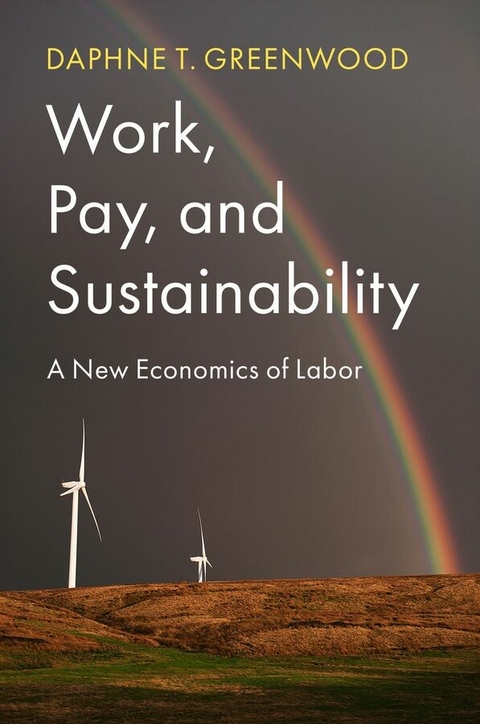
Work, Pay, and Sustainability (eBook)
494 Seiten
Polity (Verlag)
978-1-5095-3676-4 (ISBN)
Building on the work of many heterodox economists, Greenwood introduces wage and employment models that are embedded in the economy, environment, and society. Beginning with evidence on work and pay in the US today, she explains why tools for analyzing commodity exchange are not sufficient for analyzing labor relationships. She brings bargaining power to the fore, analyses dynamic monopsony, and looks at the role of wealth as well as income in framing opportunities. Throughout the book, Greenwood addresses threats to sustainability and equity from unpaid social costs; institutional changes such as financialization and fissured workplaces; as well as race-ethnicity and gender. Among the possibilities explored for improving work and pay are sectoral bargaining, job guarantees, worker-owned cooperatives, and universal basic income.
The first undergraduate-friendly book on its topic, Work, Pay and Sustainability is an important resource for students and scholars alike.
Daphne T. Greenwood is Professor Emerita of Economics at the University of Colorado-Colorado Springs.
Daphne Greenwood presents the first comprehensive introduction to pluralist labor economics. She expands the economics toolbox with theories taken from institutionalist, feminist, social, ecological, and stratification economists. Pluralists, she explains, focus on how formal and informal institutions affect the distribution of productivity dividends and how this has evolved over time. Pluralists are concerned with job quality as well as financial compensation. They acknowledge the modern-day abundance created by technology, but advocate for institutional changes to direct it in equitable and sustainable ways. Building on the work of many heterodox economists, Greenwood introduces wage and employment models that are embedded in the economy, environment, and society. Beginning with evidence on work and pay in the US today, she explains why tools for analyzing commodity exchange are not sufficient for analyzing labor relationships. She brings bargaining power to the fore, analyses dynamic monopsony, and looks at the role of wealth as well as income in framing opportunities. Throughout the book, Greenwood addresses threats to sustainability and equity from unpaid social costs; institutional changes such as financialization and fissured workplaces; as well as race-ethnicity and gender. Among the possibilities explored for improving work and pay are sectoral bargaining, job guarantees, worker-owned cooperatives, and universal basic income.The first undergraduate-friendly book on its topic, Work, Pay and Sustainability is an important resource for students and scholars alike.
INTRODUCTION
This book is focused on work and sustainability, particularly in affluent nations. Examples are primarily from the United States (US). The terms “work” and “labor” are used interchangeably to refer to all productive activities—paid or unpaid. A great deal of housework and caring labor is still unpaid, although much has been marketized in modern affluent economies.
Paid work can be analyzed from three different vantage points. The first two are familiar: what workers want from their jobs and what employers want from workers. But all societies must prepare the next generation for life and work in the community—economic, social, and as concerned citizens. Since workers are also the unpaid parents, family members, and neighbors who do that, it’s important to consider how work and pay affect them in those roles.
Throughout the book we focus on central issues in work and pay today—especially in the US—and how to use pluralist economic analysis to better understand them. One issue is why pay, opportunities, and working conditions are less equal among US workers today than in the mid-twentieth century. Collective bargaining play an important role and is addressed in multiple sections across chapters. Another issue is why the US has higher inequality than other affluent countries today—across workers regardless of race-ethnicity or gender. The particular barriers and different outcomes of female and non-White male workers are addressed not just in one chapter, but throughout the book.
To move toward a sustainable workplace, we must explore what’s behind differences in working conditions and pay in general. How much influence does gender, race-ethnicity, or parents’ social and economic status have on opportunity? Is greater pay equity consistent with economic efficiency? How will workplaces adapt to social and technological (think AI) change? How will environmental pressures and mitigation affect workers’ standard of living—which includes non-market aspects of quality of life (see Greenwood and Holt 2014a [2010])). Some of these come from the natural, built, or social environment. Others depend on quality of the workplace and the particular job.
THREE FUNDAMENTAL SHIFTS
As we deal with these issues, keep in mind three fundamental shifts that have affected work and pay. The first is a reversal of what is abundant and what is scarce. For the last hundred years, technological advances and education have massively increased the amount that a worker can produce in an hour. US per capita gross domestic product (GDP) is now over four times what it was in 1950, after adjusting for price changes. It’s good news that starvation and malnutrition around the world are no longer inevitable (Dugger and Peach 2009). Countries can now increase wealth through higher productivity (output per worker hour) and international trade. For much of human history, the primary method was seizing territory. That hasn’t ended, but it’s less common than in the past.
The bad news is that although coal and oil helped produce an abundance of market goods over the last century and a half, their carbon waste now overloads natural clean-up capacity. Economic processes must adapt to the new scarcity of many formerly “free goods”—clean air and water—and the abundance of traditionally scarce manufactured outputs. It’s hard for many people to shift from seeing fossil fuels as creators of abundance to recognizing that they create environmental scarcities—even with cheaper renewable energy sources. Support systems from extended families and communities are also more “scarce” in modern economies. We’ll explore why social and economic insecurity—along with environmental degradation—has increased even as production has become more abundant.
The second fundamental shift has been in business. From 1947 to 2017, the financial sector grew from 10 to 21 percent of GDP. It’s now larger than the trade or manufacturing sectors (Witko 2016; Sundaram and Hui 2019). Equally important, it’s much more active in business decisions than traditional banking. This financialization of the economy has led to “money manager capitalism” during the last forty years (Palley 2007; Baranes 2022). It means more focus on short-term profits, more outsourcing, and less security for workers. Business investment decisions, plant closures, and layoffs are now often made by private equity and institutional investors (Applebaum and Batt 2014; Lazonick 2009). Milton Friedman argued that corporations don’t have social responsibility. Their sole responsibility is maximizing shareholder profits (1970). This argument dominated financial and mainstream economic thinking for half a century. It’s now widely questioned—even by many business leaders.
The third shift is a change in corporate leadership. More come from finance and marketing backgrounds, fewer started in engineering. Their behavior has also changed. During the Cold War with the Soviet Union (1950s–1980s), many sought to demonstrate that capitalism was better for workers than communism. They pursued long-term profits, were concerned with consumer and worker loyalty, and often worked with unions rather than opposing them. Universities and cultural institutions in communities with headquarters and major plants often received large corporate contributions. Journalists wrote about “people’s capitalism” thirty-two times in the New York Times alone in 1956 (Yarrow 2010, 124). That phrase would be confusing today.
THE US ECONOMY … A LOOK BACK
Let’s turn now to how some basics have changed since 1980. Real gross domestic product (GDP) per capita more than doubled by the end of 20231—from slightly above $31,000 per person to almost $68,000. Per capita real growth reflects increased productivity, or average output per hour of work. Historically, this leads to increased profits and real wages. When President John F. Kennedy called economic growth “a rising tide that lifts all the boats” in the 1960s, that was true—and had been for several decades. But things began to change in the late 1970s. Average hourly pay increased by under 12 percent between 1979 and 2019, less than one-sixth of the 70 percent productivity increase over that thirty-year period.
How did families maintain living standards when costs for housing, health care, and higher education rose more rapidly than worker pay? At first, more second earners joined the workplace. But that strategy had limits. Median household income growth lagged inflation from 1999 to 2015. It has risen since, but real wage gains were mostly in the top 5 percent of households—especially the top one percent in most years.
Two forces drove increased wage inequality. The first was a shift in how the pie was split between labor and capital. In the post-World War II decades of the late 1940s to the 1980s, labor’s share of total national income varied cyclically (i.e. with the state of the economy) between 62 and 66 percent. Since 2000, it has fallen sharply, and now moves between 58 and 60 percent of GDP. In 2022, it was at its lowest level since the 1930s’ Great Depression (Karabarbounis 2023). In an economy of more than twenty trillion dollars a year, a change of 4 to 6 percentage points is not chump change!
The second factor was that within labor’s share, earnings from work rose most at the top. The lower 90 percent of workers experienced little or no real wage growth, with many seeing declines and fewer benefits. As workers from marginalized groups became a larger share of the workforce, their lower opportunities and outcomes were part of this—despite new doors being opened through equal opportunity laws.
In many higher paying jobs, benefits expanded to include paid parental leave, athletic facilities, or tuition assistance. But the share of jobs without basic benefits—like medical or retirement insurance—has increased since the 1980s. The COVID-19 pandemic revealed how many lack paid sick leave. It ramped up discussion of whether it should be universal across all US workplaces, as in most Western European countries. The pandemic also highlighted the issue of family leave to care for seriously ill family members, as well as young children or aging parents.
Working conditions also showed a great divide. On the one hand, there is more awareness of long-term dangers from chemical exposure or repetitive motion. Some workplaces have adopted ergonomic equipment to minimize worker strain, as well as serious policies regarding sexual or race-based harassment. But in others, the rules are weak—and frequently violated. Laws and their enforcement also vary considerably between states and industries. Penalties and enforcement are often lighter for firms than individuals.
New York Times columnist Jamelle Bouie has observed that if someone is caught shoplifting at Walgreens (for example), there’s a penalty beyond returning the item or promising never to do it again. But, if the same firm requires off-the-clock work that isn’t compensated, they often escape penalties or sanctions just by promising to do better and restoring back pay.
Work schedules have also changed considerably. With more two-worker and single-parent families, flextime and paid family leave help work–life balance. “Just-in-time” scheduling and unpaid overtime does...
| Erscheint lt. Verlag | 9.12.2024 |
|---|---|
| Sprache | englisch |
| Themenwelt | Wirtschaft ► Volkswirtschaftslehre |
| Schlagworte | Adam Smith • a new economics of labor • a new economics of labour • Daphne Greenwood • Demographic economics • Economic Ethics • Economics • economy • Environmental economics • Environmental Ethics • ethics • Greenwood • labor and demographic economics • Labor Economics • labour and demographic economics • Labour Economics • political economics • Political Economy • Politics • sustainability • sustainability economics • work pay and sustainability • work pay and sustainability a new economics of labor • work pay and sustainability a new economics of labour |
| ISBN-10 | 1-5095-3676-0 / 1509536760 |
| ISBN-13 | 978-1-5095-3676-4 / 9781509536764 |
| Informationen gemäß Produktsicherheitsverordnung (GPSR) | |
| Haben Sie eine Frage zum Produkt? |
 EPUB (Adobe DRM)
Kopierschutz: Adobe-DRM
Adobe-DRM ist ein Kopierschutz, der das eBook vor Mißbrauch schützen soll. Dabei wird das eBook bereits beim Download auf Ihre persönliche Adobe-ID autorisiert. Lesen können Sie das eBook dann nur auf den Geräten, welche ebenfalls auf Ihre Adobe-ID registriert sind.
Details zum Adobe-DRM
Dateiformat: EPUB (Electronic Publication)
EPUB ist ein offener Standard für eBooks und eignet sich besonders zur Darstellung von Belletristik und Sachbüchern. Der Fließtext wird dynamisch an die Display- und Schriftgröße angepasst. Auch für mobile Lesegeräte ist EPUB daher gut geeignet.
Systemvoraussetzungen:
PC/Mac: Mit einem PC oder Mac können Sie dieses eBook lesen. Sie benötigen eine
eReader: Dieses eBook kann mit (fast) allen eBook-Readern gelesen werden. Mit dem amazon-Kindle ist es aber nicht kompatibel.
Smartphone/Tablet: Egal ob Apple oder Android, dieses eBook können Sie lesen. Sie benötigen eine
Geräteliste und zusätzliche Hinweise
Buying eBooks from abroad
For tax law reasons we can sell eBooks just within Germany and Switzerland. Regrettably we cannot fulfill eBook-orders from other countries.
aus dem Bereich