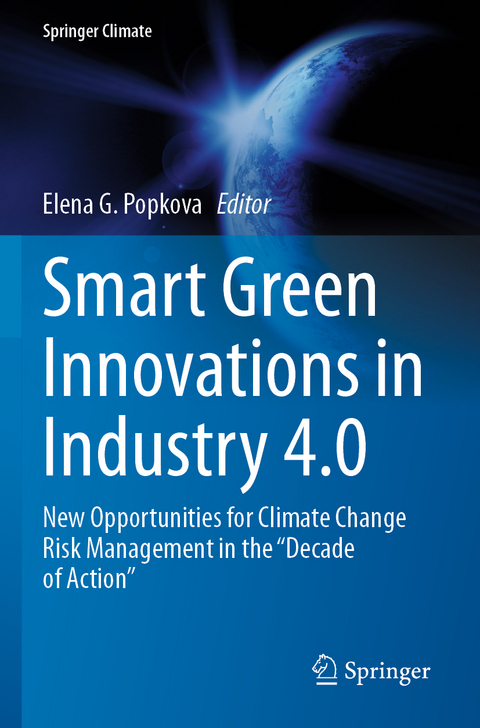
Smart Green Innovations in Industry 4.0
Springer International Publishing (Verlag)
978-3-031-45832-3 (ISBN)
As a forward-looking response (management measure) to the risks of climate change in the economy and business, this book suggests using smart green innovations in Industry 4.0 - high technologies in support of the sustainable development goals (SDGs). The advantage of smart technologies to combat climate change is their increased flexibility and adaptability, as well as the resistance of smart (automated, robotic) machines to different environmental conditions.
The academic significance of the book is attributable to the fact that it covers, as widely and comprehensively as possible, the full range of ground-breaking smart green innovations in Industry 4.0 with a potential of climate change risk management: from green finance (for example, blockchain-based cryptocurrencies) to smart and clean energy, as well as smart industrial innovations in Industry 4.0. The combination of public and corporate risk management measures of climate change allows achieving a "synergetic effect" in the form of enhanced support for the implementation of the SDGs.
Prof. Dr. Elena G. Popkova, Doctor of Economics, the Founder and President of the Institute of Scientific Communications (Volgograd, Russia), Professor of the Department of Economics, Chair of International Economic Relations at RUDN University, Moscow, Russia. Author of more than 150 publications in Scopus (h-index: 39). Editor of more than 50 books and a large number of special issues of international peer-reviewed scientific journals. Member of the editorial board of the International Journal of Economic Policy in Emerging Economies and the International Journal for Quality Research. Recipient of Highly Commended Paper Award for the journal On the Horizon for 2020 (Emerald). Honoured worker of science and high technologies of the Russian Federation. Honoured professor of Osh State University (Osh, Kyrgyzstan). She is among Scopus top 2% of most-cited scholars of the world in 2019-2021.
Part 1: Climate Responsibility in Managing Entrepreneurship in Digital Economy Markets.- Chapter 1: Competitiveness of Climate-responsible Entrepreneurship of Central Asia and Eastern Europe in the World Markets of the Digital Economy.- Chapter 2: Digital Environment of Entrepreneurial Structures as a Basis for Spatial Regional Development: Problems and Ways to Solve Them.- Chapter 3: Platform Approach as an Innovative Trend in the Development of Digital Entrepreneurship: Regional Aspect.- Chapter 4: High-Tech Export as a Vector of Development of Climate-Responsible Entrepreneurship in the Markets of the Digital Economy in Developed Countries.- Chapter 5: Effects of the Economic Crisis on the Development of Climate-Responsible Entrepreneurship in the Markets of the Digital Economy in Developed and Developing Countries.- Chapter 6: Conditions of Doing Business for the Development of Climate-Responsible Entrepreneurship in the Markets of the Digital Economy on the Example of Developed and Developing Countries.- Chapter 7: The Contribution of Climate-Responsible Entrepreneurship in the Digital Economy Markets to Green Growth in Developed and Developing Countries.- Chapter 8: Sustainable Development of Climate-responsible Entrepreneurship of Central Asia and Eastern Europe in the Digital Economy Markets under the Crisis Conditions.- Chapter 9: Practical Experience of Climate-responsible business in the Digital Economy Markets in the Eurasian Economic Union (EAEU).- Chapter 10: Case Experience of Adaptation of Climate-responsible Entrepreneurship in the Russian Markets of the Digital Economy to the Conditions of the COVID-19 Pandemic and Crisis.- Chapter 11: Case Experience of Conducting Climate-Responsible Entrepreneurship in the Digital Economy Markets in Russia.- Chapter 12: Customs Regulation in Support of Development of Climate-responsible Entrepreneurship in Digital Economy Markets.- Part 2: Fighting climate change using Advanced Technology and Green Innovations ofIndustry 4.0.- Chapter 13: The Modern Experience and Prospects for the Development of Climate-Responsible Entrepreneurship in the Digital Economy Market in the Sphere of E-Commerce.- Chapter 14: Features of Climate Risk Management of Entrepreneurship in the Digital Economy Markets in AgroTech.- Chapter 15: The Role of Robotization in the Development of Climate-Responsible Entrepreneurship in Developing Countries' Digital Economy Markets.- Chapter 16: The Concept of Smart Risk Management of Climate-responsible Entrepreneurship in Digital Economy Markets with Reliance on AI.- Chapter 17: Improvement of Green Entrepreneurship Planning in Digital Economy Markets with the Help of Big Data to Increase Climate Resilience.- Chapter 18: The System Approach to the Management of Climate Responsibility of Entrepreneurship in Digital Economy Markets Based on the Internet of Things.- Chapter 19: Development of the E-government System to Support Climate-responsible Entrepreneurship in the Markets ofthe Digital Economy.- Chapter 20: Consequences of the Development of International Digital Platforms for the Environment.- Chapter 21: Economic and Legal Aspects of Environmental Quality Management in Industry 4.0..- Part 3: Decarbonization and Sustainable Economic Development based on ESG Principles.- Chapter 22: Applied Solutions for ESG Management of Entrepreneurship in Digital Economy Markets with the Help of Blockchain.- Chapter 23: Peculiarities of Financing ESG Investments in the Russian Market.- Chapter 24: Digitalization of the Nuclear Industry for Sustainable Development.- Chapter 25: Environmental Factors Moderating Effect on Intangible Organizational Resources and Performance of Insurance Brokers in Zambia.- Chapter 26: Integration of ESG Principles in the Practice of Managing Enterprises in the Agro-industrial Complex.- Chapter 27: The Role of Public-Private Partnerships for the Development of Green Building.- Chapter 28: Improving the Quality of Corporate Governance withRe
| Erscheinungsdatum | 10.12.2024 |
|---|---|
| Reihe/Serie | Springer Climate |
| Zusatzinfo | XIV, 399 p. 5 illus., 2 illus. in color. |
| Verlagsort | Cham |
| Sprache | englisch |
| Maße | 155 x 235 mm |
| Themenwelt | Wirtschaft ► Volkswirtschaftslehre |
| Schlagworte | Climate Change Economics • environmental accounting • Green Energy • Green Innovation • Industry 4.0 • sustainable development |
| ISBN-10 | 3-031-45832-X / 303145832X |
| ISBN-13 | 978-3-031-45832-3 / 9783031458323 |
| Zustand | Neuware |
| Informationen gemäß Produktsicherheitsverordnung (GPSR) | |
| Haben Sie eine Frage zum Produkt? |
aus dem Bereich