


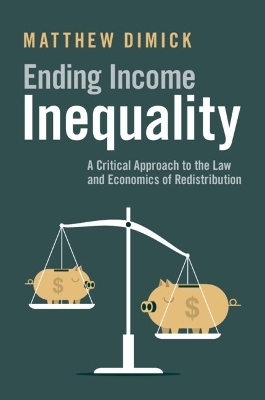
Ending Income Inequality
A Critical Approach to the Law and Economics of Redistribution
Seiten
2025
Cambridge University Press (Verlag)
978-1-108-82284-8 (ISBN)
Cambridge University Press (Verlag)
978-1-108-82284-8 (ISBN)
Income inequality has been rising for decades, yet there is a longstanding bias in legal thought-especially among law and economics scholars-against using legal rules to respond to this problem. This book shows why we should use legal rules, and not just income taxes, to address rising income inequality.
Income inequality in America has been on the rise for decades, but policy and legal thought has yet to catch up. Both parties in the United States have been hesitant to intervene in the market to address this problem, while the income tax system has been touted as a better and more efficient way to tackle income inequality. However, the tax system itself has failed to keep pace with the widening gaps in income. Ending Income Inequality challenges arguments made by legal scholars in the field of law and economics, who have supported the tax system over redistributive legal rules. By examining specific areas of the law such as minimum wage, collective bargaining, antitrust law, intellectual property, and housing regulation, the book argues that using legal rules, in addition to income taxes, is a promising path to reverse rising inequality.
Income inequality in America has been on the rise for decades, but policy and legal thought has yet to catch up. Both parties in the United States have been hesitant to intervene in the market to address this problem, while the income tax system has been touted as a better and more efficient way to tackle income inequality. However, the tax system itself has failed to keep pace with the widening gaps in income. Ending Income Inequality challenges arguments made by legal scholars in the field of law and economics, who have supported the tax system over redistributive legal rules. By examining specific areas of the law such as minimum wage, collective bargaining, antitrust law, intellectual property, and housing regulation, the book argues that using legal rules, in addition to income taxes, is a promising path to reverse rising inequality.
Matthew Dimick is Professor of Law at the University at Buffalo School of Law and Director of the Baldy Center for Law & Social Policy.
Acknowledgments; Part I. Introduction: 1. Orienting the argument; 2. Redistributing income efficiently; Part II. The Common Law: 3. Property; 4. Torts; 5. Contracts; Part III. Regulation and Functional Law: 6. Labor and Employment Law; 7. Antitrust; 8. Intellectual Property; 9. Housing Regulation; Part IV. Contents: 10. Conclusion.
| Erscheinungsdatum | 21.06.2025 |
|---|---|
| Zusatzinfo | Worked examples or Exercises |
| Verlagsort | Cambridge |
| Sprache | englisch |
| Themenwelt | Recht / Steuern ► EU / Internationales Recht |
| Recht / Steuern ► Steuern / Steuerrecht | |
| Sozialwissenschaften ► Politik / Verwaltung ► Staat / Verwaltung | |
| Wirtschaft ► Volkswirtschaftslehre ► Wirtschaftspolitik | |
| ISBN-10 | 1-108-82284-3 / 1108822843 |
| ISBN-13 | 978-1-108-82284-8 / 9781108822848 |
| Zustand | Neuware |
| Informationen gemäß Produktsicherheitsverordnung (GPSR) | |
| Haben Sie eine Frage zum Produkt? |
Mehr entdecken
aus dem Bereich

aus dem Bereich
Organisationen steuern, Strukturen schaffen, Prozesse gestalten
Buch | Softcover (2024)
Rehm Verlag
CHF 53,20
über 1000 Stichworte mit Fundstellenhinweisen
Buch (2025)
NWB Verlag
CHF 36,90


