Too Big to Care (eBook)
296 Seiten
Lioncrest Publishing (Verlag)
978-1-5445-4096-2 (ISBN)
Tatsuhiko Nakazawa is the CEO and co-founder of Smart Vision Logistics (SVL), a pioneering company revolutionizing the global landscape with circular economics. Previously the founder and CEO of TrustOne Logistics Corporation and with more than twenty-five years of experience in his field, Tatsuhiko has built a reputation as a trusted leader in the Japanese business community.
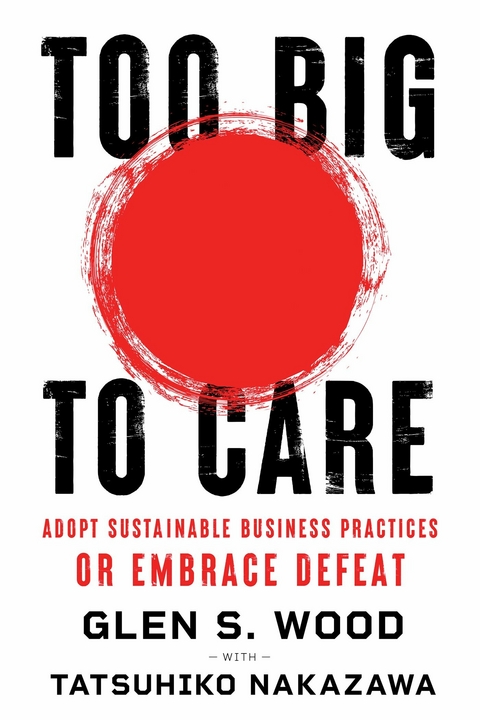
Sustainable practices-they're how you survive in the corporate world. But what sustainability means for your business remains unclear for many corporate leaders today. To some, corporate survival is doing the right thing, no matter the cost. Others think it's idealistic to always prioritize people and protect the environment. No matter where you stand, one thing is clear: Sustainability is born from market-driven solutions that make the world a better place. In Too Big to Care, Glen Wood explores our corporate future and reveals the business logic behind adding measurable value to society. Investors, employees, and customers benefit from corporate governance that is ethical and transparent. This means better jobs, higher incomes, fewer scandals, and a synergy between family life and workplace values all attributes of true capitalism. Including Glen's own paternity leave struggle with Mitsubishi and Morgan Stanley that earned him the title, "e;The Father of Japan,"e; this book takes you on a deep dive into new definitions of progress and profitability and exposes the lessons we can learn from the past.
Introduction
Let me tell you about a cycle of events that plays out every day in the world.
The CEO of a multinational corporation in a major city in say, the United States, has a conversation with his board of directors about something called “SDGs.” He brings the matter to his executive team, and they in turn task their managers with this new initiative. The US manager has never even heard the term, but he doesn’t want to look stupid, so he does an internet search and lands on a United Nations web page for Sustainable Development Goals.1 There he finds a list of seventeen SDGs.
Is this what his CEO was talking about? Because nothing on the page looks familiar to him. These are not the usual goals he’s asked to meet. The first goal, for example, is about ending poverty. Since when did his company care about poverty? There’s another goal about gender equality and another about climate action.
The only thing remotely familiar to him is the eighth goal: decent work and economic growth. His bosses are always looking for ways to make more money, but what does that have to do with—as the United Nations page states—“decent work for all?”
None of this makes sense to him, but he doesn’t want to say that out loud. Instead, he calls the manager in Tokyo.
“We need some SDGs from you guys,” he says, praying the Tokyo manager won’t ask him what it means. To his relief, the Tokyo manager is familiar with the term. “Esdeegees” is a fairly common word in Japan. It’s a hot topic in business circles. The Tokyo manager is even wearing a lapel pin to show his company supports sustainable goals. He doesn’t know that “esdeegees” is in fact three letters—S, D, and G—and stands for Sustainable Development Goals, but he’s heard the word.
The US manager hangs up, relieved. This is now somebody else’s problem. The Tokyo manager hangs up, troubled. Sure, he knows the term, but he is not sure what he needs to actually do to make his bosses happy. What can he do in his day-to-day work that will have an impact on esdeegees? How does he realistically deliver on this vague goal?
A Changing World
The world is changing quickly. Technology and social media have enabled a new global connectedness and free-flowing of communication and ideas, changing how humans interact and causing a cultural shift. All of this influences business leaders’ focus and how they run their companies. It makes them take a harder look at how they are perceived by the public. Leaders question whether they are supportive enough of their people. They wonder whether they are environmentally conscious enough, and if it really matters. They are also worried about what their customers think about their corporate governance and their brand. Are they transparent enough? Are they too transparent?
Leaders are wondering how the traditional nature of their businesses fits in this new corporate environment. They know what has worked in the past, but fear that the relevance of their established brand is waning. They want to know which parts of their brand are timeless—and which parts are outdated. They are proud of where they came from and believe in the value of their company heritage. But they don’t know exactly where they are going and question whether their history will continue to benefit them or become a detriment to growth.
At the same time, the pressure on business leaders to globalize—or not to globalize—comes with a lot of uncertainty. If globalization is the best path forward for their company, they want to know the best time to start, how quickly to ramp up, and how much globalization will be necessary to remain competitive. How will globalization change their company and will they need to change the way they do business to fit into the culture of the global economy? Whether or not they choose to globalize, they want to know what they have to gain and the risks that come with their decision.
Business leaders also have to consider the expectations of their investors, employees, and customers, not to mention the regulators and politicians. For many, the world around them has changed so much, yet they have not—and now they are at a point where they must decide whether it’s time to redefine who they are as a company. This means getting back to the basics about what is important to them, their investors, their employees, and their customers. That’s a lot of people to satisfy in a super-connected, evolving world. Do they pay more attention to investors? Close shops and go to an online presence only? Should they shift to a different strategy, for example, a mergers and acquisitions (M&A) strategy? Should they hire more people, or look to cut back?
Hindering their action is the fact that many are locked into a corporate structure and culture that’s no longer sustainable. This makes it difficult for them to hire and maintain good talent. They have problems with both employee retention and client acquisition. Their customers are expecting more from them, not just in products and services, but in how they manage their companies.
So are their shareholders. Before making investments, shareholders are now looking at the total environmental impact of a company’s policies and practices. Are they damaging the environmental ecosystem? Are they sustaining it? Do they define themselves as environmentally neutral, environmentally damaging, or environmentally helping? Likewise, shareholders are concerned about the social impact of a company—not just within the business, but on the world. Business leaders are expected to tackle harassment, eliminate discrimination, and treat their employees fairly, as well as offer a product that contributes to society by adding value. For example, a tobacco company could treat its employees like gold, but it will always fail the second part of the social impact test because its product is, by nature, harmful to society.
Also on the list of shareholder demands is corporate governance. Are business leaders transparent about their corporate governance policies? Are they communicating them clearly to their managers and employees? How accurate is their reporting, and how often do they share it with stakeholders? These three standards—environmental impact strategies, social impact strategies, and corporate governance strategies—come together in what is known as ESG strategies or goals. (If you’ve ever invested your retirement savings in a mutual fund with an ESG tag, now you know what it means.) This, along with the United Nations Sustainable Development Goals, are now crucial requirements for business leaders. Yet many leaders either don’t know how to address these requests, aren’t willing to address them, or they do not fully understand the benefits and the risks of compliance versus non-compliance.
Those who have chosen to ignore the cultural shift may be dealing with social problems, management problems, and even legal problems and lawsuits from employees within their companies. Behind the curve and out of touch, they’re struggling to understand why what worked in the past doesn’t work anymore. Some are running to catch up, but still very much behind. Others are paralyzed with indecision, unsure of what to do next, and getting further behind by the day. Leaders know they have to make changes, but they don’t want to lose themselves—or the heart of their businesses—in the process. What is the best way to deal with this vastly changing world?
The United Nations Sustainable Development Goals
The United Nations Sustainable Development Goals, or SDGs (pronounced es-dee-gees), are a great place to start for any business looking to develop a strategy for social improvement. These seventeen goals touch on issues of society, environment, and corporate governance and are “perhaps the most comprehensive inventory of what needs to change or improve”:2
- No poverty
- Zero hunger
- Good health and well-being
- Quality education
- Gender equality
- Clean water and sanitation
- Affordable and clean energy
- Decent work and economic growth
- Industry, innovation and infrastructure
- Reduced inequalities
- Sustainable cities and communities
- Responsible consumption and production
- Climate action
- Life below water
- Life on land
- Peace, justice and strong institutions
- Partnerships for the goals
The United Nations SDGs were developed over decades, but only recently codified for their 2030 agenda. At the time of publication of this book, that’s only seven years away. The UN has put out an urgent call for action by all countries, both developed and developing. Their dream is to have a global partnership among countries to achieve these...
| Erscheint lt. Verlag | 21.1.2025 |
|---|---|
| Sprache | englisch |
| Themenwelt | Wirtschaft ► Betriebswirtschaft / Management |
| ISBN-10 | 1-5445-4096-5 / 1544540965 |
| ISBN-13 | 978-1-5445-4096-2 / 9781544540962 |
| Informationen gemäß Produktsicherheitsverordnung (GPSR) | |
| Haben Sie eine Frage zum Produkt? |
 EPUB (Ohne DRM)
Größe: 3,3 MB
Digital Rights Management: ohne DRM
Dieses eBook enthält kein DRM oder Kopierschutz. Eine Weitergabe an Dritte ist jedoch rechtlich nicht zulässig, weil Sie beim Kauf nur die Rechte an der persönlichen Nutzung erwerben.
Dateiformat: EPUB (Electronic Publication)
EPUB ist ein offener Standard für eBooks und eignet sich besonders zur Darstellung von Belletristik und Sachbüchern. Der Fließtext wird dynamisch an die Display- und Schriftgröße angepasst. Auch für mobile Lesegeräte ist EPUB daher gut geeignet.
Systemvoraussetzungen:
PC/Mac: Mit einem PC oder Mac können Sie dieses eBook lesen. Sie benötigen dafür die kostenlose Software Adobe Digital Editions.
eReader: Dieses eBook kann mit (fast) allen eBook-Readern gelesen werden. Mit dem amazon-Kindle ist es aber nicht kompatibel.
Smartphone/Tablet: Egal ob Apple oder Android, dieses eBook können Sie lesen. Sie benötigen dafür eine kostenlose App.
Geräteliste und zusätzliche Hinweise
Buying eBooks from abroad
For tax law reasons we can sell eBooks just within Germany and Switzerland. Regrettably we cannot fulfill eBook-orders from other countries.
aus dem Bereich