
AI Product Manager's Handbook (eBook)
488 Seiten
Packt Publishing (Verlag)
978-1-83588-285-6 (ISBN)
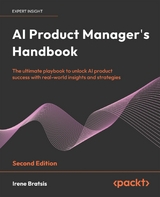
AI is rapidly transforming product management, presenting new challenges and business opportunities. As AI-driven solutions become more complex, product managers must bridge the gap between technological capabilities and business needs. This book provides a detailed roadmap for successfully building and maintaining AI-driven products, serving as an indispensable companion on your journey to becoming an effective AI product manager. In this second edition, you'll find fresh insights into generative AI, and responsible AI practices with the most relevant tools for building AI-powered products.
Authored by a leading AI product expert with years of hands-on experience in developing and managing AI solutions, this guide translates complex AI concepts into actionable strategies. Whether you're an aspiring AI PM or an experienced professional, this book offers a structured approach to defining AI product vision, leveraging data effectively, and aligning AI with business objectives. With new case studies and refined frameworks, this edition provides deeper insights into ethical AI, cross-functional collaboration, and deployment challenges.
By the end of this book, you'll be equipped with the knowledge to drive AI product success with key techniques for identifying AI opportunities and managing risks in a rapidly evolving landscape.
No detailed description available for "e;AI Product Manager's Handbook"e;.
Preface
It’s hard to find anyone these days who doesn’t have strong reactions to AI. I’ve watched my own feelings evolve with its rise, ebbing and flowing over the years. As a student, I felt an overwhelming excitement and optimism about where AI – and the fourth industrial revolution it accompanies – might lead us. That initial thrill was tempered as I began organizing AI events with virtual speakers and managing a data and AI book club. I adopted a monthly practice of learning about how bias and dependence on AI compromise our lives in both visible and unseen ways. AI is a double-edged sword – capable of driving immense progress but fraught with ethical dilemmas, privacy risks, and the perpetuation of biases we’re still struggling to confront in the real world today.
And so, we arrive at one of the greatest debates that resurfaces with every technological leap: do we dare embrace powerful technology even when we’re aware of the risks? As far as I see it, we don’t really have a choice – the debate itself is an illusion we indulge in. With the rise of accessible, generative AI tools available today, it’s clear that it’s here to stay. Nihilistic fears about it won’t protect us from harm. Pandora’s box is open, and as we peer into what remains inside, we find that hope springs eternal. AI is shaping our future, whether we’re ready or not. It has the potential to enhance human creativity and address pressing global challenges. Yet, the more we integrate this technology, the more we must ensure that AI serves humanity, and not just the interests of a few. Philosophically, the questions AI raises about intelligence and consciousness are essential to redefining what it means to be human in an age where machines can think, adapt, and even create.
I wanted to write a book about AI product management because it’s the makers of products who transform possibilities into realities. Understanding the intricacies of how to ideate, build, manage, and sustain AI products with integrity, to the best of my ability, feels like the greatest contribution I can offer to this field at this moment in time. I’m encouraged by the collective bargaining power of individuals demanding that companies adopt AI ethically and responsibly. I’m relieved that so many AI product teams today prioritize human-centered design and are committed to building products they can proudly bring to market. This shift holds a mirror to our biases and prejudices, prompting us to look deeply into the reflection we see – asking whether we truly like what we’ve created. It places the human experience of AI front and center, encouraging us to build expressions of AI that reflect our highest aspirations rather than our deepest flaws.
It’s been an honor to deliver this second edition.
Who this book is for
This book is for people that aspire to be AI product managers, AI technologists, and entrepreneurs, or for people that are casually interested in the considerations of bringing AI products to life. It should serve you if you’re already working in product management and you have a curiosity about building AI products. It should also serve you if you already work in AI development in some capacity and you’re looking to bring those concepts into the discipline of product management and adopt a more business-oriented role. While some chapters in the book are more technically focused, all of the technical content in the book can be considered beginner level and accessible to all.
Part 1 of this book is meant to serve as an overview of topics spanning the AI landscape overall, types of product that can exist in the space and a glance at the industry as a whole. Part 2 will have more practical, applied content regarding the product management of AI native tools. Part 3 will keep this format, but will focus on transitioning a traditional software product into an AI product. In these two parts, you’ll see more diagrams, flow charts, checklists, and visual aids suitable for a handbook. Finally, Part 4, the newest part of the book, will focus on the management of an AI career itself, serving as a handbook for maturing in the PM role and the pathways you can take with it.
What this book covers
Chapter 1, Understanding the Infrastructure and Tools for Building AI Products, offers an overview of the main concepts and areas of infrastructure for managing AI products.
Chapter 2, Model Development and Maintenance for AI Products, delves into the nuances of model development and maintenance.
Chapter 3, Machine Learning and Deep Learning Deep Dive, is a broader discussion of the difference between traditional deep learning and deep learning algorithms and their use cases.
Chapter 4, Commercializing AI Products, discusses the major areas of AI products we see in the market, as well as examples of the ethics and success factors that contribute to commercialization.
Chapter 5, AI Transformation and Its Impact on Product Management, explores the ways AI can be incorporated into the major market sectors in the future.
Chapter 6, Understanding the AI-Native Product, provides an overview of the strategies, processes, and team building needed to empower the success of an AI-native product.
Chapter 7, Productizing the ML Service, is an exploration of the trials and tribulations that may come up when building an AI product from scratch.
Chapter 8, Customization for Verticals, Customers, and Peer Groups, is a discussion on how AI products change and evolve over various types of verticals, customer types, and peer groups.
Chapter 9, Product Design for the AI-Native Product, is an overview of product design principles and concepts that are customized for products built natively with AI/ML components.
Chapter 10, Benchmarking Performance, Growth Hacking, and Cost, explains the benchmarking needed to gauge product success at the product level rather than the model performance level.
Chapter 11, Managing the AI-Native Product, reviews ongoing AI PM considerations that relate to leadership and visionary, stakeholder and operational alignment of products built natively with AI.
Chapter 12, The Rising Tide of AI, revisits the concept of the Fourth Industrial Revolution and a blueprint for products that don’t currently leverage AI.
Chapter 13, Trends and Insights across Industry, dives into the various ways we’re seeing AI trending across industries, as well as accessible routes product teams can take when enabling AI
Chapter 14, Evolving Products into AI Products, is a practical guide on how to deliver AI features and upgrade the existing logic of products to successfully update products for AI commercial success.
Chapter 15, The Role of AI Product Design, refocuses AI design and communication foundations applied to product teams that are looking to evolve traditional software products with AI/ML capabilities.
Chapter 16, Managing the Evolving AI Product, reviews ongoing AI PM considerations that relate to leadership and visionary, stakeholder and operational alignment of traditional software products adopting AI features and capabilities.
Chapter 17, Starting a Career as an AI PM, brings readers striving for AI PM careers on a journey through the theoretical and applied foundations to set up their budding careers up for success.
Chapter 18, What Does It Mean to Be a Good AI PM?, breaks down the various facets of an AI PM and the technical, business, communication, leadership and problem solving considerations for those looking to excel in the role.
Chapter 19, Maturing and Growing as an AI PM, explores the various ways AI PMs can mature in their careers through projecting their ideal AI PM roadmap, staying informed with learning paths, networking to deepen connections and sharing their experiences and wisdom with others.
Download the color images
We also provide a PDF file that has color images of the screenshots/diagrams used in this book. You can download it here: https://packt.link/gbp/9781835882849.
Conventions used
There are a number of text conventions used throughout this book.
CodeInText: Indicates code words in text, database table names, folder names, filenames, file extensions, pathnames, dummy URLs, user input, and Twitter handles. For example: “One of our hyperparameters for this random forest example was setting our cross-validation to 10.
Bold: Indicates a new term, an important word, or words that you see on the screen. For instance, words in menus or dialog boxes appear in the text like this. For example: “ This phenomenon is called overfitting and it’s a big topic of conversation in data science and ML circles.”
Warnings or important notes appear like this.
Tips and tricks appear like this.
Get in touch
Feedback from our readers is always welcome.
General feedback: Email feedback@packtpub.com and mention the book’s title in the subject of your message. If you have questions about any aspect of this book, please email us at...
| Erscheint lt. Verlag | 13.12.2024 |
|---|---|
| Sprache | englisch |
| Themenwelt | Mathematik / Informatik ► Informatik ► Theorie / Studium |
| Mathematik / Informatik ► Informatik ► Web / Internet | |
| Technik | |
| Wirtschaft ► Betriebswirtschaft / Management ► Logistik / Produktion | |
| ISBN-10 | 1-83588-285-4 / 1835882854 |
| ISBN-13 | 978-1-83588-285-6 / 9781835882856 |
| Informationen gemäß Produktsicherheitsverordnung (GPSR) | |
| Haben Sie eine Frage zum Produkt? |
 EPUB (Ohne DRM)
Digital Rights Management: ohne DRM
Dieses eBook enthält kein DRM oder Kopierschutz. Eine Weitergabe an Dritte ist jedoch rechtlich nicht zulässig, weil Sie beim Kauf nur die Rechte an der persönlichen Nutzung erwerben.
Dateiformat: EPUB (Electronic Publication)
EPUB ist ein offener Standard für eBooks und eignet sich besonders zur Darstellung von Belletristik und Sachbüchern. Der Fließtext wird dynamisch an die Display- und Schriftgröße angepasst. Auch für mobile Lesegeräte ist EPUB daher gut geeignet.
Systemvoraussetzungen:
PC/Mac: Mit einem PC oder Mac können Sie dieses eBook lesen. Sie benötigen dafür die kostenlose Software Adobe Digital Editions.
eReader: Dieses eBook kann mit (fast) allen eBook-Readern gelesen werden. Mit dem amazon-Kindle ist es aber nicht kompatibel.
Smartphone/Tablet: Egal ob Apple oder Android, dieses eBook können Sie lesen. Sie benötigen dafür eine kostenlose App.
Geräteliste und zusätzliche Hinweise
Buying eBooks from abroad
For tax law reasons we can sell eBooks just within Germany and Switzerland. Regrettably we cannot fulfill eBook-orders from other countries.
aus dem Bereich