


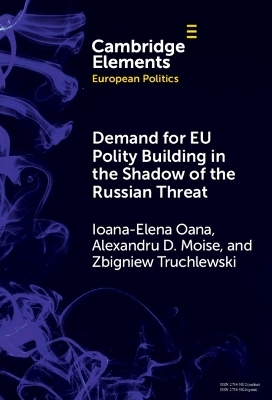
Demand for EU Polity Building in the Shadow of the Russian Threat
Seiten
2025
Cambridge University Press (Verlag)
978-1-009-49760-2 (ISBN)
Cambridge University Press (Verlag)
978-1-009-49760-2 (ISBN)
This Element investigates the effects of the Russian invasion of Ukraine on public support for European polity building across key policy domains. This title is also available as Open Access on Cambridge Core.
The Russian invasion of Ukraine came on the heels of a series of crises that tested the resilience of the EU as a compound polity and arguably reshaped European policymaking at all levels. This Element investigates the effects of the invasion on public support for European polity building across four key policy domains: refugee policy, energy policy, foreign policy, and defence. It shows how support varies across four polity types (centralized, decentralized, pooled, reinsurance) stemming from a distinction between policy and polity support. In terms of the drivers of support and its evolution over time, performance evaluations and ideational factors appear as strong predictors, while perceived threat and economic vulnerability appear to matter less. Results show strong support for further resource pooling at the EU level in all domains that can lead to novel and differentiated forms of polity-building. This title is also available as Open Access on Cambridge Core.
The Russian invasion of Ukraine came on the heels of a series of crises that tested the resilience of the EU as a compound polity and arguably reshaped European policymaking at all levels. This Element investigates the effects of the invasion on public support for European polity building across four key policy domains: refugee policy, energy policy, foreign policy, and defence. It shows how support varies across four polity types (centralized, decentralized, pooled, reinsurance) stemming from a distinction between policy and polity support. In terms of the drivers of support and its evolution over time, performance evaluations and ideational factors appear as strong predictors, while perceived threat and economic vulnerability appear to matter less. Results show strong support for further resource pooling at the EU level in all domains that can lead to novel and differentiated forms of polity-building. This title is also available as Open Access on Cambridge Core.
1. Introduction; 2. EU polity support – a theoretical and empirical framework; 3. Refugee policy; 4. Energy policy; 5. Foreign policy; 6. Military policy; 7. Conclusions.
| Erscheinungsdatum | 10.04.2025 |
|---|---|
| Reihe/Serie | Elements in European Politics |
| Zusatzinfo | Worked examples or Exercises |
| Verlagsort | Cambridge |
| Sprache | englisch |
| Maße | 152 x 229 mm |
| Gewicht | 277 g |
| Themenwelt | Sozialwissenschaften ► Politik / Verwaltung ► Politische Systeme |
| Sozialwissenschaften ► Politik / Verwaltung ► Politische Theorie | |
| Sozialwissenschaften ► Politik / Verwaltung ► Staat / Verwaltung | |
| Wirtschaft ► Betriebswirtschaft / Management ► Planung / Organisation | |
| ISBN-10 | 1-009-49760-X / 100949760X |
| ISBN-13 | 978-1-009-49760-2 / 9781009497602 |
| Zustand | Neuware |
| Informationen gemäß Produktsicherheitsverordnung (GPSR) | |
| Haben Sie eine Frage zum Produkt? |
Mehr entdecken
aus dem Bereich


aus dem Bereich
Das politische System der USA und die Zukunft der Demokratie
Buch | Hardcover (2025)
C.H.Beck (Verlag)
CHF 39,20
Russland, Europa, Amerika
Buch | Softcover (2025)
C.H.Beck (Verlag)
CHF 25,20


