


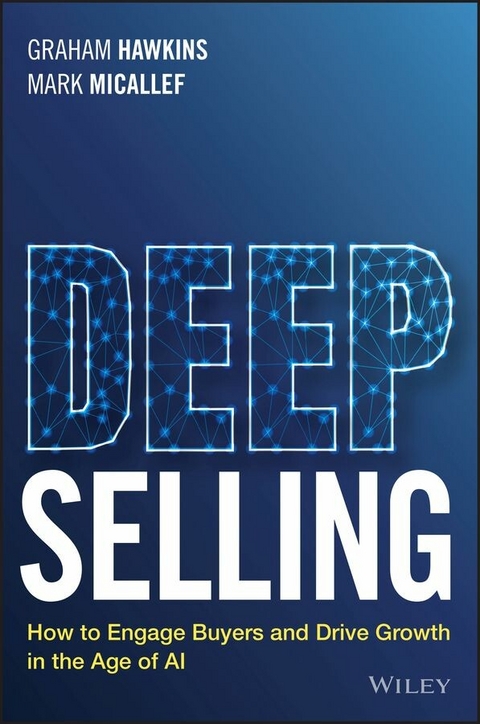
Develop stronger, more profitable relationships with your buyers in the digital era
Right now, how we buy and sell is evolving dramatically. People have fundamentally changed the way they do business. To put it simply: buyers no longer interact with sellers in the same way. To ensure a profitable future, sales leaders and teams need to embrace this transformation. In the face of globalisation, ecommerce, subscription services, and new digital tools for buyers and sellers alike, you need new strategies to generate successful sales and better bottom lines.
Deep Selling shares the cutting-edge sales model you need to create a buyer-obsessed, high-performance culture. Your team urgently needs to embrace the growing suite of digital and AI technologies. But new technologies alone won't solve all your selling problems. To really maximise your success, you need to evolve your selling frameworks and behaviours. You need to use these new tools in smart ways, embedding them into your sales execution models.
In this book, you'll discover how to:
- Audit the current sales techniques and cycles in your organisation
- Transform your sales execution models
- Achieve organisational buy-in through new performance measures and shared goals for success
- Use data to drive strategy, and revolutionise your selling with the latest digital and AI tools
- Build deeper buyer relationships that create more value and improve buyer outcomes
With Deep Selling, you and your team will learn how to meet buyers on today's real-world terms - and engage them more fully and successfully than ever before.
GRAHAM HAWKINS, MBA, is founder and CEO of SalesTribe, helping businesses improve sales capability via digital sales enablement. Graham is also co-founder of Qoos.ai, an AI-Guided Selling platform.
MARK MICALLEF, PHD, is a digital transformation expert with over 20 years' sales experience. He has published work in leading international sales and marketing journals.
Develop stronger, more profitable relationships with your buyers in the digital era Right now, how we buy and sell is evolving dramatically. People have fundamentally changed the way they do business. To put it simply: buyers no longer interact with sellers in the same way. To ensure a profitable future, sales leaders and teams need to embrace this transformation. In the face of globalisation, ecommerce, subscription services, and new digital tools for buyers and sellers alike, you need new strategies to generate successful sales and better bottom lines. Deep Selling shares the cutting-edge sales model you need to create a buyer-obsessed, high-performance culture. Your team urgently needs to embrace the growing suite of digital and AI technologies. But new technologies alone won t solve all your selling problems. To really maximise your success, you need to evolve your selling frameworks and behaviours. You need to use these new tools in smart ways, embedding them into your sales execution models. In this book, you ll discover how to: Audit the current sales techniques and cycles in your organisation Transform your sales execution models Achieve organisational buy-in through new performance measures and shared goals for success Use data to drive strategy, and revolutionise your selling with the latest digital and AI tools Build deeper buyer relationships that create more value and improve buyer outcomes With Deep Selling, you and your team will learn how to meet buyers on today s real-world terms and engage them more fully and successfully than ever before.
INTRODUCTION
Today's sales leaders find themselves in an almost impossible situation, caught in a vortex of competing pressures. They must meet the rising expectations of senior management and the board, adapt to the changing reality of the sales and buying landscapes, and find a way to boost falling sales team performance and reduce attrition rates. At the same time, new technologies promise to solve these challenges, and yet when vendor organisations attempt to innovate, these projects fail more often than they succeed.
How did we get here?
Simply, the rise of globalisation, digitalisation and servitisation have irrevocably transformed the sales and buying landscape.
From a buyer perspective, these trends mean buyers are more informed, have more choice and are therefore more powerful than ever before. However, this power has led to greater responsibility, and between 40 and 60 per cent of purchasing decisions now end in a ‘no decision’ outcome due to buyer fear of messing up.1 Increased risk averseness means that buyers are less likely to take chances on unproven vendors than in the past, and they are rationalising the vendors they do have.
Meanwhile, globalisation and market maturity have led to higher competition across every industry, with lower barriers to entry than ever before. Previously niche products are becoming increasingly commoditised, forcing vendors to compete on price and squeezing vendor margins and profits. The combination of risk‐averse buyers, higher competition and increased commoditisation often means the only way for vendor organisations to expand is within their existing buyer base.
Yet, despite these changes taking place, many vendor organisations continue to operate the same way they always have. Among many sales teams, and even at the executive level, there is a mistaken belief that sales is the way it's always been: just follow the script, follow the formula. One‐hundred calls equals 30 interested parties. Thirty interested parties equals 10 meetings. Ten meetings equals three sales. Keep working the numbers and always be closing. This was what worked when your executives were in the field, and if it worked for them, why shouldn't it work for today's sales professionals?
While this might be the executive point of view, any switched‐on sales leader knows that the old‐world, push‐selling, product‐centric approach is no longer working. B2B sales cycles are longer than ever before, typically ranging from six to twelve months for complex, high‐value solutions. Meanwhile, the time required to bring a new hire to full productivity is longer than ever, with 65.2 per cent of organisations saying it takes at least seven months to bring new hires up to speed, and 28.8 per cent of organisations saying it takes at least one year.2 Average tenure among salespeople has also dropped to just 1.4 years (or 16.8 months), with the median annual turnover among sales professionals sitting at 50 per cent in 2022!3
If you do the maths, this means the average salesperson only has time to complete one to two sales cycles before moving on to their next role, and many will not successfully close those sales, with only 22 per cent of salespeople hitting their quota in the fourth quarter of 2022.4
In tandem, we have experienced an explosion of digital technologies over the past 15 years, with the latest trend being the rise of generative artificial intelligence (AI). In the face of falling profits and opportunities, many vendor organisations are eager to jump on the technology bandwagon. Whether the push comes from leaders who are keen to remain on the bleeding edge, or tech‐savvy junior employees who want to make an impact, each new tool is treated as a magic pill that might solve their struggles.
This leaves sales leaders stuck like flies in a metaphorical web.
They are caught between the pressure to drive strategic change while managing the day‐to‐day operations of their sales team. On one hand, they are charged with innovating, yet they don't know where to start. Some might even lack clarity around what exactly should change. They know they are getting left behind, but don't know how to catch up. At the same time, when they are buried in day‐to‐day pressures it is impossible for them to get a broader perspective. In some cases, they might intentionally blinker themselves to reduce the noise so they can focus on just getting the job done.
These leaders are also caught between innovation and risk reduction. In a typical vendor organisation, where costs are climbing and revenue is falling, sales leaders likely have the CEO on one shoulder and the CFO on the other, with the CEO pushing for innovation and transformation, while the CFO wants to reduce risk and focus on reliable revenue drivers (like quotas and commissions).
Ultimately, sales leaders are facing challenges from all directions, and attempting to address any of them only results in an even more tangled web.
The sales innovation paradox
We know things can't continue as they are. Yet, in cases where sales leaders attempt to innovate, or even attempt to implement a change forced on them by another part of the organisation, this rarely ends well.
Many changes being implemented by vendor organisations are those driven by technology. These changes might start with the vague direction of ‘let's leverage AI’ (or any other trending tool), and leaders quickly find themselves overwhelmed by the hundreds of tools available in any category without the knowledge and resources to choose appropriately. Or they might start with a specific tool (or selection of tools) in mind, yet even in this case many vendor organisations lack an understanding of how to use these technologies to create value.
These changes rarely deliver the promised results. The first outcome is where the implementation doesn't get off the ground because the process of managing the change becomes too complex and too costly. The second outcome is that the new technology is implemented, but it only makes existing processes and structures more difficult to manage. This leads to end users finding workarounds, and often doing manual work that takes more time than the way they were managing things before.
These outcomes leave leaders biased against new ideas and technology because they believe these implementations will fail. Every time there is a failure, vendor organisations become even more risk averse and less willing to take chances on wide‐scale technology transformations.
Even worse for sales leaders is that if these implementations fail, it is seen as the sales leader's responsibility (even if the original drive for the change came from outside the team).
What is going wrong?
First, the leadership at many vendor organisations doesn't see the need to change, which means there is an immediate barrier to doing anything differently. This is particularly common in organisations where the executive team and board are made up of former field sales professionals who have a mindset of knuckling down and getting on with it. They don't recognise that the old ways of working are no longer effective in the modern sales and buying environment.
In cases where organisations do see a need to change, they see technology as being the answer — the magic pill we mentioned earlier. This puts organisations in a position of doubling down on what doesn't work. Generally, new tools don't change the way an organisation is doing things — they allow the organisation to do those things more efficiently. If an organisation is focusing on the wrong things (or things that don't work in today's sales and buying landscape), new technology will simply accelerate poor behaviour.
Howard Dover coined the term ‘the sales innovation paradox’ to describe this. Organisations have high expectations for growth and they invest in training, technology and enablement, but they experience failing sales performance as a result. In short, they don't see the expected return after implementation.
As software engineer Grady Booch said, ‘A fool with a tool is still a fool’.
It is clear that something needs to change, but vendor organisations keep focusing on the wrong things.
The way forward: Deep Selling
The world has changed, and it is time for vendor organisations to change with it. Vendor organisations must shift from the old‐world, product‐centric approach of push selling to the new‐world, buyer‐centric, data‐driven approach of Deep Selling.
The old‐world approach to sales was Shallow: vendor salespeople would play the numbers game, going a mile wide and an inch deep, knowing that the more prospects they pitched, the more deals they would eventually close. In the past, this worked: vendor organisations had proprietary solutions, buyers had limited access to solutions and information, and buyers treated salespeople as trusted advisers who could help them solve business problems.
Today, with changing buyer dynamics, new technology and more competitive markets, everyone is fishing in the Shallows. To borrow the term ‘blue ocean’ from Renée Mauborgne and W Chan Kim's book Blue ocean strategy, going Deep is your blue ocean. The Deep water is where the big fish are. Yes, it is harder to get to, but there's less competition there.
What do we mean...
| Erscheint lt. Verlag | 21.11.2024 |
|---|---|
| Sprache | englisch |
| Themenwelt | Wirtschaft ► Betriebswirtschaft / Management ► Marketing / Vertrieb |
| Schlagworte | AI for sales • Artificial Intelligence • B2B Sales • Brand • brand strategy • Business Self-Help • Digital Marketing • Digital Sales • Digital Tools • Digital transformation • eCommerce • generative AI • </P> • <p>business books • Marketing • Marketing tools • organisational management • Performance • product sales • professional development • Restructure • risk-averse buyers • Sales • sales formula • Salespeople • sales pipeline • sales script • sales techniques • sales tools • Sales Trends • SalesTribe • Servitisation • Strategic Change • Strategy • vendor sales |
| ISBN-13 | 9781394303083 / 9781394303083 |
| Informationen gemäß Produktsicherheitsverordnung (GPSR) | |
| Haben Sie eine Frage zum Produkt? |
 EPUB (Adobe DRM)
Kopierschutz: Adobe-DRM
Adobe-DRM ist ein Kopierschutz, der das eBook vor Mißbrauch schützen soll. Dabei wird das eBook bereits beim Download auf Ihre persönliche Adobe-ID autorisiert. Lesen können Sie das eBook dann nur auf den Geräten, welche ebenfalls auf Ihre Adobe-ID registriert sind.
Details zum Adobe-DRM
Dateiformat: EPUB (Electronic Publication)
EPUB ist ein offener Standard für eBooks und eignet sich besonders zur Darstellung von Belletristik und Sachbüchern. Der Fließtext wird dynamisch an die Display- und Schriftgröße angepasst. Auch für mobile Lesegeräte ist EPUB daher gut geeignet.
Systemvoraussetzungen:
PC/Mac: Mit einem PC oder Mac können Sie dieses eBook lesen. Sie benötigen eine
eReader: Dieses eBook kann mit (fast) allen eBook-Readern gelesen werden. Mit dem amazon-Kindle ist es aber nicht kompatibel.
Smartphone/Tablet: Egal ob Apple oder Android, dieses eBook können Sie lesen. Sie benötigen eine
Geräteliste und zusätzliche Hinweise
Buying eBooks from abroad
For tax law reasons we can sell eBooks just within Germany and Switzerland. Regrettably we cannot fulfill eBook-orders from other countries.
aus dem Bereich


