


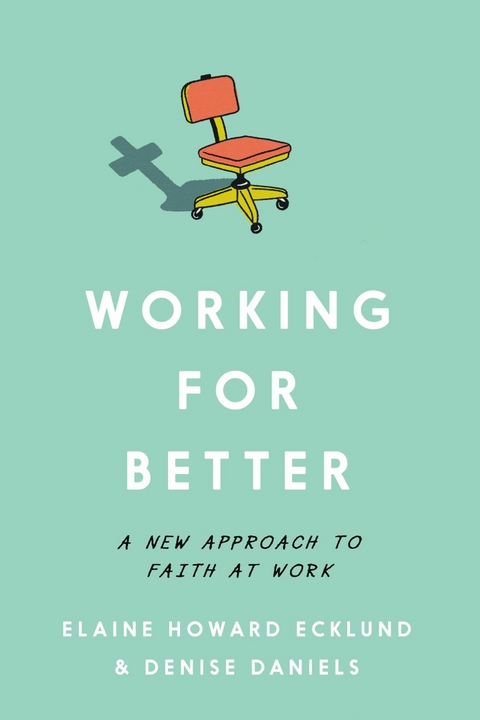
Working for Better (eBook)
240 Seiten
IVP Academic (Verlag)
978-1-5140-1127-0 (ISBN)
Elaine Howard Ecklund is the Herbert S. Autrey Chair in Social Sciences, professor of sociology, and director of the Boniuk Institute at Rice University. She is best known for her sociological work on the intersection of science and religion and has also published research on religious discrimination, religion and immigration, religion and race, and religion in the workplace. She is the author of numerous books and research articles, including Science vs. Religion: What Scientists Really Think.
Elaine Howard Ecklund is the Herbert S. Autrey Chair in Social Sciences, professor of sociology, and director of the Boniuk Institute at Rice University. She is best known for her sociological work on the intersection of science and religion and has also published research on religious discrimination, religion and immigration, religion and race, and religion in the workplace. She is the author of numerous books and research articles, including Science vs. Religion: What Scientists Really Think. Denise Daniels is Hudson T. Harrison Professor of Entrepreneurship at Wheaton College. She is a management scholar with deep theological engagement in her teaching, publications, and consulting work, which focuses on leadership development and vocation in the marketplace. She co-authored the book Working in the Presence of God: Spiritual Practices for Everyday Work.
1
A Look at How the World Is Changing
JOANN WAS WORRIED that if people knew about her beliefs, the door would be closed to any future promotions.1 When Denise interviewed her as part of an organizational assessment, Joann was a successful midlevel manager. She explained: “I would love to be myself at work. I’d love to be open with people and divulge my whole identity. But I have to be careful to watch what I say; I feel like I’m lying to everyone. I’m generally a very open and honest person, but I have to keep myself hidden here. I don’t feel like there’s an alternative.”
On the one hand, these reflections feel familiar. Many Christians have some concern that expressing their faith at work could limit their opportunities in the workplace. But Joann was not a Christian. She was an atheist who did not believe in God or a spiritual realm. Joann was concerned that it was these beliefs that would limit her ability to succeed beyond her current role if she were found out. The founders and current leadership of the company where she worked were all outspoken Christians. These leaders wanted to honor God in their company. They wanted to care for their employees and wanted for everyone in the company to be able to bring their whole selves—including their faith—to work. But they were unaware of the ways in which their approach to faith in the workplace might be stifling for those with religious identities that were very different from their own.
We have seen how Christian faith lived openly in a workplace can make employees feel cared for and more committed, reform the workplace in helpful ways, foster other kinds of diversity, and facilitate working with others for the common good of an organization. But we have also seen organizations and organizational leaders approach faith through a narrow lens, which leads to substantial blind spots, undermining rather than helping them accomplish their goals.
A NEW APPROACH TO FAITH AT WORK
One of the historical trends that has been both a positive influence and a pressure factor at the intersection of religion and work is the explosion in recent decades of the faith-at-work movement. In the post–World War II boom, evangelical Christians, in particular, began pushing back against the view that ministry was restricted to a full-time calling to a church or Christian organization, and everybody else by default went into the secular workplace, rejoining their Christian fellowship at church on Sunday in order to recharge for their long stretches out in the world. In contrast, the new emphasis encouraged Christians to see their work as their ministry, as their calling.
Viewing themselves as mostly loners among nonbelievers, these Monday morning believers were encouraged to develop their own personal witness to the world in considering such questions as, What is my role as a Christian in a secular job? How and when should I share my faith? How do I witness without words? How should I treat and be treated by those who don’t share my faith? How can I help lead others to faith in Christ? This individualized approach helped reinforce a minority identity, giving rise to concerns about infringements on religious freedoms and experiences of persecution for holding religious beliefs or abstaining from workplace behavior that violated those beliefs.
Although this Christian perspective has tended to distinguish the commercial workplace as a secular setting, this is not really the case. There is a new focus in modern workplaces on bringing our whole selves to work; people of faith increasingly want to express their convictions while on the job. At all levels of business in the United States, employees no longer want to leave their faith behind when they go to work. Nearly three-quarters of Americans are affiliated with a religious tradition, and many feel their religious faith is an essential part of who they are—associated with the deepest values they hold, relationships they forge, actions they take, and decisions they make.2 And many of those who are not part of religious organizations consider spirituality a meaningful part of their lives and relevant to their work.3 They want to express this part of themselves in their work life, which dominates the majority of their time.
As workers increasingly bring their faith to work, it creates new challenges for leaders in handling religion in the workplace. Leaders are rightly concerned that employees talking about their faith at work might feel invasive or marginalizing to those who do not share the faith, giving rise to conflict. And while religious accommodations for legitimate expressions of faith are legally mandated, it is often unclear to organizational leaders, amid the many pressing needs of their workplaces, how best to accommodate such expressions.
Organizational leaders need tools for how to foster respectful expression rather than suppress religious identity. The well-being of all workers and the health of organizations is served by religious pluralism, not religious privatization. If organizational leaders want to increase diversity of all types in their workplaces, especially racial and gender diversity, they must also understand how religious diversity is deeply linked to these categories.
The growing pluralism of US society also creates new challenges for Christians at work. Although Christianity is still the largest religious tradition in the United States, workplaces are becoming more religiously diverse, with a growing nonreligious population. In this current cultural climate, our faith demands that we fully live out our Christian commitments while also making space for others to express their own religious or nonreligious identities.
Christians have traditionally expressed their faith at work with a focus on the self: talking about their faith, sharing their beliefs, defending their moral stances, and focusing on their religious freedoms. But there is much less tolerance than there used to be for overt expressions of our faith. How to respect this space while expressing Christian faith appropriately is an increasingly tricky proposition. Christians need a new approach to faith at work that does not compromise their faith while still meeting the moment.
COMPLEXITIES RAISE NEW QUESTIONS
Because the rapid pace of change in US society has exacerbated the tensions already inherent in this arena, we conducted a first-of-its-kind set of research projects to form a data-driven approach to identifying and proposing solutions for the challenge of fostering faith at work. For those who are data junkies, we include several more pages of information about the specifics of our study at the end of the book. Our insights and suggested practices are based on a collective twenty years of research on the faith-at-work movement and how Christians specifically seek to integrate faith and work.
Over the past few years, we have conducted the most comprehensive set of studies to date of faith at work, including (1) focus groups with pastors and congregants in several cities in the United States; (2) surveys of over fifteen thousand workers—before, during, and after the pandemic—who are representative of the demographics of the US population, including those from a variety of faith traditions as well as nonreligious workers; and (3) in-depth follow-up interviews with 287 people, many of whom are committed Christians who care about faith at work. Since this is a book written primarily for Christians, the majority of the narratives presented in this book are from Christians we interviewed, unless we specify otherwise.
Although we come to this topic as scholars, we are also living faith-and-work integration ourselves. In addition to the data, we also provide personal stories from our own experiences since these topics are important for each of us as Christians. The recommendations we make in this book for the tensions we have identified reflect our hope that people of faith will do all they can to help make the world better for everyone, not just for Christians.
Our research has revealed how new demographic realities in American culture are requiring changes in the traditional models of the faith-at-work movement. For example, we put personal expressions of faith such as evangelizing alongside different pieces of the Christian tradition—those that emphasize the imago Dei, the idea that all people are created in the image of God. In our interviews with Christian workers, some talked about the importance of this concept for finding meaning and purpose. “If I am created by God, in God’s image, in His likeness, and I’m given a purpose, I have a reason for living. . . . I help other people not to make myself look better, or to feel better,” a man who works as a village planner told Elaine. A geneticist said he helped others “because [I want to] glorify the one who created me, in his image.” In this scientist’s view, “we all have that shared calling of being made in the image of God. That’s our calling. It’s to reflect him. It’s to represent him.”4
These responses reflect a new model of faith at work garnered from a bedrock of Christian theology: all people are made in the image of God. The new possibilities arising from this emphasis suggest that in these divisive times of increasingly violent conflict on the global stage, US Christians at work should do more to focus on how others—all of us—are made in the image of God. Expressing Christian faith at...
| Erscheint lt. Verlag | 26.8.2025 |
|---|---|
| Verlagsort | Lisle |
| Sprache | englisch |
| Themenwelt | Religion / Theologie ► Christentum ► Moraltheologie / Sozialethik |
| Wirtschaft ► Betriebswirtschaft / Management | |
| Schlagworte | Apologetics • Belief • Biblical • calling • Case study • Christian • Culture • Data • defending • Diverse • Employee • Evangelism • Flourish • freedom • Health • Manager • Moral • organization • pluralism • Privatization • Protestant • Research • Student • Theological • Tolerance • Vocation |
| ISBN-10 | 1-5140-1127-1 / 1514011271 |
| ISBN-13 | 978-1-5140-1127-0 / 9781514011270 |
| Informationen gemäß Produktsicherheitsverordnung (GPSR) | |
| Haben Sie eine Frage zum Produkt? |
 EPUB (Wasserzeichen)
DRM: Digitales Wasserzeichen
Dieses eBook enthält ein digitales Wasserzeichen und ist damit für Sie personalisiert. Bei einer missbräuchlichen Weitergabe des eBooks an Dritte ist eine Rückverfolgung an die Quelle möglich.
Dateiformat: EPUB (Electronic Publication)
EPUB ist ein offener Standard für eBooks und eignet sich besonders zur Darstellung von Belletristik und Sachbüchern. Der Fließtext wird dynamisch an die Display- und Schriftgröße angepasst. Auch für mobile Lesegeräte ist EPUB daher gut geeignet.
Systemvoraussetzungen:
PC/Mac: Mit einem PC oder Mac können Sie dieses eBook lesen. Sie benötigen dafür die kostenlose Software Adobe Digital Editions.
eReader: Dieses eBook kann mit (fast) allen eBook-Readern gelesen werden. Mit dem amazon-Kindle ist es aber nicht kompatibel.
Smartphone/Tablet: Egal ob Apple oder Android, dieses eBook können Sie lesen. Sie benötigen dafür eine kostenlose App.
Geräteliste und zusätzliche Hinweise
Buying eBooks from abroad
For tax law reasons we can sell eBooks just within Germany and Switzerland. Regrettably we cannot fulfill eBook-orders from other countries.
aus dem Bereich


