


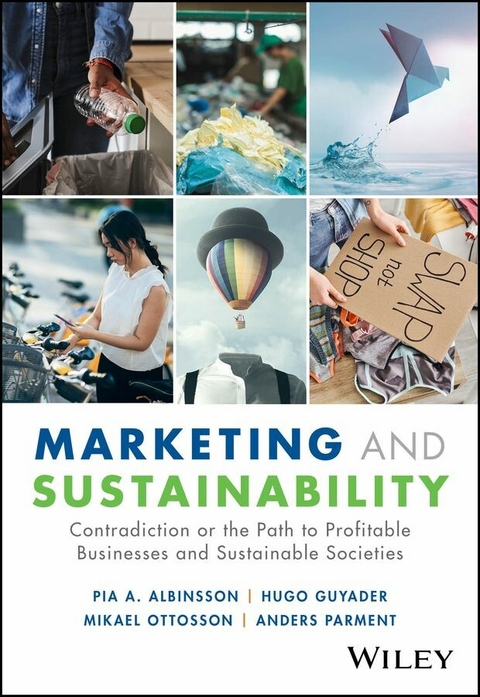
Marketing and Sustainability (eBook)
In-depth, authoritative overview of sustainability issues and how sustainability is integrated into management and marketing theory and practices
Marketing and Sustainability equips readers in the fields of management and marketing with an in-depth understanding of sustainability issues and how sustainability is integrated into business. Examples from across the globe are included on topics such as how businesses use services, sharing practices, and sustainable business models in their operations to face increasing demands to reduce greenhouse gas emissions, limited resources, and increased global competition.
This book is concerned with consumer and business markets, considering marketing practices as part of business administration. Up-to-date and topical areas of research such as the sharing economy, are thoroughly discussed and illustrated with supporting models, figures, and vignettes.
The book is accompanied by a companion site for instructors and faculty, which includes PowerPoint slides and exam Q&A's. Videos introducing each chapter's content are also available via YouTube.
Written by a team of highly qualified academics, Marketing and Sustainability includes information on:
- Factors influencing consumers and their choices, sustainable marketing practices and their effectiveness, and how to communicate sustainability initiatives through marketing campaigns
- Strategies to be heard in a crowded, branded world, and sustainability business models including product-service systems, social enterprises, and sharing and circular economy models
- Sustainable marketing strategies including chapters on sustainable marketing channels, sustainable pricing, sustainability oriented marketing communication and branding
- Greenwashing, the process of conveying a false impression or misleading information about how a company's products are environmentally sound, and why it's bound to backfire
Marketing and Sustainability is an essential reference for undergraduate, graduate, and post-graduate students as well as managers in companies, the public sector, and civil society-all of whom are under increasing pressure to deal with marketing and sustainability for strategic purposes as well as in everyday practices.
Pia A. Albinsson is Professor of Marketing in the Walker College of Business at Appalachian State University, USA.
Hugo Guyader is Associate Professor of Marketing at Linköping University, Sweden.
Mikael Ottosson is Senior Associate Professor of Marketing at Linköping University, Sweden.
Anders Parment is Research Fellow of Marketing at Stockholm Business School in Sweden and teaches regularly at Linköping University, Sweden and University of Innsbruck, Austria.
Preface
Increased demands for sustainability are affecting all parts of the business world such as prices and inflation, resource constraints, resource depletion, logistic and supply chain bottlenecks and delays, and consumer demands. Many of the forthcoming challenges are due to climate change, resource depletion, and increased costs related to escalated volatility in weather patterns. This book provides frameworks, models, and concepts needed as current and future business leaders must be aware of sustainable business practices to stay competitive and be responsible market actors. Marketing is a core business function, and knowing how it relates to sustainability is key for current students and practitioners who will become future responsible business leaders.
Marketing and Sustainability: Contradiction or the Path to Profitable Businesses and Sustainable Societies will provide students at the undergraduate and graduate levels as well as business professionals with an overview of marketing and how it relates to sustainability practices.
This book results from each of the four authors’ long-term interests and efforts at incorporating sustainability initiatives in research, business practice, and marketing classes. While based in both the United States and Sweden, the international author team has experience from working in many countries, universities, and various industries. For example, Anders Parment and Mikael Ottosson, two of the authors of this book, wrote the first version of Sustainable Marketing: how social, environmental and economic considerations can contribute to sustainable businesses and markets for the Swedish market in 2012. Hugo Guyader was then invited to update the book in 2020, still focusing on the Scandinavian higher education market. Pia Albinsson was invited to co-author the latest version you hold in your hands: the global edition.
The combined expertise of the European and U.S. markets and business practices adds to the breadth of the knowledge presented. The book invites marketing students and teachers from these regions to reflect upon the models provided therein to illustrate with examples they’re most familiar with and to draw local parallels. Nevertheless, the authors have aimed to bring up global brand examples and research findings from scholars around the world that have impacted sustainability research and business practices.
This book integrates sustainable development principles and marketing. From consumer behavior to sustainable pricing, we provide examples from across the globe, e.g. how businesses use design thinking for the environment, eco-innovation, biomimicry, and a general sustainable focus in their operations to face increasing costs, limited resources, and increased global competition among other contemporary challenges. Marketing and Sustainability covers both business-to-business markets and consumer markets, considering marketing practices as part of business administration. Up-to-date and topical areas of research such as circular business models, sustainability ecosystems, and the sharing economy are thoroughly discussed and illustrated with models and figures.
We have extensive research experience and exemplify these with cases that are used as illustrative examples of how sustainability can be connected to various business practices – we package some of these cases with a longer description as “vignettes” in each chapter. In addition, we have been involved in business transformation as consultants and analysts and hence have experience integrating sustainability in marketing practices.
It is our conviction that our textbook will provide the target market with a profound contribution. The book provides invaluable contributions to undergraduate, graduate, and post-graduate students as well as managers in companies, the public sector, and civil society – all under increasing pressure to deal with marketing and sustainability for strategic purposes as well as in everyday practices. Our book integrates sustainable development principles throughout – sustainability is a cornerstone – and we integrate and relate it to marketing frameworks, models, and concepts. This involves the relationships between sustainability and the marketing mix (product, place, price, promotion), consumer behavior, service, business models, marketing channels, branding, and operations. We believe that this comprehensive approach will equip readers with the knowledge and tools necessary to navigate and excel in an ever-evolving market landscape. Ultimately, our textbook aims to foster a deeper understanding of the crucial interplay between marketing and sustainability, empowering professionals and students alike to make impactful decisions.
The book addresses marketing and sustainability from various perspectives.
Chapter 1, Marketing and Sustainability: An Overview
This chapter introduces the way the field of marketing relates to the broad phenomenon of sustainability. It also introduces the term sustainability, its role today, and the historical significance of sustainability in marketing and business. Three dimensions of sustainability will be presented from several perspectives. In addition, the chapter discusses the necessity to include sustainability in current and future marketing practices.
Chapter 2, Factors Influencing Consumers and Their Sustainability Choices
Numerous factors impact consumption, spanning from broader environmental and contextual circumstances to aspects of individual personality and psychological processes. This chapter covers general factors at first that can pose challenges to encouraging more sustainable consumption practices among consumers and to which marketers can bring solutions, before focusing on how pro-environmental attitudes shape consumer behavior such as shopping for organic groceries, commuting by sustainable transportation alternatives, choosing to recycle, etc.
Chapter 3, Is There Such a Thing as Sustainable Consumers?
This chapter builds on Chapter 2 as we continue to discuss consumer behavior and sustainable consumption. Using a global view, the content presents various factors affecting consumption patterns and enabling sustainable consumption. We also discuss how a group of consumer researchers have shifted from the unbalanced view of acquisition and consumption by also considering the social impact of their work. This shift to focus on consumer well-being and social impact had its beginnings in the leadership of the Association for Consumer Research and has been named Transformative Consumer Research. The chapter also introduces the attitude-behavior gap, also referred to the green gap, that exists in the marketplace. Different ways of exerting influence over consumption and what the individual consumer can do to contribute to sustainability is also discussed.
Chapter 4, Sustainable Marketing Practices
This chapter initiates an exploration into research concerning the sustainable operations of companies, which many perceive as not only beneficial but also obligatory. Historically, companies have often been viewed as unsustainable entities, but a notable shift has occurred due to the growing emphasis on sustainability. For example, sustainability oriented companies may use biomimicry, design for the environment, or cradle-to-cradle design concepts when developing new products. Within this chapter, we highlight examples of companies embracing sustainability. We examine the potential benefits these sustainable companies can gain in the market and delve into various reasons why certain companies may resist transitioning toward a more sustainable approach.
Chapter 5, Sustainability by Service Provision
Much of the early work regarding companies and sustainability focused on manufacturing firms and their emissions to air, water, and soil. In this chapter we introduce services research, which increasingly has started to analyze how service provision could become more sustainable. We uncover innovative ways to reduce environmental impacts within the service sector, which plays a crucial role in modern economies. Additionally, a deeper understanding of sustainability in service provision can drive the development of new practices that support long-term ecological balance and social well-being.
Chapter 6, How to Communicate Sustainability Initiatives
In Chapter 6, we discuss marketing communications and sustainability, two areas that strongly influence each other: companies with sustainability claims must carry out marketing communications differently, and marketing communications will be different when sustainability is part of the communication. Meanwhile, consumers and other stakeholders are increasingly expecting companies to be sustainable, whereas many companies actually engage in greenwashing. Sustainability requires honesty, transparency, and a societal orientation, and these characteristics must be reflected in messages that are being communicated.
Chapter 7, Sustainability and Branding
For many decades, companies have worked intensively with their brands to enjoy a range of advantages that come with strong brands. Branding practices have become widespread, and organizations in civil society and the public sectors alike have put a lot of effort into strengthening their brands. Brands communicate promises and result in expectations that are linked to how companies and others communicate. For...
| Erscheint lt. Verlag | 11.1.2024 |
|---|---|
| Sprache | englisch |
| Themenwelt | Wirtschaft ► Betriebswirtschaft / Management ► Marketing / Vertrieb |
| Schlagworte | access-based consumption • circular economy • consumer choices • eco-friendly products • fair-trade products • Green Products • Greenwashing • Product-Service Systems • Responsible consumption • Sharing Economy • social enterprises • Sustainable brands • Sustainable business models • Sustainable Ecosystem • Sustainable marketing practices • sustainable pricing |
| ISBN-13 | 9781394273782 / 9781394273782 |
| Informationen gemäß Produktsicherheitsverordnung (GPSR) | |
| Haben Sie eine Frage zum Produkt? |
 EPUB (Adobe DRM)
Kopierschutz: Adobe-DRM
Adobe-DRM ist ein Kopierschutz, der das eBook vor Mißbrauch schützen soll. Dabei wird das eBook bereits beim Download auf Ihre persönliche Adobe-ID autorisiert. Lesen können Sie das eBook dann nur auf den Geräten, welche ebenfalls auf Ihre Adobe-ID registriert sind.
Details zum Adobe-DRM
Dateiformat: EPUB (Electronic Publication)
EPUB ist ein offener Standard für eBooks und eignet sich besonders zur Darstellung von Belletristik und Sachbüchern. Der Fließtext wird dynamisch an die Display- und Schriftgröße angepasst. Auch für mobile Lesegeräte ist EPUB daher gut geeignet.
Systemvoraussetzungen:
PC/Mac: Mit einem PC oder Mac können Sie dieses eBook lesen. Sie benötigen eine
eReader: Dieses eBook kann mit (fast) allen eBook-Readern gelesen werden. Mit dem amazon-Kindle ist es aber nicht kompatibel.
Smartphone/Tablet: Egal ob Apple oder Android, dieses eBook können Sie lesen. Sie benötigen eine
Geräteliste und zusätzliche Hinweise
Buying eBooks from abroad
For tax law reasons we can sell eBooks just within Germany and Switzerland. Regrettably we cannot fulfill eBook-orders from other countries.
aus dem Bereich


