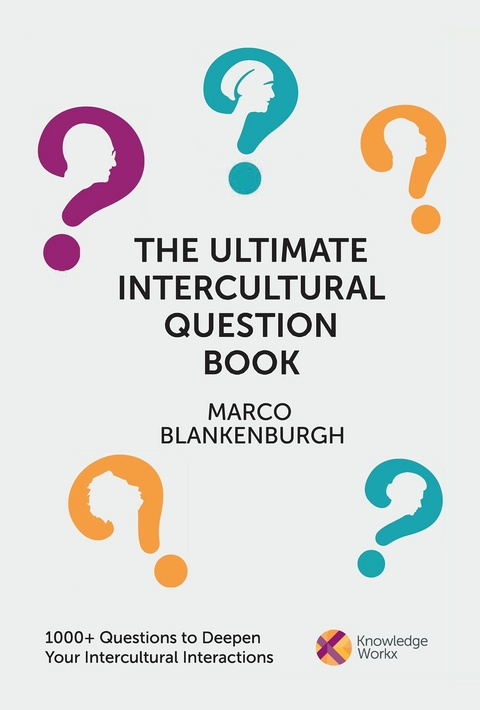
Ultimate Intercultural Question Book (eBook)
276 Seiten
Bookbaby (Verlag)
979-8-3509-8126-1 (ISBN)
Marco is a true international citizen. Originally from the Netherlands, his fascination with global work and culture has led him to work in over 70 countries. Realizing that international workers needed to be better equipped with intercultural intelligence led him to start KnowledgeWorkx in 2001. As International Director of KnowledgeWorkx, Marco created the Inter-Cultural Intelligence (ICI) methodology for people development. In a world that needs more human connection, he is passionate about equipping people and organizations with the tools they need to enhance relational success with people around them. Marco brings 28 years of intercultural work experience into everything he does - as a skilled facilitator and coach, he uses the KnowledgeWorkx ICI methodology to equip people with intercultural agility, giving them the best chance of not only succeeding but thriving in our increasingly global world. By volunteering for not-for-profit organizations, he assists with the development of intercultural agility for their organizations and people. Marco lives with his family in the UAE. He is interculturally married and has the privilege of raising four 'Third Culture Kids'.
"e;This unique book is a treasure trove of thought-provoking questions that spark intercultural dialogue. By encouraging self-reflection and empathy, it helps individuals and organizations thrive in our interconnected world."e;- Omar Ayyash, President & CEO of World Trade Center Kentucky"e;This book is a true gift for anyone navigating intercultural spaces. The power of thoughtful questions cannot be overstated - it not only invites others to share their stories but also guides us to look inward and reflect on our own worldviews. The author's lived experience shines through. This book will be among the permanent references on my desk."e;- Rana Nejem, Founding Director of YARNU; The Art of Social Intelligence, Author of When in the Arab WorldThere's so much packed into The Ultimate Intercultural Question Book, and in an impressively easy to use way. Broken down into an expansive collection of topics relevant to anyone wanting to increase their cross-cultural understanding or abilities, this book is not just a conversation starter but a bridge-builder to enhance intercultural discernment, appreciation, and know-how, as well as self-awareness. The Ultimate Intercultural Question Book, its approach, and the questions it equips us with, are powerful tools in the effort to create empathetic connection and meaningful interaction in an ever-globalizing world. - Christopher O'Shaughnessy, International Speaker and Author of Arrivals, Departures and the Adventures In-BetweenThe best learning comes from the best questions. When connecting with people, knowing how to ask questions is the gateway to gaining true insight into individuals and engaging in effective, relationship-building conversations. Asking good questions, in particular, allows us to delve beyond the surface and gain a genuine understanding of people and culture. Get equipped with practical tools to have powerful intercultural conversations going deeper than the usual, "e;What's your culture like?"e; With 60+ stories of successful and not-so-successful intercultural interactions, you can learn from others' experiences. Ultimately, you will have over 1,000 intercultural questions to grow your connection and understanding of anyone from your colleague to your taxi driver.
- Intercultural Agility
Out of that great realization, KnowledgeWorkx was born and with it came a new framework addressing one of the greatest challenges of our globalized world: meaningful human relationship and connection.
The way in which KnowledgeWorkx empowers individuals to navigate relating in a global world is through what we call Intercultural Agility. We take a dynamic approach, equipping you to read culturally diverse situations in real-time, so that you can anticipate, correctly interpret, adjust, and respond tactfully in any context.
The Intercultural Agility framework weaves history, research, and real-world experience into a tool which unlocks deep cultural understanding. This chapter will dive into the different facets of Intercultural Agility, starting with the way we view culture.
“Intercultural Agility is not simply having the knowledge of both the visible and invisible aspects of culture. It also requires the skill of analysis — knowing how to most effectively deepen that knowledge. This, in turn, allows us to move towards a deeper understanding of the culture as it is experienced by the insiders. Developing Intercultural Agility is key for effectiveness in a cross-cultural setting, no matter the type of work.”
—Joann Pitmann
- Self-Cultural Analysis
The world has become more globalized than ever before. In 2020, over 281 million people lived in a different country from their passport1. A third of the global workforce is engaged across diversities and across borders every day. While that number is large and can feel like just a statistic, it’s likely that you can think of someone right now who fits into that category. Maybe even you do! There has been a significant rise in working virtually, which has resulted in being able to hire talent, serve customers, and offer support from anywhere to anywhere.
Research shows that, due to humanity’s interconnectedness, will need to become “more human humans”: better at listening, better at asking questions, collaborating, innovating, communicating, developing ourselves, managing people, negotiating, and navigating complex problems together.
Diverse and intercultural teams are becoming the norm, and we need to up our game in order to be “more human humans” across cultures. In this new reality, we have a significant challenge that needs to be addressed: we still insist on explaining who we are as cultural human beings through the lenses of nationality and ethnicity. Unfortunately, boxing people in based on those classifications is often done outside the context of relationships. As a result, it doesn’t lead to meaningful connection, and even causes people to drift apart.
It is our mission to change this. We need a new way of looking at who we are as cultural beings. We are not saying that nationality, ethnicity, and race are not important, but we are saying that they are inadequate starting points for developing meaningful and productive relationships. Consider the story of my colleague Ashni; while she may be Indian by nationality, she is someone very different when it comes to the way she identifies herself as a cultural human being. Her Hindi is not that great, and she has lived most of her life in another country. Ashni considers herself an NRI or non-resident Indian but is mistaken for a local when in India because that is who she is on the outside. You would never know who Ashni really is by assuming her language or culture based on the shell of nationality.
So, we have developed a multi-faceted approach that allows you to get to know every person as an individual with their own unique cultural wiring whose depth and richness is uncovered through learning, or how we like to put it, question-asking.
- Issues that led us to find a new approach
The world has become more global than ever before. Even if you have not made efforts to reach out to the world, the world has come to you. We engage the world through the Internet, games, sports, the entertainment industry, news, education, work, and even the people who live next door.
In this global and diverse world, we still sit on a strange notion: the insistence that culture has to be understood through the lenses of nationality and ethnicity. In 2004, we realized this was not going to work for the globalized world we live in today. Although your new colleague may carry a Swedish passport, how do you know if they match the “blueprint” of a “true Swede”? What if you pull out your “cheat sheet for working with Swedes” only to discover that your new Swedish colleague is a global nomad who was born in Sudan and has lived on four continents before finishing high school? (This is actually one of my colleagues)
- The radical new idea
After plowing through a whole bunch of books that used nationality and ethnicity as a way to guide the reader in intercultural relationships, we realized that trying to live and become more effective in relationships with this nationality-driven grid was a challenge. Not only was it impossible to memorize over 200 cheat sheets for every possible nationality, but it was also dangerous in a world where hundreds of millions of people are “cultural composites” of the rich cultural journeys that they and the generations before them have been on in life.
The more we looked at this, the more we realized that a nationality and ethnicity-oriented approach of looking at culture was insufficient to engage people effectively in a multicultural world.
Within the field of psychology, many psychometric instruments have been developed to help people understand themselves and relate to others. Experts have attempted to “map out” the terrain of human personality from various angles. In talking to psychologists, there is a common assumption that the world of psychology can explain most of what is going on in human behavior but living and interacting with many different cultures in Dubai in the early 2000s, we found that to be profoundly incomplete.
Our experience underlined a problem: that by emphasizing the psychological side of behavior so much, the cultural side of behavior has been underemphasized.
Looking at the number of assessments available on each side of the equation, there are hundreds of tools on the psychology of human behavior, but as of the publishing of this book, we had found only fifty-four assessments on the cultural side of the equation2 (https://inter-culturalintelligence.com).
So, we asked the question: “Why can’t we map out personal cultural preferences like we do personality ones?”
We started pursuing that goal in 2002, coining the term “Self-Cultural Analysis”, committing to never use these tools to create averages or stereotypes for countries.
- What is Self-Cultural Analysis
We set out to develop a framework that creates a structure and language for specifically the culturally driven behavior of humans around the world.
We were not the first to try and create a framework that explains human cultural behavior. Many researchers have worked with dimensions, polarities, or values that seem to manifest themselves more strongly in various cultures. We stand on the shoulders of these researchers and are very grateful for the work they have done, but we wanted to make these frameworks more practical.
We looked specifically at the work of people like E.T. Hall, G. Hofstede, and F.J. Trompenaars and asked the question: “When I meet somebody for the first time, what would I want to know about that person to understand who they are as a cultural being? What is truly relevant and meaningful to assist me in building a strong relationship with them?”
Using their research, we have created a framework for Self-Cultural Analysis that allows us to measure personal cultural behavioral preferences – not just trends in larger populations. We do that for ourselves first and then as a grid for understanding others.
We have developed two Self-Cultural Analysis tools: The Three Colors of Worldview© and the Cultural Mapping Inventory© based on the 12 Dimensions of Culture©.
- How does Self-Cultural Analysis work
Self-Cultural Analysis starts with understanding the cultural motivators and demotivators we bring into any relationship; drivers that run deeper than actual behaviors. We call these the Three Colors of Worldview©.
The Three Colors of Worldview© map out three main cultural drivers:
- Doing the right thing and avoiding the wrong thing - Innocence/Guilt
- Doing what is honorable and avoiding what is shameful - Honor/Shame
- Doing what gives you power and avoiding situations where your power is diminished - Power/Fear
Knowing the cultural drivers that we bring into a conversation is the key to getting started. Cultural drivers impact the way we develop trust, handle conflict, lead a team, and engage effectively with clients. We have developed an online cultural assessment to help you understand your mix of these cultural drivers and how they affect your behavioral choices.
On its own, The Three Colors of Worldview© is merely a starting point. It doesn’t give the language and analysis framework necessary to understand any possible intercultural situation.
Seventeen years ago, we researched every cultural dimension we found documented in academia and asked...
| Erscheint lt. Verlag | 1.11.2024 |
|---|---|
| Sprache | englisch |
| Themenwelt | Wirtschaft ► Betriebswirtschaft / Management ► Unternehmensführung / Management |
| ISBN-13 | 979-8-3509-8126-1 / 9798350981261 |
| Informationen gemäß Produktsicherheitsverordnung (GPSR) | |
| Haben Sie eine Frage zum Produkt? |
 EPUB (Ohne DRM)
Größe: 2,4 MB
Digital Rights Management: ohne DRM
Dieses eBook enthält kein DRM oder Kopierschutz. Eine Weitergabe an Dritte ist jedoch rechtlich nicht zulässig, weil Sie beim Kauf nur die Rechte an der persönlichen Nutzung erwerben.
Dateiformat: EPUB (Electronic Publication)
EPUB ist ein offener Standard für eBooks und eignet sich besonders zur Darstellung von Belletristik und Sachbüchern. Der Fließtext wird dynamisch an die Display- und Schriftgröße angepasst. Auch für mobile Lesegeräte ist EPUB daher gut geeignet.
Systemvoraussetzungen:
PC/Mac: Mit einem PC oder Mac können Sie dieses eBook lesen. Sie benötigen dafür die kostenlose Software Adobe Digital Editions.
eReader: Dieses eBook kann mit (fast) allen eBook-Readern gelesen werden. Mit dem amazon-Kindle ist es aber nicht kompatibel.
Smartphone/Tablet: Egal ob Apple oder Android, dieses eBook können Sie lesen. Sie benötigen dafür eine kostenlose App.
Geräteliste und zusätzliche Hinweise
Buying eBooks from abroad
For tax law reasons we can sell eBooks just within Germany and Switzerland. Regrettably we cannot fulfill eBook-orders from other countries.
aus dem Bereich