


The Growing Business Handbook
Kogan Page Ltd (Verlag)
978-0-7494-4807-3 (ISBN)
- Titel erscheint in neuer Auflage
- Artikel merken
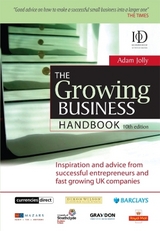
The Growing Business Handbook is a practical source of advice and reference for companies with dynamic growth potential. Combining the knowledge and expertise of leading professional advisors with the experience of entrepreneurs, the book gives a comprehensive insight into the challenges involved in building a high-growth venture in 2007.
With sections on marketing, funding, people, business technology, innovation, global expansion, acquisitions and risk control, it highlights potential new sources of value for enterprises to exploit. It also stresses that high performance is inherently complex and stressful.
The Growing Business Handbook is an invaluable guide for executives as they confront decisive points in the growth cycle. It includes best practice advice from established businesses and organizations including 3i, British Franchise Association, Knight Frank, Mazars and Strathclyde Business School.
Adam Jolly is a business writer and editor. He is currently working on projects with the DTI, the Institute of Directors and the Design Council. He is also the Consultant Editor on a number of Kogan Page titles including A Handbook of Intellectual Property Management and From Idea to Profit.
Part 1: Planning for growth 1.1Change the market Karan Bilimora, Cobra Bangalore; Build credibility; Indian restaurants; Take-off; Brewing partners; From cult to brand; Ideas per hour; The power of innovation; The bottling model; Complexity of growth; Evolution of capital structure 1.2Entrepreneurial challenges Philip Verity, Mazars Leaders imagine; Leaders create opportunities; Leaders are talent fanatics; Leaders understand that it's all people; Leaders are not the king of the castle; Leaders are financial engineers; Leaders make mistakes; Leaders communicate; Leaders make things happen; Leaders develop other leaders 1.3Strategy on a budget Mike Robson, SPS Why some companies do not succeed; The attributes of successful business; The business owner's dilemma; The strategic plan; Implementation; Selecting advisers 1.4Dealing with dilemmas Patrick Dunne, 3i Introduction; The nature of dilemmas; Some principles for dealing with dilemmas; Summary 1.5Prospects for growth Andrew McLaughlin and David Fenton, The Royal Bank of Scotland Group The end is nigh; What a difference a year makes... not really; Stability versus ability Part 2: Exploiting ideas 2.1Build it and they will come Andy Reid, ?What If! Attitude: stay positive and 'can do'; Embrace risk and the irreverent; Laugh: take fun seriously 2.2Innovation in smaller companies Gerard Burke, Business Growth and Development Programme 2.3The innovation process Peter Ives, Business Dynamix 2.4Knowledge transfer Jo Wheeler, Knowledge Transfer Partnerships Collaboration; Lowering risks; Diffusion of technology and best practice; 2.5Research and development tax relief for SMEs Jon Sutton, Dixon Wilson Qualifying companies; Qualifying expenditure; Specific detail concerning the qualifying costs; Ownership of the intellectual property; Nature of the relief; Making a claim for relief; Other relevant issues 2.6Intellectual property Stephen Carter, Mewburn Ellis Patents; Trade marks; Designs 2.7Making standards work Marcus Long, British Standards Institution Business benefits of standards; Types of standards; Selecting and applying standards; Buying and introducing a standard; Certification and product marking; The certification process 2.8Accreditation Jon Murthy, UKAS What is accreditation?; What are the benefits?; Are accredited services relevant to your business?; What types of certification are accredited? Part 3: Gaining market share 3.1Smarter marketing Paul Hewerdine, Loewy What your brand means to customers; put the wow factor into your campaigns; Think multiple channels for multiple impact; Remember your salespeople are your best channel to market; When they search, make sure you get noticed; Next time, make it personal; A little packaging of services goes a long way 3.2Building a reputation Louise Third, Integra Communications Gathering storm clouds; Storm protection; Agenda item 1: A reputation that works for us; Agenda item 2: Our communications plan; Agenda item 3: Getting everyone on board; Agenda item 4: Getting external advice; Sunnier times 3.3Franchising Dan Archer, British Franchise Association Franchisees; Franchisors 3.4Licensing: a good way to grow Robert Sales, Swindell & Pearson Licensing; Free beer?; Why license?; Why do you need to be able to license?; Particular rights that may be licensed; What you should be looking for in a licence; Summary Part 4: Customer service 4.1Service on the move Martin Taylor, Impact Applications Financial burden; Meeting objectives; Keeping ahead 4.2Just one number Georgette Jones What a One Number-hosted telephone solution can do for your business; Available types of marketing telephone numbers; Business benefits of using a One Number telephone solution; Think you're too small for a telephony solution? 4.3Complaints Paul Cooper, Institute of Customer Service Real benefits in prioritizing and improving complaints handling; Definition of a complaint; Golden rules of complaints handling for organizations 4.4Recognizing and rewarding customer service Paul Cooper, Institute of Customer Service Major conclusions 4.5Smaller companies and CRM Mark Staniszewski, Green Button Software Definition of a small business; CRM for the sole trader; CRM for the small business with employees; CRM and marketing Part 5: People and performance 5.1Twenty-first-century HR services for SMEs Laura Firth, Reed Consulting Executive development to lead and engage employees in the change; Outsourcing HR services: focused, value-driven HR interventions; Cost-efficient recruitment; Employee retention: improving organizational performance; Conclusion 5.2Complications and costs of employment law Mike Huss, Corporate Risk Solutions 5.3Lock in top performers Andrew Broome, haysmacintyre Offering shares in the business; Types of scheme; Enterprise Management Incentive schemes; 5.4Flexible resourcing John Thomas, Professional Contractors Group How large is the freelance workforce in the United Kingdom?; Benefits of engaging freelances; Legal and contractual issues 5.5Stretching performance Ruth Spellman, Investors in People 5.6Recruiting in the new Europe Rosemary Whibley, J S Hamilton A move from mass labour to added value skills is in sight... Part 6: Property and locations 6.1Property challenges facing growing companies Bradley Baker, Knight Frank Newmark Escalating rents; 'Village concept' versus one central building; A micro local view versus a regional macro-strategic view; Information is key; Outsourcing/offshoring; Summary 6.2Relocation, relocation, relocation Graham Harrison, South West RDA Taking the plunge; Careful consideration; Current trends; A helping hand 6.3Office hot spots Catherine Penman, Knight Frank Office market prospects; Investment market 6.4Property conversions Graham Elliott, haysmacintyre Claiming the VAT; DIY 6.5Profiles: the Isle of Man, North Lincolnshire and the North Midlands Isle of Man; North Lincolnshire; The North Midlands Part 7: Cash flow and working capital 7.1Reviewing the efficiency of your business Fiona Rook, My Business Centre Streamline your processes; Make use of your balance sheet; Benchmarking and budgets; In conclusion 7.2Slow payments Martin Williams, Graydon UK 7.3Banking relationships for smaller companies Stewart Dickey, British Bankers' Association Working with your bank; How to manage your bank manager; Negotiate with your bank manager 7.4Challenges for tax planning in the growth cycle Cathy Corns, Mazars Raising additional finance; Product development; Capital spend; Staff retention and incentives; Acquisitions; In conclusion 7.5Treasury risks Paul Gamba, The Royal Bank of Scotland 7.6Energy contracts Sebastian Eyre, John Hall Associates Increases in commodity prices; Complex and volatile energy markets; Prices have increased substantially; Risk management and financial tools; Indexation; Hedging; Exceptions; Diesel; Conclusion 7.7Fuel cards Alyson Baywa, JetCard Online services Part 8: Business technology and systems 8.1Software asset management Chris Minchin, FAST Corporate Services Money down the drain; Legal compliance; Setting boundaries; Getting your house in order; Ensuring compliance; Ongoing management; Six-point guide to software asset management 8.2Types of offshoring engagement models Rajiv Dey, NIIT SmartServe Value creation: hybrid models; Venture capital-funded projects; Latest trends; Conclusions 8.3Video conferencing John Cooper, JKC Information Technology What is video conferencing?; Types of video conferencing; What you should consider; Justification of investment in video conferencing; Beginning your search; Choosing a supplier; The result Part 9: Managing the growing organization 9.1Using management information Craig Goodwin, Mazars What to measure?; Surely management accounts tell me all I need to know?; It already takes long enough to compile the management accounts!; We have query tools that tell us all we need to know; So what?; Oh no, not another software system...; Conclusion 9.2Breaking barriers David Pinches, Sage The problems multiply; Real-time agility; Achieving integration; Building the links; The integrated suite; Integration works 9.3Growth and risk: two sides of the same coin Stephen Kelly, idRisk Growth: managing the risk; The issue; Growth and enterprise risk management; External factors; The challenge; Use existing business performance metrics to measure risk; Risk management and performance reporting; A positive dialogue on your terms 9.4Project success in dynamic enterprises Ky Nichol, Pcubed Where it all tends to go wrong; Lessons learned; Conclusion 9.5Managing transition and change Peter McInnes, Nic Beech and Robert MacIntosh, Strathclyde University Business School Difficulties of managing change in growing firms; The multiple nature of organizational change; The multiple nature of organizational life; Communication and identity issues; An inquiry-based approach to managing change 9.6Mentoring for growth Philip de Lisle What is a mentor?; Choosing a mentor; Using your mentor; Bringing down the curtain Part 10: International expansion 10.1Are you ready to export? Jim Sherlock, Institute of Export 10.2Dilemmas in international trade David Millet, The Royal Bank of Scotland Some common dilemmas; Some tips; Address all elements of your approach in parallel; Summary 10.3Global expansion David Sayers, Mazars Small acorns; Code contradiction; Financing the expansion; Making it more permanent; Bringing the tax home; Conclusion 10.4Doing business in China Joanna Lavan, Connect China Take a medium- to long-term view; Be selective in choosing the right partner; Translate your business materials; Visiting China; Pay attention to guanxi; Do your due diligence; Intellectual property rights; Contracts; When the going gets tough...; Payment terms; Ganbei! 10.5Trade statistics Stephen Browning, HM Revenue and Customs 10.6Taxation and international expansion Liesbeth Staps, Netherlands Foreign Investment Agency Introduction; The European Union: a competitive market; Dutch government plans; Tax treaties; Advantages Part 11: Corporate finance 11.1Optimizing the deal structure Andrew Millington, Mazars Why the keep it simple approach fails; Structuring options; Financing options; Watch out; Conclusion 11.2Business grooming Stephen Harris, Mazars Where are you going?; Outright sale; Change in control; Trade partnering; Generic areas 11.3Twenty-one tips for raising venture capital Geoff Sankey, The Capital Fund Getting your hands on finance; The bank says 'yes'; The bank says 'no'; Friends, family and angels; Venture capital institutions; Twenty-one tips 11.4AIM or Ofex Mike Grayer, Menzies Corporate Finance Why float?; Difference between AIM and Ofex; Choosing the right market; Where should you go? 11.5Structured finance Kevin Smith, AWS Equity; Senior debt; Subordinated debt; Mezzanine finance; Asset finance; Trade finance; Structured finance 11.6Tax planning Colin Copeland, Mazars You can't think about tax too early; The relief; Getting dressed for the right party; BATR: the investment trap; How is 'substantial' measured?; The timing issue; Demerger Part 12: Succession and exits 12.1Preparing for the ultimate customer Jonathan Levie and Sharon Eaton, University of Strathclyde Preparing for exit: getting the 'product' ready; Market intelligence: know your ultimate customer; Attracting potential buyers; Using advisers to best effect; Conclusion 12.2Succession planning and partial exits Stephen Harris, Mazars So it's easy to effect?; What will I need to do to achieve this?; Post-transaction; Ultimate exit?; What should I do now? 12.3Tax target: 10 per cent Nigel Landsman, haysmacintyre Taper relief; Business asset taper relief; Tax planning
| Erscheint lt. Verlag | 3.11.2006 |
|---|---|
| Verlagsort | London |
| Sprache | englisch |
| Maße | 170 x 214 mm |
| Themenwelt | Wirtschaft ► Betriebswirtschaft / Management ► Finanzierung |
| Wirtschaft ► Betriebswirtschaft / Management ► Personalwesen | |
| Wirtschaft ► Betriebswirtschaft / Management ► Unternehmensführung / Management | |
| ISBN-10 | 0-7494-4807-5 / 0749448075 |
| ISBN-13 | 978-0-7494-4807-3 / 9780749448073 |
| Zustand | Neuware |
| Informationen gemäß Produktsicherheitsverordnung (GPSR) | |
| Haben Sie eine Frage zum Produkt? |
aus dem Bereich


