


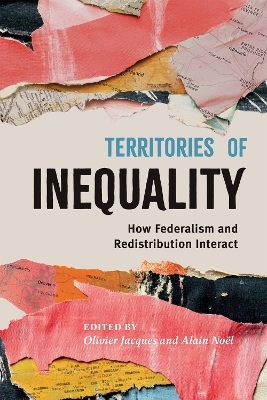
Territories of Inequality
How Federalism and Redistribution Interact
Seiten
2025
McGill-Queen's University Press (Verlag)
978-0-2280-2457-6 (ISBN)
McGill-Queen's University Press (Verlag)
978-0-2280-2457-6 (ISBN)
This volume analyses the effect of decentralization and federalism on policy outcomes and on public preferences, as well as the connections between fiscal federalism, political forces, and inequality.
The rise of income and wealth inequality and the possibilities of redistribution animate contemporary social and political debates, but much of the scholarship on the issue is limited to the individual level. There is a spatial dimension to the redistribution of income, however, and in federations, this is especially important.
In Territories of Inequality leading political scientists propose a territorial approach to inequality and redistribution, informed by political economy, political geography, and a comparative analysis of federalism and multilevel governance. Chapters explore the relationship between interpersonal and interregional redistribution, the role of progressive or regressive governing coalitions, and the foundations of individual preferences for or aversions to interregional redistribution. They consider different federations and quasi-federations and emphasize the unique situation of Indigenous Peoples, who navigate a complex relationship with institutions shaped by colonialism.
Examining how decentralization and federalism influence policy outcomes and public preferences, Territories of Inequality provides new ways to approach the question of redistribution.
The rise of income and wealth inequality and the possibilities of redistribution animate contemporary social and political debates, but much of the scholarship on the issue is limited to the individual level. There is a spatial dimension to the redistribution of income, however, and in federations, this is especially important.
In Territories of Inequality leading political scientists propose a territorial approach to inequality and redistribution, informed by political economy, political geography, and a comparative analysis of federalism and multilevel governance. Chapters explore the relationship between interpersonal and interregional redistribution, the role of progressive or regressive governing coalitions, and the foundations of individual preferences for or aversions to interregional redistribution. They consider different federations and quasi-federations and emphasize the unique situation of Indigenous Peoples, who navigate a complex relationship with institutions shaped by colonialism.
Examining how decentralization and federalism influence policy outcomes and public preferences, Territories of Inequality provides new ways to approach the question of redistribution.
Olivier Jacques is assistant professor in the Department of Health Management, Evaluation and Policy at l'Université de Montréal. Alain Noël is professor emeritus in the Department of Political Science at l'Université de Montréal.
| Erscheinungsdatum | 02.08.2025 |
|---|---|
| Reihe/Serie | Democracy, Diversity, and Citizen Engagement Series |
| Zusatzinfo | 23 diagrams, 11 tables |
| Verlagsort | Montreal |
| Sprache | englisch |
| Maße | 152 x 229 mm |
| Themenwelt | Sozialwissenschaften ► Politik / Verwaltung |
| Wirtschaft ► Volkswirtschaftslehre ► Wirtschaftspolitik | |
| ISBN-10 | 0-2280-2457-9 / 0228024579 |
| ISBN-13 | 978-0-2280-2457-6 / 9780228024576 |
| Zustand | Neuware |
| Informationen gemäß Produktsicherheitsverordnung (GPSR) | |
| Haben Sie eine Frage zum Produkt? |
Mehr entdecken
aus dem Bereich


aus dem Bereich
Wohlstand, Wachstum, Wettbewerb
Buch | Softcover (2025)
Kohlhammer (Verlag)
CHF 68,90
mit Marx, Menger und Marshall durch die Grundlagen der Ökonomie
Buch | Hardcover (2025)
De Gruyter Oldenbourg (Verlag)
CHF 62,90
Wurzeln und Perspektiven
Buch | Softcover (2025)
Kohlhammer (Verlag)
CHF 44,75


