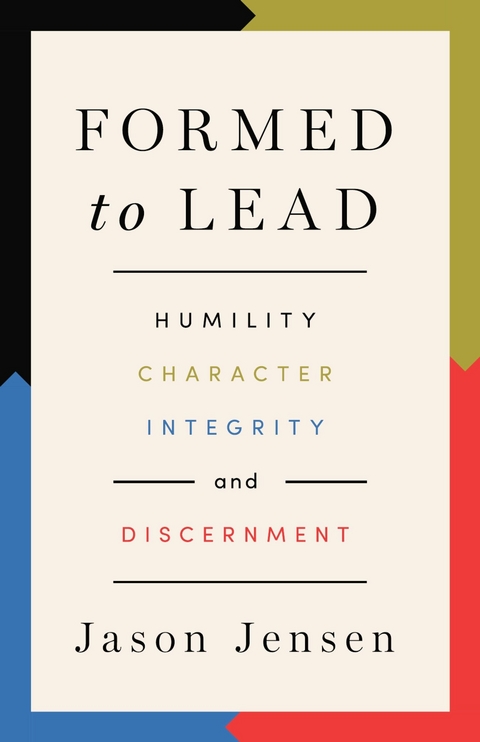
Formed to Lead (eBook)
168 Seiten
IVP Formatio (Verlag)
978-1-5140-0991-8 (ISBN)
Jason Jensen (MA, Fuller) is vice president of spiritual foundations for InterVarsity Christian Fellowship/USA. Jason led InterVarsity staff teams in Berkeley, California, for twenty-nine years. He and his wife, Susi, are based in Madison, Wisconsin, where Jason oversees the formation of InterVarsity staff in Scripture, theology, spiritual formation, and prayer. Their two adult children live in California.
Jason Jensen (MA, Fuller) is vice president of spiritual foundations for InterVarsity Christian Fellowship/USA. Jason led InterVarsity staff teams in Berkeley, California, for twenty-nine years. He and his wife, Susi, are based in Madison, Wisconsin, where Jason oversees the formation of InterVarsity staff in Scripture, theology, spiritual formation, and prayer. Their two adult children live in California.
1
LEADERSHIP INTEGRITY
Luke’s Surprising Vision
Lord Jesus, when we look closely, we sense that leadership is full of temptations. Teach us to see ourselves and the world more clearly. Show us a path forward to grow as both humble disciples and faith-filled leaders. Deliver us from pride and fear. Empower us and direct us by your Spirit. Amen.
As a Christian, I’m often skeptical about leadership. I look at public figures admired for leadership excellence and I feel torn. On one hand I long for similar strength, brilliance, and accomplishment. I want to be effective and smart, and in control. On the other hand I feel vaguely repelled. Most public leaders don’t reflect much of Christ’s character. Any faith they have seems like a thin veneer, a colorful user interface over a morally bankrupt operating system.
For example, I love the boldness and innovation I often see from leaders in the tech industry. Their strategic and creative brilliance has transformed the world in profound ways. Some of them manage to generate wealth and influence that serves great causes. I want to lead boldly and innovate for God’s kingdom! At the same time as I look closely at many (but not all) of these leaders from the perspective of character and spirituality, I don’t want to emulate them. I often see arrogance, abuse, or addiction at the core. I seldom see compassion, humility, or authentic faith.
In contrast, I think of my friend and mentor Mary Anne Voelkel. Mary Anne and her husband, Jack, were missionaries in Colombia for thirty years, planting a student ministry and passing leadership along to local leaders. She also planted a fruitful prayer, healing, and evangelism ministry in the prisons of Medellin in the 1980s during very turbulent times.
In 1990, I had the honor of being Mary Anne’s chauffer and assistant during a conference where she was leading a large prayer effort. What an amazing experience it was! The Holy Spirit moved powerfully among students. Like we see in the book of Acts, the drama included healing, deliverance, conversion, and worship—along with significant conflict and resistance.
As I accompanied Mary Anne through that week of intense eighteen- to twenty-hour days, I saw what I call leadership integrity. She was the same in public and in private. She was consistent in success and failure, when receiving affirmation and pushback. She showed the fruit of the Holy Spirit while she ministered in the gifts of the Holy Spirit. Somehow while she was serving, it was her affection for Jesus that always came forward. She was able to forgive others and ask forgiveness when needed. While I was excited by the drama of the ministry, I was most impressed by learning from a leader whose character seemed congruent with her contribution. Later in friendship with Mary Anne, I learned more about the suffering God used to form her and about the private spiritual disciplines that made her leadership integrity possible.
The world admires leadership for its brilliance, its strength, and its impact. All of these can be good and redemptive when applied toward the kingdom of God. But Christian leadership holds another vision as well: a vision of integrity where our methods and character and presence reflect the Spirit of Jesus. For Christian leaders, both our work and our character should give off the aroma of Christ.
Worldly leadership implies mastery, but a Christian is called first to be a humble follower. If you are a follower of Jesus and are also called to lead, you must live with this paradox of humility and strength.
LUKE’S SKEPTICISM OF WORLDLY LEADERSHIP
In the early chapters of the narrative, Luke’s Gospel expresses a distinct skepticism about leadership. Luke critiques worldly leadership as he paints a picture of power in first-century Palestine. He grips the reader with contrasts: Those who lead in the kingdom of God are different from those in the world.
At the beginning of chapter 3, Luke uses a lot of parchment on the names of leaders: “In the fifteenth year of the reign of Tiberius Caesar—when Pontius Pilate was governor of Judea, Herod tetrarch of Galilee, his brother Philip tetrarch of Iturea and Traconitis, and Lysanias tetrarch of Abilene—during the high-priesthood of Annas and Caiaphas, the word of God came to John” (Luke 3:1-2). At the beginning of chapter 2, Luke also mentions Caesar Augustus. Why name two Caesars and the rest of these political figures? It does set the historical and geopolitical context, and it gives credibility to Luke’s account, but I believe there is something more.
Luke references these leaders in sharp contrast to the heroes of his story. We recognize Tiberias’s name, but the Roman Empire has fallen by the time of our reading. Herod and Pilate we recognize, but only in the context of the history-shaping life of Jesus. Despite the historical context, the likes of Caesar, Herod, Pilate, Annas, and Caiaphas are not central actors in the story being told. Rather, they are part of the landscape into which the Word of the Lord and the Holy Spirit take dramatic action.
Among human characters early in Luke’s account, the most focal and significant is a vulnerable teenage girl named Mary, who welcomes the presence and movement of the Holy Spirit. The Gospel also illuminates surprising turns of provision and circumstance for the humble and faithful Zechariah and Elizabeth. John the Baptist is portrayed not as an excellent strategist but as a peculiar prophet to whom the word of the Lord arrives. These everyday characters (and not the politicians) are leaders of truly historic significance.
Leadership as the world defines it is clearly not center stage in Luke’s narrative. Rather than leaders like Caesar making things happen, God is working in history, bringing surprises by the power of the Spirit despite the evil decisions of those seen as leaders. The Gospel critiques traditional power from the very beginning, casting King Herod in dark shadows of moral compromise and abuse of power. The early chapters of Luke reveal God as one who overturns established assumptions about leadership.
LUKE’S LEADERSHIP VISION
Luke contrasts the Herods, Ceasars, and Pilates of the world with a positive vision for leadership. Filled with the Holy Spirit, young Mary says of the Lord:
He has performed mighty deeds with his arm;
he has scattered those who are proud in their inmost thoughts.
He has brought down rulers from their thrones
but has lifted up the humble.
He has filled the hungry with good things
but has sent the rich away empty. (Luke 1:51-53)
Luke’s vision is of an upside-down kingdom where God is at work. His kind of leaders don’t conform to the world’s expectations. Rather, they carry the humility and integrity of Mary, Elizabeth, Zechariah, and John, and they cooperate with the Spirit’s work in the world.
When we cooperate with the Spirit, leadership is our action in the world that intentionally creates culture and influences people.
In Genesis, God gives humankind a cultural mandate to fill the earth, subdue it, give names, and tend his creation. Our actions in the world (to create, give meaning, influence others, and shape our environment) fulfill God’s mandate and create culture. Andy Crouch’s thinking about culture making as leadership has expanded my vision to a holistic one that includes the artistic and prophetic as leadership. Our intentional action toward influence and culture creation is always leadership.1
This kind of leadership is not only the realm of executives and coaches. The stay-at-home parent of young children is practicing an incredibly influential form of leadership. The student and the entry-level employee practice leadership from their own social location by stewarding integrity and growth, and they influence the people and culture around them. Like Mary and Elizabeth, in God’s economy those with low social position are often entrusted with leadership of special importance.
Some would say that in order to be a leader, one simply must have followers. This is true in a very basic sense—leaders lead followers and followers follow a leader. However, this perspective overlooks those who intentionally pursue a vision in faith. This intentional influence sometimes precedes the presence of followers. Like an artist whose work is appreciated only posthumously, these leaders pursue a vision and ultimately have an impact. It is not always the most obvious leaders who are changing the world! Mary, the mother of Jesus, responded faithfully to the initiative of God. She had no followers initially, but has become one of the most influential leaders in history.
From any position, the stewardship of our influence is a sacred trust from God, and it requires intentionality. As leaders, we do what we do on purpose. In this sense every Christian is called to be a leader.
Luke shows us that God himself is the protagonist of history.
Even though we create culture and influence others, we are not the center of the story. God intervenes among people. He brings down rulers from their thrones and exalts the humble, as stated in Mary’s prayer (Luke 1:52). God...
| Erscheint lt. Verlag | 26.8.2025 |
|---|---|
| Verlagsort | Lisle |
| Sprache | englisch |
| Themenwelt | Religion / Theologie ► Christentum ► Moraltheologie / Sozialethik |
| Wirtschaft ► Betriebswirtschaft / Management ► Unternehmensführung / Management | |
| Schlagworte | Abuse • Anxiety • Biblical • Burnout • Christian • Church • contemplative • Discipleship • Ethical • Evil • Failure • Faith • fallibility • Formation • God • Gospel • Holy Spirit • Jesus • Leadership • Luke • ministry • Moral • New Testament • Pastor • scandal • Shame • Spiritual • Trinity • Vision • Work |
| ISBN-10 | 1-5140-0991-9 / 1514009919 |
| ISBN-13 | 978-1-5140-0991-8 / 9781514009918 |
| Informationen gemäß Produktsicherheitsverordnung (GPSR) | |
| Haben Sie eine Frage zum Produkt? |
 EPUB (Wasserzeichen)
DRM: Digitales Wasserzeichen
Dieses eBook enthält ein digitales Wasserzeichen und ist damit für Sie personalisiert. Bei einer missbräuchlichen Weitergabe des eBooks an Dritte ist eine Rückverfolgung an die Quelle möglich.
Dateiformat: EPUB (Electronic Publication)
EPUB ist ein offener Standard für eBooks und eignet sich besonders zur Darstellung von Belletristik und Sachbüchern. Der Fließtext wird dynamisch an die Display- und Schriftgröße angepasst. Auch für mobile Lesegeräte ist EPUB daher gut geeignet.
Systemvoraussetzungen:
PC/Mac: Mit einem PC oder Mac können Sie dieses eBook lesen. Sie benötigen dafür die kostenlose Software Adobe Digital Editions.
eReader: Dieses eBook kann mit (fast) allen eBook-Readern gelesen werden. Mit dem amazon-Kindle ist es aber nicht kompatibel.
Smartphone/Tablet: Egal ob Apple oder Android, dieses eBook können Sie lesen. Sie benötigen dafür eine kostenlose App.
Geräteliste und zusätzliche Hinweise
Buying eBooks from abroad
For tax law reasons we can sell eBooks just within Germany and Switzerland. Regrettably we cannot fulfill eBook-orders from other countries.
aus dem Bereich