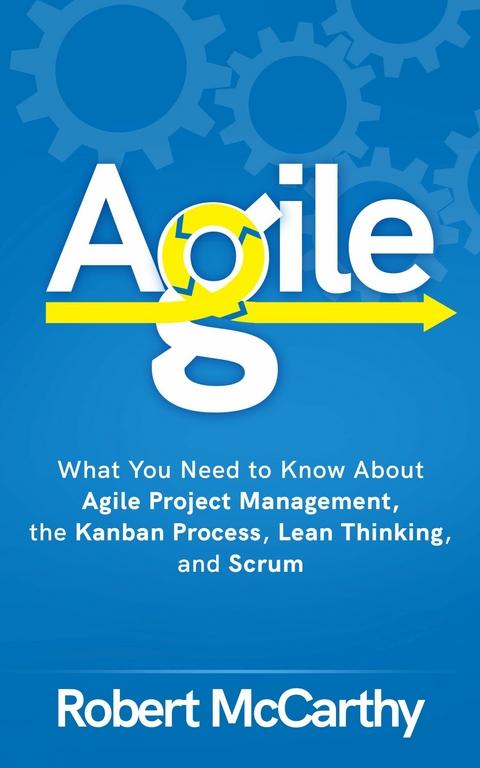
Agile (eBook)
105 Seiten
Robert McCarthy (Verlag)
9781393955641 (ISBN)
Project management comprises time-sensitive goals assigned to a specific team and includes initiation, planning, execution, control, and closure of the project. Teams the world over, and across different sectors, use project management to achieve project-related goals with time constraints and predefined success criteria. These time constraints and success criteria are usually defined before the commencement of a particular project.
Scope, quality, time, and budget are the primary or key constraints of project management. In other words, the success of a project is gauged largely by how well it aligns with its expected or planned scope, quality, time, and budget. These constraints include the client’s requirements and expectations and those of the company or organization the project team belongs to.
Client requirements and expectations are usually gathered and documented before a project begins. A clear understanding of those expectations and requirements enables the project stakeholders to form the project team that will create the end product to meet the predefined client requirements and expectations. Therefore, proper gathering and analysis of client requirements and expectations play a key role in determining a project’s success.
A project is a temporary mission that is enforced to achieve a set of objectives during a specified period. Therefore, a project must have clear objectives regarding the product or service it will achieve. Furthermore, a project must also have a start and end date.
A project can create or make improvements to an existing product or service. A project can also be a one-time endeavor or an ongoing one. However, since a project needs to have a start and end date, an ongoing project is technically a project that repeats itself upon completion of its objectives.
For example, there may be a project where the objective is to manufacture a sports car according to strict guidelines in a month. The project team may complete the car in 29 days, bringing it to a closure. The same team might move on to the next project, which is the same: manufacturing the same car with the same requirements and time frame. Such projects are called ongoing projects.
Project management aims to utilize the resources available to a team to achieve project objectives without delays and to exceed the budget. The planning of resources includes personnel, finances, technology, and intellectual property. Project management also aims to meet predefined customer requirements and expectations while also facilitating some changes to those requirements and expectations along the way.
A project manager’s job is to use a suitable project management methodology to initiate, plan, execute, control, and close the project within the allowed time frame. In most methodologies, the project manager determines when certain project components will be completed and which team members will contribute to those tasks. Some project management methodologies involve smaller teams making those decisions and initiating and executing tasks.
1.1 History of Project Management
Ancient records prove that officials were allocated management roles to complete different sections of the Great Pyramid of Giza built by the Pharaohs. The construction of the four faces of the Great Pyramid was assigned to different managers, who ensured they were completed on time. This would have involved planning, execution, and control.
The Great Wall of China is another enormous project that would have required a lot of management skills. Historical data indicate that the laborers were divided into three main groups or categories: soldiers, commoners, and criminals. These groups—that amounted to millions of people—were separately managed. Therefore, there is concrete evidence suggesting that some project management levels have been around for thousands of years.
The civil engineering industry in the 1950s first applied project management practices; however, they were limited to complex projects. The practices were not applied for smaller projects at the time. Over the next decade, project management expanded into many other engineering fields.
Henry Laurence Gantt, an American mechanical engineer who created the Gantt Chart in 1917, was one of the pioneers of scientific management and project management practices. Gantt charts became popular as a tool to guide projects, and he introduced many other techniques and tools to help plan and control projects. Henri Fayol, a French engineer, also introduced the five project management functions, which laid a foundation for project management for years to come.
The era of modern project management dawned in the 1950s, with many core engineering fields contributing towards its evolution. Project management was recognized as an important practice and discipline in many engineering sectors around this time. Gantt charts were used to manage most projects along with various informal tools before the 1950s. However, two project scheduling models emerged around this time that changed how project management was carried out.
This Critical Path Method (CPM) was one of those mathematical methods. It was developed through a joint venture between the Remington Rand Corporation and the DuPont Corporation. CPM quickly gained popularity and was used to manage plant maintenance projects.
The Program Evaluation and Review Technique (PERT) was the other project scheduling model that emerged. It was a model created by the U.S. Navy Special Projects Office along with Booz Allen Hamilton and the Lockheed Corporation for the Polaris missile submarine program. CPM and PERT have many similarities; however, they have numerous distinctions that make them more or less suitable for certain projects or industries.
CPM was used to manage projects that have predefined time frames for different tasks. PERT, on the other hand, was widely used in projects with uncertain time frames. Many private entities across different industries quickly started using CPM and PERT to manage different projects depending on their characteristics.
Different techniques were introduced to estimate and manage the cost of projects with Hans Lang dominating the way. The American Association of Cost Engineers was formed in 1956 by individuals and companies that used different project management tools and methodologies. The organization is now known as the Association for the Advancement of Cost Engineering (AACE). Practices that involve planning, cost estimation, scheduling, cost control, and project control have, for decades, been guided by the AACE.
The United States Department of Defense developed the concept of the Work Breakdown Structure (WBS) for the Polaris ballistic missile project. It was published upon completion of the project and mandated for use in future projects of the same size and scope. The WBS is a hierarchical structure for tasks and deliverables that need to be completed to close a particular project. The method was later adopted by the private sector and remains to be a highly useful project management tool to this date.
The International Project Management Association (IPMA) was formed in Vienna in 1965. It acted as a forum for project managers to share information, with more than 50 project management associations from across the world joining its network. The IPMA intends to develop the profession of project management with its membership exceeding 120,000 in 2012.
The Project Management Institute (PMI), formed in 1969 in the United States, aimed to improve the science, practice, and profession of project management. PMI’s first symposium was held in Atlanta, Georgia, the same year with 83 attendees. Since then, the institute has taken giant strides by being highly recognized around the world for publishing A Guide to the Project Management Body of Knowledge (PMBOK), which acts as an essential tool for project managers. It includes different project management practices suitable for “most projects, most of the time.”
The Project Management Institute also began issuing certifications for project management experts that highly contributed to the worldwide recognition of project management as a profession and expertise. PMI’s two project management certifications are Project Management Professional (PMP) and Certified Associate in Project Management (CAPM).
Simpact Systems Limited created PROMPT II in 1975 as a response to the outcry for a solution to address projects extending delivery dates and exceeding budgets, especially in the IT industry. PROMPTII sets guidelines to the way stages flow in a computer project. The Government’s Central Computing and Telecommunications Agency (CCTA) in the United Kingdom adopted PROMPT II for all of its information systems projects in 1979.
Author, philosopher, and business leader, Dr. Eliyahu M. Goldratt, introduced the Theory of Constraints (TOC) in his novel The Goal in 1984. The management philosophy was aimed at helping companies continuously achieve their goals. The theory aims to identify constraints that limit projects from achieving their goals. The process uses Five Focusing steps to restructure an organization around the constraints that are identified. The algorithms and philosophy behind TOC laid the foundation for the development of Critical Chain Project Management.
Scrum was recognized as a project management style in a paper titled “The New New Product Development Game,” written by professors Hirotaka Takeuchi and Ikujiro Nonaka in 1986. Scrum was initially intended for the...
| Erscheint lt. Verlag | 17.7.2020 |
|---|---|
| Verlagsort | Njurunda |
| Sprache | englisch |
| Themenwelt | Wirtschaft ► Betriebswirtschaft / Management ► Unternehmensführung / Management |
| Schlagworte | Agile • Agile methodology • agile project management • Continuous Improvement • Kanban process • Lean Thinking • Project Efficiency • Scrum • Team collaboration • workflow optimization |
| ISBN-13 | 9781393955641 / 9781393955641 |
| Informationen gemäß Produktsicherheitsverordnung (GPSR) | |
| Haben Sie eine Frage zum Produkt? |
 EPUB (Wasserzeichen)
DRM: Digitales Wasserzeichen
Dieses eBook enthält ein digitales Wasserzeichen und ist damit für Sie personalisiert. Bei einer missbräuchlichen Weitergabe des eBooks an Dritte ist eine Rückverfolgung an die Quelle möglich.
Dateiformat: EPUB (Electronic Publication)
EPUB ist ein offener Standard für eBooks und eignet sich besonders zur Darstellung von Belletristik und Sachbüchern. Der Fließtext wird dynamisch an die Display- und Schriftgröße angepasst. Auch für mobile Lesegeräte ist EPUB daher gut geeignet.
Systemvoraussetzungen:
PC/Mac: Mit einem PC oder Mac können Sie dieses eBook lesen. Sie benötigen dafür die kostenlose Software Adobe Digital Editions.
eReader: Dieses eBook kann mit (fast) allen eBook-Readern gelesen werden. Mit dem amazon-Kindle ist es aber nicht kompatibel.
Smartphone/Tablet: Egal ob Apple oder Android, dieses eBook können Sie lesen. Sie benötigen dafür eine kostenlose App.
Geräteliste und zusätzliche Hinweise
Buying eBooks from abroad
For tax law reasons we can sell eBooks just within Germany and Switzerland. Regrettably we cannot fulfill eBook-orders from other countries.
aus dem Bereich