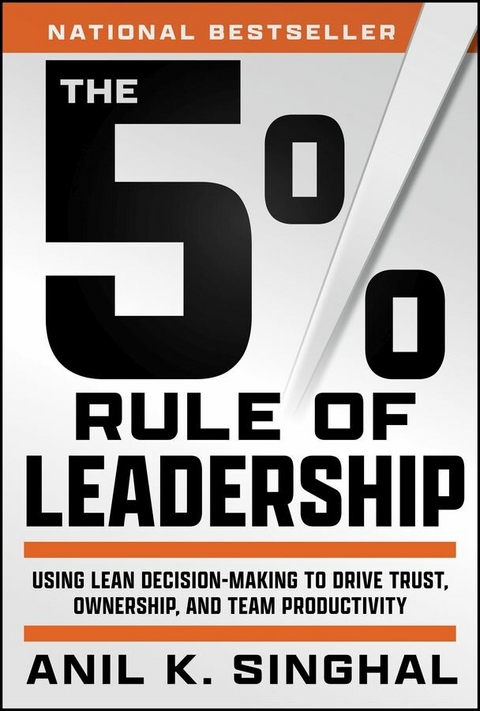
The 5% Rule of Leadership (eBook)
234 Seiten
Wiley (Verlag)
978-1-394-28515-0 (ISBN)
Maintain focus on the first, critical 5% of any project and multiply your results
In The 5% Rule of Leadership: Using Lean Decision-Making to Drive Trust, Ownership, and Team Productivity, veteran technology leader and executive Anil Singhal delivers a transformative approach to project management and company leadership. He explains how to focus your efforts on the first, critical stages of any project or initiative to multiply your results and efficacy, delegating the rest to their capable team.
The book is a blueprint for building resilient organizations, departments, teams, and projects that can withstand today's unpredictable and volatile environment. You'll learn to avoid micromanagement and maintain your focus on the big, strategic picture, while a well-managed team brings you the results you need.
You'll also find:
- Strategies for determining how to properly set priorities and satisfy employees, customers, and shareholders
- Techniques for building trust amongst your workforce, your leadership, and other stakeholders
- Myth-busting advice that blows up misleading and counterproductive habits held by businesspeople and leaders around the world
Perfect for managers, directors, executives, entrepreneurs, founders, and other business leaders, The 5% Rule of Leadership will be invaluable to anyone who wants to lead with values and purpose-and deliver remarkable results.
ANIL K. SINGHAL is the Co-founder, Chief Executive Officer, and Director of NetScout, a software developer that makes products to help customers monitor the reliability and security of their business networks. He provides strategic leadership, vision, operational priorities, and engagement and succession planning for the company's management team.
NATIONAL BESTSELLERMaintain focus on the first, critical 5% of any project and multiply your results In The 5% Rule of Leadership: Using Lean Decision-Making to Drive Trust, Ownership, and Team Productivity, veteran technology leader and executive Anil Singhal delivers a transformative approach to project management and company leadership. He explains how to focus your efforts on the first, critical stages of any project or initiative to multiply your results and efficacy, delegating the rest to their capable team. The book is a blueprint for building resilient organizations, departments, teams, and projects that can withstand today's unpredictable and volatile environment. You'll learn to avoid micromanagement and maintain your focus on the big, strategic picture, while a well-managed team brings you the results you need. You'll also find: Strategies for determining how to properly set priorities and satisfy employees, customers, and shareholders Techniques for building trust amongst your workforce, your leadership, and other stakeholders Myth-busting advice that blows up misleading and counterproductive habits held by businesspeople and leaders around the world Perfect for managers, directors, executives, entrepreneurs, founders, and other business leaders, The 5% Rule of Leadership will be invaluable to anyone who wants to lead with values and purpose and deliver remarkable results.
Introduction
In an era of perpetual and rapid change, this book argues for deliberation.
At a time when the accepted business philosophy is to get under way as soon as possible and make course corrections on the fly, this book offers a strategy for making your key decisions up front.
In an era of regular layoffs during downturns. Of rewarding company superstars more highly than the rank‐and‐file. Of creating different classes of stock for different management levels. And of jettisoning veteran employees after they have been with the firm for more than a few years. This book counsel's fairness, and equivalent treatment, and aspiring to keep your employees not just until they retire, but even after. It's what I have come to call a Not Mean culture—a culture that centers on people‐first values, fairness, and purpose.
When we founded NetScout, my motive from the beginning was not benevolence or an overdeveloped sense of fairness. It was based on pragmatism—that is, what worked. But, in time, I came to realize through trial and error, that fairness needed to be the heart of the company. Why? Fairness drives transparency, which in turn enables simplicity. These factors have proven to be a great foundation for what I refer to as Lean decision‐making—a set of techniques that I have developed over time to help me navigate the myriad choices any leader confronts on a regular basis.
Happily, being in a niche business—corporate information infrastructure—I was able to observe and interact with the many famous, and soon‐to‐be famous, technology companies without risk of takeover or competitive intervention. I saw how many of those companies laid off employees on a regular basis. How they sometimes drove out anyone with too much tenure under the misconceived premise that they could no longer be innovative contributors. And I read how the executives of many of those companies got extraordinarily rich while leaving their hard‐working employees unrewarded. Both my wife and I had experienced inexplicable and seemingly capricious layoffs in the early part of our professional careers—and we did not want to inflict that type of unsettling cruelty on others.
Much of this shocked me; but what really appalled me was how many of the employees of these companies suffered from low morale and were ready to find new jobs whenever they got the chance. I knew the lore of Silicon Valley, and that founding Valley companies had not always been this way. Something had changed in their values and everyday workers were bearing the brunt of that change.
I resolved to find another way. The behavior of my neighbors may have been an impetus, but they were not the only reason. I have always been a bit contrary as a leader. I have a natural affinity for simplicity and economy over complexity and expense, for well‐considered up‐front decisions over rushing headlong into costly and risky new ventures. And I have never believed that treating employees unfairly is anything but a recipe for long‐term disaster.
In founding NetScout, my cofounder and I never wanted a quick turnaround, becoming a “pump and dump” company that captured enough market attention to lure a buyer, make the founders rich, and then disappear. Rather, we had wanted the traditional dream of building a great company that lasted generations, produced high‐quality products that attracted deep loyalty from customers, and gave its employees the kind of secure employment that enabled them to start families and enjoy stable lives.
You can understand now why my theories of management have sometimes been called “contrary,” “anachronistic,” and “counterintuitive.” And I do not mind, because as I have watched companies come and go over the last three decades, I have become only more convinced that I am right.
NetScout is always aspiring to reach greater and greater heights, not just in terms of attaining profit but also in terms of continuing to meet the needs of our rapidly evolving industry and our global workforce. In the process, we have acquired more than 10 companies, both large and small and including some of Silicon Valley's industry darlings, and navigated the company successfully through profound technological change. Despite economic booms and bust cycles, we have held steady, with an average employee tenure of over 10 years, an average leadership tenure of over 20 years, and the vast majority of talent from acquisitions staying with the company and taking on leadership roles. In other words, we are not an anachronism, but an anomaly—and we think, most of all, that we can be a model of how to build a successful and enduring company that is also fair and transparent to all its stakeholders, most of all, its employees.
The Human Ratio
The 5% Rule can be seen as the embodiment in decision‐making of the sociological/statistical theory known as the Pareto principle, devised by Italian mathematician Vilfredo Pareto, and popularized in 1941 by the noted management consultant Joseph Juran.
You know it as the 80/20 rule, which effectively captures a characteristic of human nature that 20% of people in any field seem to do 80% of the work, and the remaining 80% do just 20% of the work. In the years since, the Pareto principle has been shown to operate in many corners of human existence and in the natural world.
Here is another definition, from Google:
It is my belief the 80/20 rule applies again to the 20% (“Pareto of Pareto”) when it comes to decision‐making. That is, I have found that a fraction of decisions result in a majority of consequences.
I had coined this phenomenon the 5% Rule of leadership long before I came to know of the Pareto principle, but I was struck by how congruent they are. The 5% Rule, when applied by the right set of leaders, at the very beginning of an important project, can deliver the Pareto of Pareto promise. To put it another way, 4% of effort (20% of 20%, rounded to my 5%), will invariably deliver 95% of the results all the time for any important project in any and all departments and disciplines of an organization.
It becomes even more interesting when you take the 5% Rule and embed it into the overall operation of an enterprise—that is, the formalization of a 5% solution to management and its formulation of a strategy and plan of execution.
What does all this mean? Nothing—other than it gives valuation to the 5% Rule as being a natural, human model for business decision‐making wherever you can apply it.
Moreover, it suggests that you as a leader are justified in devoting your time to any major company action or decision during the earliest phase of that process. It also argues against the traditional notion that the leader's time should be engaged after most of the work has been done, and the team now needs the leader to make a go, no‐go decision. Both the 5% Rule and the Pareto Principle argue that this method is inefficient, resulting in wasted efforts, and worse, it can create a momentum that can lead to poor outcomes.
Rather, the 5% Rule argues that the leader's role is to—at the start—determine the real goals of any company initiative, establish the parameters of the project to come, and then decide whether to go ahead or not. In this way, needless expense and effort can be averted, and company resources and talent can be properly devoted—and not wasted on a future dead end.
Learn as You Go
In drafting this book, I have continued to hone my use of the 5% Rule. It has proven more supple, universal, and powerful than we ever would have imagined in NetScout's early days. And I am convinced that it is a lynchpin to successful leadership. And yet, successful leadership cannot take place in a vacuum. It is important to note that although the core values of a company create the Not Mean culture, and the 5% Rule allows Lean decision‐making, it is their combination—that is the consistent application of the 5% Rule inside a Not Mean culture—that produces true success. This flies in the face of the old saying that “nice guys finish last.” In fact, throughout the course of NetScout history, I have observed the exact opposite to be true: Nice people finish first. My goal in this book is not to criticize the practices of other companies that operate differently than NetScout. Instead, my goal is to highlight how this different operating philosophy worked at NetScout, and how it might also work for you. To paraphrase one of my business colleagues, “I am surprised that NetScout has been so successful, despite not being Mean.” My answer, “NetScout, in fact, has been successful because of not being Mean, which is largely made possible because of the implementation of the 5% Rule.”
In the pages that follow, I look at the many ways that the 5% Rule can be applied to business units and businesses in general. In practice I think you will discover added nuances to make it even more powerful. My hope is that you will pass it on as you journey through your career. I believe that, together, we can spark a quiet and enlightened revolution in the business world … and in the process, we can find even greater success on the road to becoming Lean But Not Mean enterprises.
Like any book, this one can be read in the order of its chapters. But I have also organized those chapters into sections reflecting the life...
| Erscheint lt. Verlag | 9.9.2024 |
|---|---|
| Sprache | englisch |
| Themenwelt | Wirtschaft ► Betriebswirtschaft / Management ► Unternehmensführung / Management |
| Schlagworte | Business Leadership • business leadership strategy • business project leadership • Business Project Management • company leadership • Company Management • Leadership Book • Leadership Strategy • Project Leadership • Project Management • Project Strategy |
| ISBN-10 | 1-394-28515-9 / 1394285159 |
| ISBN-13 | 978-1-394-28515-0 / 9781394285150 |
| Informationen gemäß Produktsicherheitsverordnung (GPSR) | |
| Haben Sie eine Frage zum Produkt? |
 EPUB (Adobe DRM)
Kopierschutz: Adobe-DRM
Adobe-DRM ist ein Kopierschutz, der das eBook vor Mißbrauch schützen soll. Dabei wird das eBook bereits beim Download auf Ihre persönliche Adobe-ID autorisiert. Lesen können Sie das eBook dann nur auf den Geräten, welche ebenfalls auf Ihre Adobe-ID registriert sind.
Details zum Adobe-DRM
Dateiformat: EPUB (Electronic Publication)
EPUB ist ein offener Standard für eBooks und eignet sich besonders zur Darstellung von Belletristik und Sachbüchern. Der Fließtext wird dynamisch an die Display- und Schriftgröße angepasst. Auch für mobile Lesegeräte ist EPUB daher gut geeignet.
Systemvoraussetzungen:
PC/Mac: Mit einem PC oder Mac können Sie dieses eBook lesen. Sie benötigen eine
eReader: Dieses eBook kann mit (fast) allen eBook-Readern gelesen werden. Mit dem amazon-Kindle ist es aber nicht kompatibel.
Smartphone/Tablet: Egal ob Apple oder Android, dieses eBook können Sie lesen. Sie benötigen eine
Geräteliste und zusätzliche Hinweise
Buying eBooks from abroad
For tax law reasons we can sell eBooks just within Germany and Switzerland. Regrettably we cannot fulfill eBook-orders from other countries.
aus dem Bereich