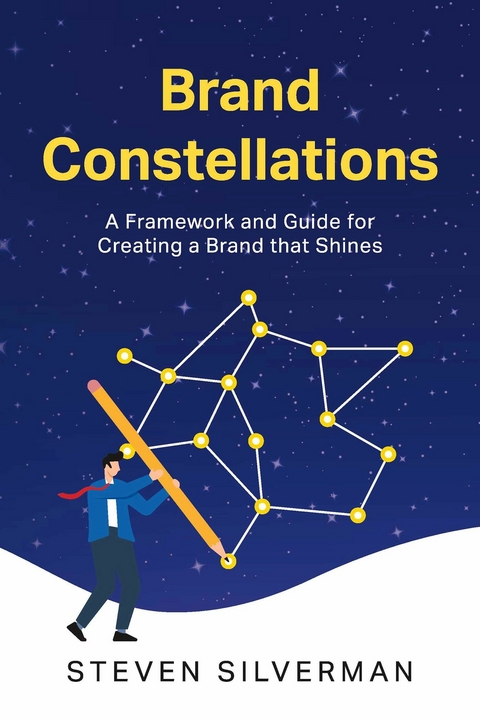
Brand Constellations (eBook)
360 Seiten
Bookbaby (Verlag)
979-8-3509-6557-5 (ISBN)
Steven Silverman, Ph.D. helps marketing and branding leaders from startups to multibillion dollar companies to build brands that stand out, mean more in the market's mind, and sell more year after year. He brings an approach that is both familiar and innovative to drive marketing and branding strategy and execution. Steven works with a range of organizations from technology builders to product providers. He has delivered measurable results for directors, vice presidents, and CMOs at Microsoft, Amazon, Mars, Bose, DuPont and others, as well as startups. As the Principal Consultant at Brand Constellations LLC, Steven uses the Brand Constellations Framer to build brands based on the eight dimensions people use to comprehend them. He has applied this framework in organizational and consulting roles driving brand success. Steven brings a strong academic background, including a PhD and MBA in Marketing to his strategic consulting approach. Combining his education and teaching experience with over three decades of management and consulting expertise, he creates clear and captivating marketing and branding strategies. These strategies detect opportunities, inspire engaging brand narratives, and drive impactful campaigns that not only attract new customers but also nurture loyalty and engagement among existing ones.
"e;Brand Constellations"e; is a revolutionary book that introduces a new paradigm in brand management. The book revolves around the Brand Constellations Framework, a model that reshapes brand perception and management. The Framework's Core ConceptThe Brand Constellations Framework is built on the premise that a brand is more than just a logo, product, or marketing campaign it is a complex mental object that exists in the minds of consumers. This object forms through the consistent connection of various brand dimensions, that create a unified and meaningful whole. Much like stars in a constellation, these dimensions come together to form a complete image in the consumer's mind, which we recognize as the brand. The book calls this a Brand Constellation. The Eight Key DimensionsThe book identifies eight critical dimensions or "e;stars"e; that form the foundation of a brand: 1. Product: The book explores how the quality, innovation, and consistency of a product contribute to the brand's overall identity. It emphasizes the importance of aligning the product's features with consumer needs and expectations to build trust and loyalty. 2. Placement: The distribution and availability of a product are crucial to its success. The book explores how strategic placement in markets and channels can enhance brand visibility and accessibility, facilitating consumer connection. 3. Price: Pricing is not just about setting a monetary value it's about communicating the brand's value proposition. "e;Brand Constellations"e; shows how pricing strategies strengthen brand positioning and influence consumer perceptions. 4. Promotion: Effective promotion is key to brand awareness and engagement. The book explores integrated marketing communications and how they create a consistent brand message for the target audience. 5. Category: Understanding the category in which a brand competes is essential for differentiation. The book emphasizes the significance of positioning the brand uniquely in its category and appealing to the target market. 6. Competitors: No brand exists in a vacuum, and understanding the competitive landscape is crucial for success. "e;Brand Constellations"e; helps brands analyze competitors and leverage strengths for a unique market position. 7. Company: The internal culture and values of a company are integral to the brand's identity. The book explains how aligning a company's mission with its brand messaging can build consumer trust. 8. Customer: Ultimately, a brand's success depends on its relationship with customers. The book stresses the importance of understanding customer preferences and behaviors to create personalized brand experiences. A Tool for Long-Term Brand Success"e;Brand Constellations"e; offers a strategic guide for building and sustaining long-term brand success. It helps brand managers navigate digital transformation, globalization, and evolving consumer expectations. The book's clear structure and practical advice make it an essential resource for anyone involved in brand management. Whether you are a CMO looking to refine your brand strategy or a marketing professional seeking to deepen your understanding of brand dynamics, "e;Brand Constellations"e; provides the insights and tools needed to create and manage brands that not only survive but thrive in today's fast-paced world. A Map for Smarter Brand Management"e;Brand Constellations"e; is more than just a book it's a map for understanding, building, and managing brands in a way that aligns with the complexities of the modern marketplace. The book demonstrates how integrating the eight dimensions creates a strong brand identity that resonates with consumers and drives long-term success. "e;Brand Constellations"e; offers the strategies and insights to help you achieve your brand's full potential.
This section explores using Product and Placement Stars to create a compelling brand offering.
Product and Placement are two very bright stars in the Brand Constellation Framework. People seek out information on the product early in the search process. They understand the problems they can solve and the benefits they will receive. This information is crucial for decision-making.
Placement conveys the ease with which the product is available and where it can be purchased. Buyers consider this information to evaluate the product’s total cost and value.
Product (Offering). The Foundation Star—Begin with the Product
Product is a bright star in a Brand Constellation. When considering the product, people look for information on usage, types, and experience.
- Usage defines the problems the product solves and/or resources it saves.
- Types specify the forms the solution takes (e.g., sizes, variations)
- Experiences entice and enrich the customer.
Building customer associations with the product fosters trust. People want to feel safe when choosing a brand. They want to reduce their risk when making a choice.
Consistently solving problems and saving resources builds trust. Emphasize that your brand is reliable in solving problems repeatedly.
Usage. Solve Problems, Save Resources
When creating your brand, you want to first define your product’s functions and forms. In other words, people want to know what the product is, how it works, and how it is used.
When considering why they use a product, people also want to know how the product solves problems and how it saves them resources across the customer journey.
Coca-Cola has strongly associated its brand with one central reason why most people drink Coca-Cola. to satisfy their thirst. That is their core problem. Coca-Cola associates the word “drink” with Coke, encouraging people to take that simple action. Coke satisfies thirst.
Explain how the offering can help customers save resources. Consider how your product helps customers conserve time, monetary, psychological, and physical resources.
Coca-Cola considers the customers’ constraints by being easily accessible and offering containers that contain the “right” amount for each occasion making it easy to get and hold a serving of Coke.
Addressing Resource Constraints. To build a brand that will link to your market you must communicate that you understand the constraints a customer faces, their problems, and their limited resources.
For example, Coca-Cola considers the customers’ constraints by offering containers that contain the “right” amount for each occasion making it easy to get and hold a serving of Coke.
Types. Product Forms
Usage is not the only problem that Coca-Cola can solve. The brand is associated with various types of products that address different problems. Some people want a low-calorie alternative. Some folks might want a smaller or larger volume of soda. This need or desire has produced various types of Coca-Cola products, including Diet Coke, Coke Zero, and 7.5-ounce cans. In this way, product form solves problems.
Product Experience
Feelings. Recognize the customer’s emotional response to resolved problems and conserved resources. The goal is to make them feel empowered, in control, secure, confident, or relieved. Creating these feelings builds a connection between the customer and your brand.
Coca-Cola creates a sense of confidence in one’s ability to make a smart choice that fits their sense of self and will meet their need for thirst relief. The ability to get just the right size of Coca-Cola may leave someone feeling confident with their choice.
Product Experience—Enticement, Enrichment. The goal is to entice and enrich the customer in the product experience. We aim to foster positive emotions when acquiring and using your service or goods.
Entice the Market. Enticing customers causes them to have good thoughts and feelings. One way to do this is through the senses. Experiences can be in the form of sights, sounds, tastes, smells, and sensations that people can associate with your brand.
These moments can form distinct associations for customers that can differentiate your brand. The objective is to encourage feelings of gratification, happiness, and love.
Enticing also goes beyond the physical senses, to entice people through their minds by offering thoughts and ideas that inspire curiosity and imagination. The best way to communicate how the product affects the customer is to cause sentimentality, empathy, nostalgia, gratitude, or humor.
Coca-Cola entices with the experience of consuming the product through senses like taste and smell. They also go beyond this with their advertising communications that encourage sentimentality, empathy, and nostalgia to inspire curiosity and imagination.
Enrich the Market. Enticement alone is not enough to build a brand constellation. Enrichment can also connect people to a brand.
Enrichment is when a brand reflects people’s personal beliefs and hopes, and it fosters a sense of belonging and distinctiveness.
You need to communicate in such a way so that customers believe they share common principles with your brand. Identify and embody these principles in marketing actions.
The product should strive to make customers feel inspired, proud, connected, validated, or influenced, which can build customers’ trust and respect.
Coca-Cola’s products encourage an experience that is shared with others who hold similar views, especially family and friends.
It encourages consumption of the product with other people at sporting events, picnics, and the beach. Sharing the product with others encourages a connection to both those people and the Coca-Cola brand.
Meeting Customer Expectations. Now consider the relationship between brand and product development, understanding customer needs. This relationship emphasizes the diverse nature of customer needs and the importance of gaining insights for product development.
The Multidimensional Nature of Customer Needs. We understand the customer’s needs are more than just basic functions. Customers value emotional rewards more than practical utility when making purchases. Empathy is crucial in product design, seeing through your customers’ eyes.
Functional Needs. Functional needs are easily identifiable and often the starting point for product development. These needs revolve around what customers require from the product.
Emotional Rewards. Moving deeper, consider the emotional rewards customers seek. Emotional rewards come from how a product makes customers feel, like a sense of belonging, achievement, or security.
Psychological Needs. Understanding customer psychology involves considering their aspirations, identities, and values. Products can enhance brand appeal by aligning with customer values.
The Product Star and Brand Strategy. The Product Star guides the brand through the competitive landscape. This segment focuses on strategic product positioning and product evolution, crucial for brand strategy and market position.
Strategic Product Positioning
Strategic product positioning integrates the product into the brand strategy. This alignment ensures that products fulfil market needs and embody the brand essence. Key elements include the following.
Market Positioning. How a product is perceived in relation to competitors and within the consumer’s mind. Effective positioning uses unique selling points to differentiate and elevate the brand in the marketplace.
Competitive Differentiation. The role of the product in establishing a competitive edge cannot be overstated. Through features, quality, or innovation, the product differentiates the brand, carving out a niche that resonates with the target audience.
Product Evolution
The only constant in the market is change—driven by shifting consumer preferences, technological advancements, and evolving industry standards. Product evolution responds to external pressures and aligns with brand values and mission. This includes the following.
Responsiveness to Market Changes. Agile product development cycles improve products through customer feedback and market analysis.
Technological Advancements. Using new technologies to enhance product functionality, user experience, and manufacturing efficiency, ensuring innovation.
Alignment with Brand Values. As products grow, they must continue to reflect the brand’s core values and mission. This alignment maintains the brand’s identity and promise.
Product Star Magnification
The Product Star’s strategic positioning and evolution capacity enhances its brilliance in the brand constellation. It is not just about what the product is...
| Erscheint lt. Verlag | 15.10.2024 |
|---|---|
| Sprache | englisch |
| Themenwelt | Wirtschaft ► Betriebswirtschaft / Management ► Marketing / Vertrieb |
| ISBN-13 | 979-8-3509-6557-5 / 9798350965575 |
| Informationen gemäß Produktsicherheitsverordnung (GPSR) | |
| Haben Sie eine Frage zum Produkt? |
 EPUB (Ohne DRM)
Größe: 3,6 MB
Digital Rights Management: ohne DRM
Dieses eBook enthält kein DRM oder Kopierschutz. Eine Weitergabe an Dritte ist jedoch rechtlich nicht zulässig, weil Sie beim Kauf nur die Rechte an der persönlichen Nutzung erwerben.
Dateiformat: EPUB (Electronic Publication)
EPUB ist ein offener Standard für eBooks und eignet sich besonders zur Darstellung von Belletristik und Sachbüchern. Der Fließtext wird dynamisch an die Display- und Schriftgröße angepasst. Auch für mobile Lesegeräte ist EPUB daher gut geeignet.
Systemvoraussetzungen:
PC/Mac: Mit einem PC oder Mac können Sie dieses eBook lesen. Sie benötigen dafür die kostenlose Software Adobe Digital Editions.
eReader: Dieses eBook kann mit (fast) allen eBook-Readern gelesen werden. Mit dem amazon-Kindle ist es aber nicht kompatibel.
Smartphone/Tablet: Egal ob Apple oder Android, dieses eBook können Sie lesen. Sie benötigen dafür eine kostenlose App.
Geräteliste und zusätzliche Hinweise
Buying eBooks from abroad
For tax law reasons we can sell eBooks just within Germany and Switzerland. Regrettably we cannot fulfill eBook-orders from other countries.
aus dem Bereich