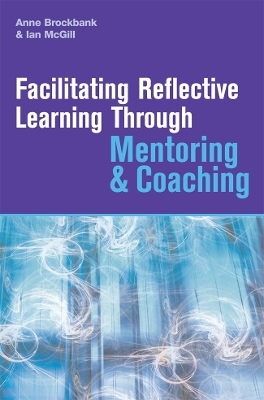
Facilitating Reflective Learning Through Mentoring and Coaching
Kogan Page Ltd (Verlag)
978-0-7494-4448-8 (ISBN)
- Titel erscheint in neuer Auflage
- Artikel merken
What is the difference between a 'coach' and a 'mentor'? How can practitioner's and clients assess their benefits if there is little or no general understanding as to their meaning? This book offers answers by describing the different theoretical models available for coaching and mentoring and by looking at how these models are applied in practice.
Robust theory is backed up by practical advice. Numerous practical exercises, case studies, templates - including a Training Workshop template - learning partner handouts and a questionnaire for selecting prospective mentors are included. Advice is also included on sensitive areas such as the boundary between mentoring or coaching and therapy, and the desirability of supervision and codes of practice.
Anne Brockbank is a learning and development consultant, working with clients in a range of public and private enterprises. She is an associate lecturer at City University. She is co-author with Ian McGill of Facilitating Reflective Learning in Higher Education and The Action Learning Handbook Ian McGill is a development consultant working with senior managers and staff in government agencies, higher education, and the private sector. He is the co-author of Action Learning: A Guide for Professional, Managerial and Educational Development (Kogan Page).
PART I LEARNING THEORIES AND VALUES 2. A map of mentoring and coaching Reality dimension; Learning outcome dimension; Functionalist approach; Engagement approach; Revolutionary approach; Evolutionary approach; The prevailing discourse; The power horizon; Learning for improvement or transformation?; Power and organizational learning; Values of reflective learning 3. Learning theories The nature of learning; Habitus, field and dispositions; Learning as a social activity; Individual learning in organizations; Single and double loop learning; Emotion in a mentoring or coaching relationship; Psychological principles of learning; Learning and the body 4. Reflective dialogue and learning Stages of learning; Reflection and reflective dialogue PART II MENTORING AND COACHING MODELS 5. What is mentoring? Functionalist mentoring; Engagement mentoring; Evolutionary mentoring; Relationships at work; Barriers, obstacles and myths in mentoring 6. What is coaching? Functionalist coaching; Engagement coaching; Evolutionary coaching; Executive coaching; Life coaching; Diversity in coaching 7. Mentoring models Traditional stage models and their implications; The cyclical mentoring model; The double matrix mentoring model 8. Coaching models The GROW model; The FLOW model; The SOS model; Jenny Rogers's model; Egan's skilled helper model PART III PRACTICE SKILLS 9. Being a client Congruence; Self-disclosure; Managing emotion as a client; Receiving feedback 10. Being a functionalist mentor or coach Contracting; Listening; Restatement of client's story; Summarizing; Questioning; Empathy; Feedback; Engagement mentoring or coaching 11. Being an evolutionary mentor or life coach Mentor presence; Mentor congruence; Listening; Restatement of client's story; Socratic questioning; Managing emotion; Advanced empathy; Summary; Feedback; Conflict, challenge and confrontation; Defence mechanisms; Immediacy; Reviewing the learning; Developing mentors and supporting them 12. Training and development of mentors and coaches Mentor training; Coach training; Training ideas for mentors and coaches; Mentoring and coaching skills; Evolutionary skills; Selection of mentors; Choosing a coach; Diversity training PART IV BOUNDARIES AND ETHICS 13. Mentoring, coaching or therapy? The boundary; What can mentors or life coaches learn from therapy?; Supervision and support for mentors and coaches 14. Conclusion Three different approaches; Code of ethics Appendix 1: Pro formas for mentors and coaches Appendix 2: Self-coaching: keeping a journal Appendix 3: Examples of ground rules Appendix 4: Passionate learning: a case of reflective learning Appendix 5: Questions for reflective dialogue Appendix 6: Case study exercises Notes
| Erscheint lt. Verlag | 3.3.2006 |
|---|---|
| Verlagsort | London |
| Sprache | englisch |
| Maße | 156 x 235 mm |
| Gewicht | 519 g |
| Themenwelt | Sozialwissenschaften ► Pädagogik |
| Wirtschaft ► Betriebswirtschaft / Management ► Personalwesen | |
| ISBN-10 | 0-7494-4448-7 / 0749444487 |
| ISBN-13 | 978-0-7494-4448-8 / 9780749444488 |
| Zustand | Neuware |
| Informationen gemäß Produktsicherheitsverordnung (GPSR) | |
| Haben Sie eine Frage zum Produkt? |
aus dem Bereich