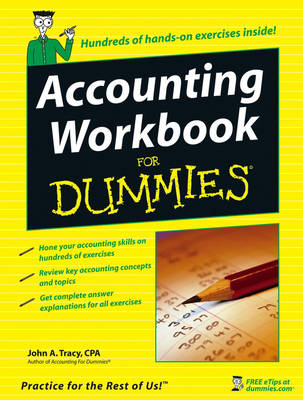
Accounting Workbook For Dummies
For Dummies (Verlag)
978-0-471-79145-4 (ISBN)
- Titel erscheint in neuer Auflage
- Artikel merken
Balance the books, learn important accounting concepts, and master the basics
Accounting Workbook For Dummies is for business bookkeepers and accountants, who need a refresher on the subject, as well as students taking their first accounting class. It’s a comprehensive study guide that can help you improve your accounting skills and lay the foundation for further advancement.
Whether you’re trying to get certified and become an accountant, or own a small business and need a little help balancing your books, this hands-on guide provides the learning and helpful practice you need.
The third edition of Accounting For Dummies contains guidance on incorporating principles to adhere to the Sarbanes-Oxley Act, reading financial reports, generating income statements and balance sheets, and establishing budgets. Accounting Workbook For Dummies provides you with real-world exercises to see these principals in action, although you don’t need to have read Accounting For Dummies.
Accounting Workbook For Dummies focuses on business accounting, explains how business transactions are recorded in the accounts of a business and the financial statements that are prepared for a business to report its profit and loss, financial condition, and cash flows. It also shows you how business managers use accounting information for decision making.
The book’s four parts cover topics like recordkeeping basics, financial statements, accounting for business managers, and investment accounting. You’ll learn to:
Record transactions, track costs, and manage accounts
Open and close bookkeeping cycles
Analyze business performance and profit
Choose the right accounting method
Master investment accounting fundamentals
Understand manufacturing cost accounting
With your own copy of Accounting Workbook For Dummies, you can learn how to do all of that, find out what you need to know about financial statements, get tips for management accounting, and more.
John A. Tracy is a former accountant and professor of accounting. He is also the author of Accounting For Dummies.
Introduction 1
About This Book 1
Foolish Assumptions 2
How This Book Is Organized 2
Part I: Business Accounting Basics 3
Part II: Preparing Financial Statements 3
Part III: Managerial, Manufacturing, and Capital Accounting 3
Part IV: The Part of Tens 3
Icons Used In This Book 3
Where to Go from Here 4
Part I: Business Accounting Basics 5
Chapter 1: Elements of Business Accounting 7
Keeping the Accounting Equation in Balance 7
Distinguishing Between Cash- and Accrual-Basis Accounting 10
Summarizing Profit Activities in the Income (Profit & Loss) Statement 13
Assembling a Balance Sheet 15
Partitioning the Statement of Cash Flows 17
Tracing How Dishonest Accounting Distorts Financial Statements 19
Answers to Problems on Elements of Business Accounting 21
Chapter 2: Financial Effects of Transactions 27
Classifying Business Transactions 27
Seeing Both Sides of Business Transactions 30
Concentrating on Sales 33
Concentrating on Expenses 36
Determining the Composite Effect of Profit 38
Answers to Problems on Financial Effects of Transactions 42
Chapter 3: Getting Started in the Bookkeeping Cycle 47
Constructing the Chart of Accounts 48
Distinguishing Real and Nominal Accounts 50
Knowing Your Debits from Your Credits 53
Making Original Journal Entries 56
Recording Revenue and Income 58
Recording Expenses and Losses 61
Recording Set-Up and Follow-Up Transactions for Revenue and Expenses 64
Recording Investing and Financing Transactions 66
Answers to Problems on the Bookkeeping Cycle 68
Chapter 4: The Bookkeeping Cycle: Adjusting and Closing Entries 75
Getting Accurate with Adjusting Entries 75
Breaking Down the End-of-Year Adjusting Entries 78
Recording depreciation expense 78
Recording amortization expense 81
Recording other adjusting entries 82
Closing the Books on the Year 85
Instituting Internal Controls 88
Answers to Problems on the Bookkeeping Cycle 90
Part II: Preparing Financial Statements 97
Chapter 5: The Effects and Reporting of Profit 99
Understanding the Nature of Profit 99
Choosing the Income Statement Format 102
Deciding on Disclosure in the Income Statement 103
Examining How Sales and Expenses Change Assets and Liabilities 105
Summing Up the Manifold Effects of Profit 109
Answers to Problems on the Effects and Reporting of Profit 113
Chapter 6: Reporting Financial Condition in the Balance Sheet 119
Getting Started on the Balance Sheet 119
Building a Balance Sheet 122
Fleshing Out the Balance Sheet 125
Clarifying the Values of Assets in Balance Sheets 130
Using the Balance Sheet in Business Valuation 133
Answers to Problems on Reporting Financial Condition in the Balance Sheet 135
Chapter 7: Coupling the Income Statement and Balance Sheet 143
Rejoining the Income Statement and Balance Sheet 143
Filling in Key Pieces of the Balance Sheet from the Income Statement 146
Putting Fixed Assets in the Picture 151
Completing the Balance Sheet with Debt and Equity 152
Answers to Problems on Coupling the Income Statement and Balance Sheet 155
Chapter 8: Reporting Cash Flows and Changes in Owners’ Equity 159
Figuring Profit from the Balance Sheet 159
Reporting the Statement of Changes in Stockholders’ Equity 162
Determining Cash Effect from Making Profit 164
Presenting the Statement of Cash Flows 166
Reporting Cash Flows 167
Connecting Balance Sheet Changes with Cash Flows 168
Answers for Problems on Reporting Cash Flows and Changes in Owners’ Equity 172
Chapter 9: Choosing Accounting Methods 177
Getting Off to a Good Start 177
Determining Whether Products Are Unique or Fungible 181
Contrasting Cost of Goods Sold Expense Methods (for Fungible Products) 181
Averaging things out 183
Going with the flow: The FIFO method 185
Going against the flow: The LIFO method 186
Appreciating Depreciation Methods 188
Timing Bad Debts Expense 190
Answers to Problems on Choosing Accounting Methods 194
Part III: Managerial, Manufacturing, and Capital Accounting 201
Chapter 10: Analyzing Profit Behavior 203
Mapping Profit for Managers 203
Analyzing Operating Profit 206
Analysis method #1: Contribution margin minus fixed costs 206
Analysis method #2: Excess over breakeven 207
Analysis method #3: Minimizing fixed costs per unit 207
Analyzing Return on Capital 210
Improving Profit Performance 213
Selling more units 213
Improving margin per unit 215
Making Trade-Offs Among Profit Factors 218
Answers to Problems on Analyzing Profit Behavior 220
Chapter 11: Manufacturing Cost Accounting 229
Minding Manufacturing Costs 229
Product costs 230
Period costs 231
Separating period and product costs 231
Taking a Short Tour of Manufacturing Entries 233
Calculating Product Cost: Basic Methods and Problems 237
Connecting fixed manufacturing overhead costs and production capacity 237
Boosting profit by boosting production 239
Calculating Product Cost in Unusual Situations 242
Answers to Problems on Manufacturing Cost Accounting 248
Chapter 12: Figuring Out Interest and Return on Investment 259
Getting Down the Basics of Interest 259
Keeping it simple with simple interest 260
Distinguishing nominal and effective interest rates 262
Discounting loans 264
Lifting the Veil on Compound Interest 266
Borrowing and Investing in Installments 268
Paying off a loan 268
Investing in a retirement account 270
Measuring Return on Investment (ROI) 272
Example 1: Steady income flow; liquidation value equals entry cost 272
Example 2: Substantial cash flows each year 274
Example 3: Zero cash flow until final year 275
Example 4: Irregular cash flows, both positive and negative 276
Example 5: Market value–driven investments 277
Answers to Problems on Interest and Return on Investment 279
Part IV: The Part of Tens 287
Chapter 13: Ten Things You Should Know About Business Financial Statements 289
Rules and Standards Matter 289
Exactitude Would Be Nice, but Estimates Are Key 290
Financial Statements Fit Together Hand in Glove 290
Accrual Basis Is Used to Record Profit, Assets, and Liabilities 291
Cash Flow Differs from Accrual Basis Profit 291
Profit and Balance Sheet Values Can Be and Often Are Manipulated 292
Financial Statements May Be Revised Later to Correct Errors and Fraud 292
Some Asset Values Are Current, but Others May Be Old 293
Financial Statements Leave Interpretation to Readers 293
Financial Statements Tell the Story of a Business, Not Its Individual Shareowners 294
Chapter 14: A Ten-Point Checklist for Management Accountants 295
Designing Internal Accounting Reports 296
Helping Managers Understand Their Accounting Reports 296
Involving Managers in Choosing Accounting Methods 297
Designing Profit Performance Reports for Managers 297
Designing Cash Flow Reports for Managers 298
Designing Management Control Reports 298
Developing Models for Management Decision-Making Analysis 299
Working Closely With Managers in Planning 299
Establishing and Enforcing Internal Controls 299
Keeping Up- to-Date on Accounting, Financial Reporting, and Tax Changes 300
Index 301
| Erscheint lt. Verlag | 31.10.2006 |
|---|---|
| Sprache | englisch |
| Maße | 206 x 272 mm |
| Gewicht | 567 g |
| Themenwelt | Wirtschaft ► Betriebswirtschaft / Management ► Rechnungswesen / Bilanzen |
| ISBN-10 | 0-471-79145-8 / 0471791458 |
| ISBN-13 | 978-0-471-79145-4 / 9780471791454 |
| Zustand | Neuware |
| Informationen gemäß Produktsicherheitsverordnung (GPSR) | |
| Haben Sie eine Frage zum Produkt? |
aus dem Bereich