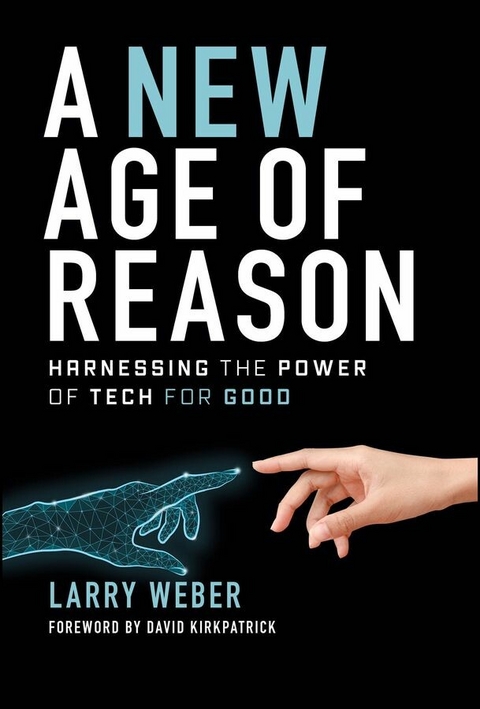
A New Age of Reason (eBook)
365 Seiten
Wiley (Verlag)
978-1-394-21661-1 (ISBN)
Leverage technology to propel humankind toward a better future
A New Age of Reason: Harnessing the Power of Tech for Good provides a roadmap for integrating emerging world-changing technologies, such as AI/robotics, chips/sensors, and quantum computing, to solve some of today's thorniest and most pressing problems like climate change and world hunger.
The author offers inspiring examples of companies using technology to positively impact humanity. The book provides an actionable playbook to transform your organization around this mission, including how to develop a tech for good strategy, how to evolve the C Suite to deliver on this mission, how to market it, as well as measure outcomes. The author also discusses the latest technology breakthroughs delivering positive world outcomes, such as:
- Extending a surgeon's 'eyes and hands' via robotics surgical systems to improve patient outcomes
- Computer vision tech that enables farmers to maximize crops to feed our burgeoning population
- AI/robotics that identify and fight wildfires
Bringing together a collective of major thinkers on this subject and providing guidance for a better future, A New Age of Reason: Harnessing the Power of Tech for Good is a timely read for all executive leaders seeking to harness the new wave of technology to solve key societal problems and have a positive impact on the world.
LARRY WEBER is a successful entrepreneur, thought leader, author, and founder of several global marketing companies. He is founder, chairman, and CEO of Racepoint Global, an integrated marketing services agency headquartered in Boston, and founder of Weber Shandwick, a leading global communications firm.
Leverage technology to propel humankind toward a better future A New Age of Reason: Harnessing the Power of Tech for Good provides a roadmap for integrating emerging world-changing technologies, such as AI/robotics, chips/sensors, and quantum computing, to solve some of today s thorniest and most pressing problems like climate change and world hunger. The author offers inspiring examples of companies using technology to positively impact humanity. The book provides an actionable playbook to transform your organization around this mission, including how to develop a tech for good strategy, how to evolve the C Suite to deliver on this mission, how to market it, as well as measure outcomes. The author also discusses the latest technology breakthroughs delivering positive world outcomes, such as: Extending a surgeon s eyes and hands via robotics surgical systems to improve patient outcomes Computer vision tech that enables farmers to maximize crops to feed our burgeoning population AI/robotics that identify and fight wildfires Bringing together a collective of major thinkers on this subject and providing guidance for a better future, A New Age of Reason: Harnessing the Power of Tech for Good is a timely read for all executive leaders seeking to harness the new wave of technology to solve key societal problems and have a positive impact on the world.
CHAPTER 2
Agtech and Deere: Tech for Good at Its Best
You may be wondering why my lead example on a new wave of technology would focus on one of the oldest occupations on the planet, farming. And you may ask why this is even relevant when farmers represent only 2% of the US population. Well, that 2% shoulders the tremendous responsibility of feeding the other 98% of us. And that 98% is expected to grow from 8 billion to 10 billion people by 2050.1
The world's staggering population growth is only part of the issue. The land itself is another critical problem, as US farmland has been declining over the past several decades, in part due to the land being converted into developments to meet the housing demand. According to the US Department of Agriculture, acres of land in farms have continued the downward trend with 879 million acres in 2023, down from 900 million acres in 2017.2 What's more, farmland is expected to continue to decline, while our population continues to grow.
But farmers face more than just those problems. There are also labor shortages, caused by a number of factors, from less interest in agriculture among younger generations to wages to immigration policies that limit the work pool. Climate change is another major factor, as warming temperatures, floods, and droughts have a direct impact on yield. Farmers face all of these issues and more, making the business of farming … and feeding all of us … extremely challenging and unpredictable.
In his 2023 CES keynote, Deere Chairman and CEO John May articulately summed up both the challenge and solution to today's farming. “In the past farmers would grow more by using more. Bigger machines, more horsepower, more seeds, and more nutrients. This approach alone doesn't work today. There's less arable land, less rural labor, less time to do their jobs due to weather volatility, and rising input costs. Technology is the solution to these challenges. Technology allows farmers to create more with fewer resources.”3
This exemplifies how today's innovations are providing solutions to the increasing challenges of farming and of feeding the world. And, what might surprise you is that although farming is one of the world's oldest industries, farmers are actually among the earliest adopters of today's innovations. The next time you fill your plate consider this: It takes everything from AI, robotics, and computer vision to advanced sensing, cloud computing, data analytics, and more to put that food on your table.
Deere Leading the Agtech Revolution
As mentioned in Chapter 1, Deere has been at the forefront of the agtech revolution and has transformed itself into a technology-powered organization bringing game-changing offerings to farmers. Through this mission, Deere is empowering farmers to do more with less so they can put food on an exponentially growing number of plates across the world, both today and for future generations (see Figure 2.1).
As a company nearly 200 years old, Deere has always had innovation in its DNA, from inventing the first steel plow in 1837, and replacing horses with engines by introducing the first two tractors in 1918, to inventing the first all-hydraulic bulldozer in 1958.5
Figure 2.1 An example of Deere's use of advanced innovations that help farmers do more with less is its See & Spray™ technology. The technology enables farmers to only spray herbicides on the weeds, which reduces the amount needed by up to 66%. The technology can “recognize the difference between plants even in conditions that would challenge the human eye. See & Spray has 36 cameras … [that] scan more than 2,200 square feet of land and capture 1.2 billion pixels per second. If you tried to match that level of sensing and processing with human eyes, it would take nearly 6,000 people.”4
Source: Copyright © 2024 Deere & Company
In more recent years, Deere has embraced digital innovations as they came to market, developing applications that have literally changed the face of agriculture. For example, in the late 1990s, Deere saw the tremendous opportunity GPS technology could bring to farming and began investing in this technology. The company later integrated GPS into its tractors so they could drive themselves through a field within an inch of accuracy, and then used GPS technology to collect geospatial data on both the inputs farmers used throughout the year and the crops they harvested at the end of the year. GPS technology is now used by farmers in more than 100 countries.6
As Deere continued on its mission to transform farming, it used connectivity and the Internet of Things to offer farmers the benefits of cloud computing, giving them access to valuable, real-time information for faster and better decision-making. And in 2022, Deere introduced the first fully autonomous self-driving tractor, which features advanced digital innovations like sensors and computer vision.
Deere is also leveraging AI and computer vision that integrates precision tech and cloud-based data with robotics, as well as computer vision and machine learning. These technologies have enabled Deere to revolutionize the planting process. Advanced sensors and robots place each seed in the ground at a scale and precision beyond human capacity, helping to optimize growth. Deere's computer vision technology enables farmers to quickly and precisely apply fertilizer so that only the weeds are hit with the pesticide, maximizing crops growing in their land. Today, Deere has more than 500,000 technology-powered connected machines running across more than a third of the earth's land surface.7 Smarter farming for better yields.
Moreover, the company is doing all of this with sustainability front and center in its mission. Deere's Leap Ambitions effort involves working to reduce carbon emission and resource consumption, recycle machinery and materials, and develop intelligent technology to help customers be more productive and profitable. The company has set goals to reduce its greenhouse gas emissions (direct and indirect) by 50% by the year 2030.8 Since 2017, the company has reduced operational greenhouse gas emissions by nearly 29%. Deere also surpassed its 2022 renewable electricity goal by achieving nearly 59% renewable electricity.9 These are just a few examples of the many sustainability efforts underway at Deere.
The result of Deere using tech for good has yielded significant quantifiable impacts. For example, the company's intelligent sprayers have helped farmers reduce herbicide use by approximately two-thirds (depending on crop and field conditions). Another example is Deere's current cloud network, which is comprised of hundreds of thousands of connected machines that provide farmers with critical information at their fingertips for better decision-making.10
But this mission has not only been good for farmers and our world. The effort has also had a tremendous impact on Deere's bottom line, with the company's net income growing to more than $10 billion in fiscal year 2023.11 This is proof that a relentless commitment to use technology to solve a massive problem like helping farmers feed our ever-growing population can marry purpose with profit and make a true difference in our world.
From a marketing perspective, Deere has built an irrefutable reputation and produced stories so strong they have universal appeal to all stakeholders. Deere's long and impressive awards list speaks volumes to this. In 2023 and 2024 alone, Deere was ranked #3 in brand reputation in an Axios/Harris Poll (2023), named among Time's World's Best Companies (2023), received CES Best of Innovation in Robotics (2023), named to Ethisphere Institute's Most Ethical Companies List (2024), ranked #1 in Construction & Farm Machinery by Fortune (2024), and ranked #9 in Newsweek's Excellence 1000 Index (2024).12
By transforming farming through today's technology, Deere has also created an entire economy around agtech, paving the way for other innovators to offer solutions. One such company is Indigo. Its Carbon by Indigo produces first-of-its-kind, registry-issued agricultural carbon credits, while supporting farmers in their transition toward more sustainable farming practices. This is one of many great examples of solutions now available that help farmers, the world's population, and the planet.
Deere Q&A
I had the pleasure of speaking with Deere Chairman and CEO John May about the company's impressive transformation from a traditional industrial company to a smart industrial company, leading the agtech revolution and doing so both sustainably and ethically. He shared valuable insights about this journey, including key organizational and behavioral changes, best practices, and lessons learned.
| Q: | What would you tell other CEOs about Deere's re-positioning and its use of technology to deliver on that vision? |
| A: | We've historically been viewed as a traditional industrial company that develops products people use to make a living. I realized around 10 years ago that we could do more. We needed to transition beyond building the highest quality products to also focus on helping our customers do their jobs better, ultimately helping them become more profitable, more productive, and to do their jobs in an... |
| Erscheint lt. Verlag | 31.7.2024 |
|---|---|
| Vorwort | David Kirkpatrick |
| Sprache | englisch |
| Themenwelt | Wirtschaft ► Betriebswirtschaft / Management ► Unternehmensführung / Management |
| Schlagworte | Artificial Intelligence • Business Performance • climate change • Corporate Purpose • Emerging technology • global warming • Healthcare technology • Internet • private sector • Public Relations • Quantum Computing • technology diplomacy • Technology Ethics • Technology Leadership • technology revolution |
| ISBN-10 | 1-394-21661-0 / 1394216610 |
| ISBN-13 | 978-1-394-21661-1 / 9781394216611 |
| Informationen gemäß Produktsicherheitsverordnung (GPSR) | |
| Haben Sie eine Frage zum Produkt? |
 EPUB (Adobe DRM)
Kopierschutz: Adobe-DRM
Adobe-DRM ist ein Kopierschutz, der das eBook vor Mißbrauch schützen soll. Dabei wird das eBook bereits beim Download auf Ihre persönliche Adobe-ID autorisiert. Lesen können Sie das eBook dann nur auf den Geräten, welche ebenfalls auf Ihre Adobe-ID registriert sind.
Details zum Adobe-DRM
Dateiformat: EPUB (Electronic Publication)
EPUB ist ein offener Standard für eBooks und eignet sich besonders zur Darstellung von Belletristik und Sachbüchern. Der Fließtext wird dynamisch an die Display- und Schriftgröße angepasst. Auch für mobile Lesegeräte ist EPUB daher gut geeignet.
Systemvoraussetzungen:
PC/Mac: Mit einem PC oder Mac können Sie dieses eBook lesen. Sie benötigen eine
eReader: Dieses eBook kann mit (fast) allen eBook-Readern gelesen werden. Mit dem amazon-Kindle ist es aber nicht kompatibel.
Smartphone/Tablet: Egal ob Apple oder Android, dieses eBook können Sie lesen. Sie benötigen eine
Geräteliste und zusätzliche Hinweise
Buying eBooks from abroad
For tax law reasons we can sell eBooks just within Germany and Switzerland. Regrettably we cannot fulfill eBook-orders from other countries.
aus dem Bereich