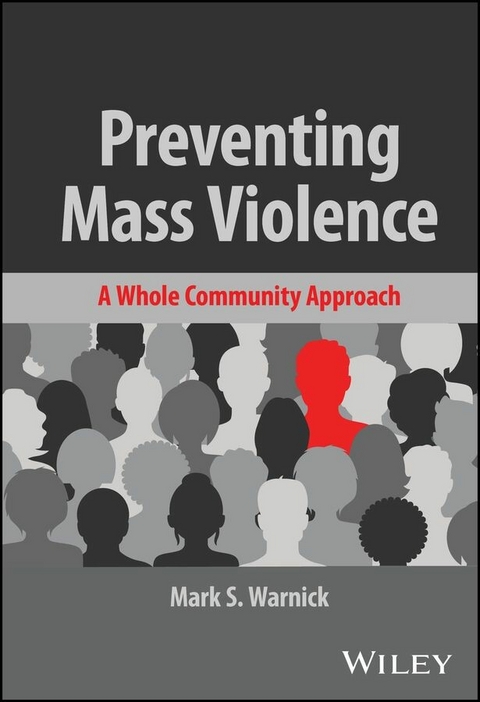
Preventing Mass Violence (eBook)
448 Seiten
Wiley (Verlag)
978-1-119-73743-8 (ISBN)
Build your community's ability to be proactive toward preventing mass violence
In the past decade, communities across America have grappled with an alarming surge in mass violence incidents, leaving citizens and authorities alike seeking effective prevention strategies. In Preventing Mass Violence: A Whole Community Approach, Dr. Mark S. Warnick draws on his extensive experience as a first responder to provide a comprehensive blueprint for thwarting mass shootings, terrorist acts, and other large-scale violence.
Emphasizing a collaborative 'whole community' model, Warnick advocates for robust cooperation among law enforcement, emergency services, businesses, schools, healthcare providers, and the public. Through actionable insights, readers will discover practical methods to cultivate resilience and deter various forms of violence, from mass shootings to vehicular attacks.
With a focus on prevention, the book equips readers with strategies to identify and address concerning behaviors, empowering law enforcement agencies and other stakeholders to navigate operational challenges effectively. Tailored for law enforcement professionals, public safety workers, healthcare personnel, educators, local governments, and organizations with emergency protocols, Preventing Mass Violence is an indispensable resource for safeguarding communities and mitigating the profound human and economic toll of such incidents.
Mark S. Warnick, PhD, is a seasoned first responder (retired) and a lecturer and researcher in Public Safety at Tennessee Tech University. He has over 30 years' experience as a responder to incidents ranging from local car accidents and disasters to large-scale, multi-jurisdictional events, like Hurricane Katrina. He possesses nearly 200 certifications in a variety of fire, EMS, emergency management, and incident management skills.
Build your community's ability to be proactive toward preventing mass violence In the past decade, communities across America have grappled with an alarming surge in mass violence incidents, leaving citizens and authorities alike seeking effective prevention strategies. In Preventing Mass Violence: A Whole Community Approach, Dr. Mark S. Warnick draws on his extensive experience as a first responder to provide a comprehensive blueprint for thwarting mass shootings, terrorist acts, and other large-scale violence. Emphasizing a collaborative "e;whole community"e; model, Warnick advocates for robust cooperation among law enforcement, emergency services, businesses, schools, healthcare providers, and the public. Through actionable insights, readers will discover practical methods to cultivate resilience and deter various forms of violence, from mass shootings to vehicular attacks. With a focus on prevention, the book equips readers with strategies to identify and address concerning behaviors, empowering law enforcement agencies and other stakeholders to navigate operational challenges effectively. Tailored for law enforcement professionals, public safety workers, healthcare personnel, educators, local governments, and organizations with emergency protocols, Preventing Mass Violence is an indispensable resource for safeguarding communities and mitigating the profound human and economic toll of such incidents.
1
Introduction
Over the last 20 years, Americans have seen mass violence occur again and again. It seems that rarely a week goes by before we hear about another mass shooting or random act of mass violence. The number of such incidents appears to have grown during the coronavirus pandemic and beyond. We have heard about a car running over a crowd of people, a teenager shooting classmates at school, and a disgruntled former employee randomly shooting people. There have also been reports of an entire family being slain before the perpetrator turns the weapon on themself and other acts of mass violence. We also have witnessed riots that destroyed businesses and taken over parts of major cities. We have even seen the United States Capitol penetrated by perpetrators. The nightly news reports these stories regularly: if it happens in your geographical location, you are left to deal with the aftermath. Unfortunately, the public, future victims, and the perpetrators of mass violence also watch the news, some of which describe every gory detail, thus burning images into the public's mind.
When the news reports these incidents, they often delve deep into the life of those committing mass violence. Often, uninformed general public or public safety entities allow nefarious individuals to conduct these acts without being caught until after killing, maiming, or destruction. Had the warning signs been recognized and acted upon, for example, understanding what to do and whom to contact, it is conceivable that the whole incident could have been averted. Many years of research have revealed that more proactive communities and increased awareness of warning signs may have entirely prevented a large portion of incidents.
Let us look at the responses to these acts of violence. We see that some individuals in America want to claim that the American gun culture is to blame. Yet, in contrast, others want to blame the lack of mental health care. In most instances, nefarious acts may be considered nothing more than domestic or international terrorism. Sometimes these acts are perpetrated by someone with a mental breakdown or having a massive pity party. In some instances, it is an act of suicide, but they want the world to know their name. Some perpetrators believe that a particular group of people, a certain religion, or a specific race of people are the enemy. These types of incidents are “hate crimes,” and more often, they should be classified as such. Equally, some blame almost anything on hate crimes and do not fit the criteria. Dumping the data from these crimes into other classifications adds to the difficulty of classifying acts of mass violence and researching any underlying factors.
One key factor often overlooked by public safety agencies and the community is the mindset regarding the potential for mass violence within their community. Many have trouble comprehending that an incident of mass violence could happen in just about any jurisdiction, including theirs, at any time. It may be due to having an abundance of faith in the community or feeling that the community is too small to have such an incident. Vital warning signs that there is the potential for an act of mass violence can be missed. Public safety leaders might stick their heads in the sand while the world around them moves on. When these crimes occur, they often look for a scapegoat or someone (or something) to blame it on.
In the world we now live in, it is essential to realize that mass violence can occur anywhere and at any time. It was not that long ago that people believed that an act of mass violence could not happen in a community of 600, let alone a mass shooting. Even so, on November 5, 2017, 26 people were killed while attending church in Sutherland Springs, Texas, with a population of 600. Similarly, many people did not think they had to worry about a vehicle ramming into a crowd and then the driver stabbing multiple people on a college campus. Yet on November 28, 2016, the driver of a car rammed a group of people, jumped out, and then stabbed numerous victims on the campus of Ohio State University. These incidents, and hundreds like them, should force the public and public safety agencies to realize that there are vulnerabilities everywhere. These might include using almost any type of conceivable (and some inconceivable) weapons. Before September 11, 2001, very few people thought a jumbo jet could be used as a weapon of mass destruction.
Many in the public safety field might deal with mass violence incidents only through reactive measures (rather than proactive ones), some prayers, and a little luck. If public safety agencies have a piecemeal approach to preventing mass violence, it is less likely to avoid larger‐scale violence. Public safety agencies overlook one key point: they are not lone wolves because the perpetrators are in a community to. If we strategically use their local businesses and citizens in their community and teach them what to look for (situational awareness), the potential for a mass violence incident would be substantially less.
The text in this book is not here to play Monday morning quarterback. It does not intend to lay the blame at any individual or agency's feet. It provides strategies that can, and will, help to prevent future death and destruction. To do this, we should first reflect on (and understand) past mistakes. When we look at the Columbine School Shooting, we can see that the tactics used during a mass shooting (at that time) were to create a perimeter around the incident and to wait on Special Weapons and Tactics (SWAT). After the death and destruction perpetrated at Columbine High School in Colorado, it was time to understand what went wrong and create new strategies and actions. While police officers were waiting for the SWAT Team, more violence was committed. Instead of waiting while those with nefarious intentions continue killing and injuring innocent victims, law enforcement after Columbine will hastily put together a contact team to engage the shooter, potentially saving more lives. Why did we change strategies? Because we learned from our mistakes of the past!
Public Safety is often slow to change, especially with new and emerging issues. Many do not like change, and some will not even consider change unless forced by some other entity. We only need to look at the attacks that took place on September 11, 2001, and the National Incident Management System (NIMS) requirements to see how resistant and hard many public safety agencies will fight change. There were many instances of outright refusal to accept using the NIMS method of incident management, even leading to the federal government making it a requirement and tying federal funding to being NIMS compliant (Warnick, 2020). There is a saying among the fire service that would hold true in most public safety disciplines; “250 years of tradition, unimpeded by progress” (author unknown). Essentially, this saying tells us that tradition often seems more important than progress to some public safety agencies.
When public safety entities decide to progress on an issue, they will often approach the problem in a piecemeal fashion. For example, they may only focus on mass shootings involving guns rather than looking at the bigger picture of mass violence. By not implementing a holistic approach, they fail to recognize that mass violence incidents can include many weapons. While many of the same preventative and response measures would be similar, they rarely consider the bigger picture. Some agencies put their primary focus on responding to acts of mass violence, but they do not identify prevention strategies, mitigation strategies, or recovery strategies. Again, they take a piecemeal approach rather than a comprehensive strategy and plan that builds resilience in their community.
This book will guide how to begin the implementation process using the holistic tactic of a Whole Community Approach. While the text may not cover everything the local community may face due to each community's uniqueness, it will provide the foundation and a thorough understanding of how to organize to create resiliency against mass violence. One central issue that will be addressed is that leaving mass violence prevention in the hands of one local agency opens the door to missing key warning signs.
Involving the community increases the likelihood of the number of individuals who know what they should be looking for and how to report it. A city with 50 police officers could realize that they now have 10,000 stakeholders trained to spot warning signs and are willing to work with law enforcement collaboratively and cooperatively. Rather than 50 sets of eyes looking for individuals who may be a threat, there could be 10,000 sets of eyes. This increases community safety exponentially.
Actively staying informed and reporting not only those with the potential to commit mass violence but almost every type of threat helps keep the community safe. Law enforcement strategies are useless unless community members play their part in keeping the community safe. If community members do not report crimes, threats, and suspected threats, law enforcement is essentially flying blind. Law enforcement cannot take actions to prevent or even respond to criminals or suspected criminals if they do not receive reports. Face it; law enforcement cannot be everywhere at any time. They need tips and information from the public.
As we navigate this book, there should be no confusion. There are standard definitions that everyone understands, and some definitions are open to interpretation. We must all be on the same page, so to improve the reader's...
| Erscheint lt. Verlag | 27.6.2024 |
|---|---|
| Sprache | englisch |
| Themenwelt | Sozialwissenschaften ► Politik / Verwaltung |
| Wirtschaft ► Betriebswirtschaft / Management | |
| ISBN-10 | 1-119-73743-5 / 1119737435 |
| ISBN-13 | 978-1-119-73743-8 / 9781119737438 |
| Informationen gemäß Produktsicherheitsverordnung (GPSR) | |
| Haben Sie eine Frage zum Produkt? |
 EPUB (Adobe DRM)
Größe: 1,1 MB
Kopierschutz: Adobe-DRM
Adobe-DRM ist ein Kopierschutz, der das eBook vor Mißbrauch schützen soll. Dabei wird das eBook bereits beim Download auf Ihre persönliche Adobe-ID autorisiert. Lesen können Sie das eBook dann nur auf den Geräten, welche ebenfalls auf Ihre Adobe-ID registriert sind.
Details zum Adobe-DRM
Dateiformat: EPUB (Electronic Publication)
EPUB ist ein offener Standard für eBooks und eignet sich besonders zur Darstellung von Belletristik und Sachbüchern. Der Fließtext wird dynamisch an die Display- und Schriftgröße angepasst. Auch für mobile Lesegeräte ist EPUB daher gut geeignet.
Systemvoraussetzungen:
PC/Mac: Mit einem PC oder Mac können Sie dieses eBook lesen. Sie benötigen eine
eReader: Dieses eBook kann mit (fast) allen eBook-Readern gelesen werden. Mit dem amazon-Kindle ist es aber nicht kompatibel.
Smartphone/Tablet: Egal ob Apple oder Android, dieses eBook können Sie lesen. Sie benötigen eine
Geräteliste und zusätzliche Hinweise
Buying eBooks from abroad
For tax law reasons we can sell eBooks just within Germany and Switzerland. Regrettably we cannot fulfill eBook-orders from other countries.
aus dem Bereich