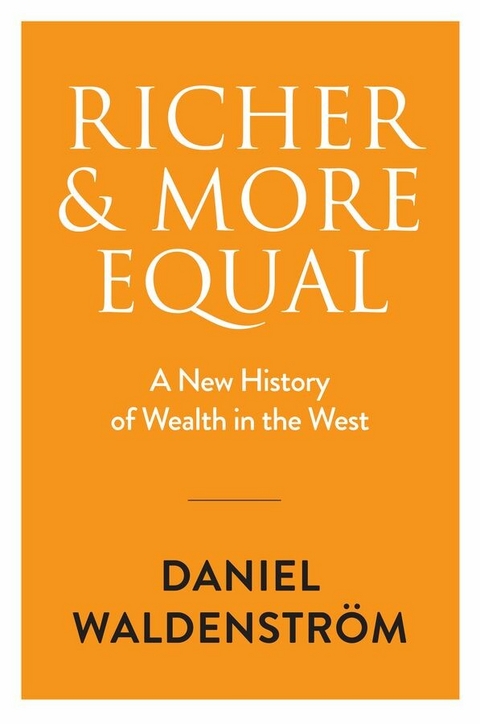
Richer and More Equal (eBook)
338 Seiten
John Wiley & Sons (Verlag)
978-1-5095-5780-6 (ISBN)
Using cutting-edge research and new, sometimes surprising, data, Waldenström shows that what stands out since the late 1800s is a massive rise in the size of the middle class and its share of society's total wealth. Unfettered capitalism, it seems, doesn't have to lead to boundless inequality. The key to progress was political and institutional change that enabled citizens to become educated, better paid, and to amass wealth through housing and pension savings. Waldenström asks how we can consolidate these gains while encouraging the creation of new capital. The answer, he argues, is to pursue tax and social policies that raise the wealth of people in the bottom and middle rather than cutting wealth of entrepreneurs at the top.
Richer and More Equal is a benchmark account of one of the most profound and encouraging social changes in human history and a blueprint for continued progress.
Daniel Waldenström is a professor at the Research Institute of Industrial Economics.
Once there were princes and peasants and very few between. The extremes of wealth and poverty are still with us, but that shouldn't blind us to the fact our societies have been utterly transformed for the better over the past century. As Daniel Waldenstr m makes clear in this authoritative account of wealth accumulation and inequality in the modern west, we are today both significantly richer and more equal. Using cutting-edge research and new, sometimes surprising, data, Waldenstr m shows that what stands out since the late 1800s is a massive rise in the size of the middle class and its share of society s total wealth. Unfettered capitalism, it seems, doesn t have to lead to boundless inequality. The key to progress was political and institutional change that enabled citizens to become educated, better paid, and to amass wealth through housing and pension savings. Waldenstr m asks how we can consolidate these gains while encouraging the creation of new capital. The answer, he argues, is to pursue tax and social policies that raise the wealth of people in the bottom and middle rather than cutting wealth of entrepreneurs at the top. Richer and More Equal is a benchmark account of one of the most profound and encouraging social changes in human history and a blueprint for continued progress.
1
Uncovering a Positive Story
Over many decades, the distribution of wealth has been a topic of fascination and contention. It has stirred emotions and sparked debates among scholars, policymakers, and the public alike. The answers to questions such as how wealth is accumulated, distributed, and inherited are important for understanding economic growth, social mobility, and the overall wellbeing of a society. And, as for any other complex subject, our understanding of wealth distribution is evolving whenever new evidence and interpretations come to light.
Calls to reduce the ever-present disparities between rich and poor may be as old as the disparities themselves, and in recent years they have grown louder. The ambition to reduce inequality, however, should not distract us from a positive aspect to the narrative, which is largely untold. Over the past century, people in Western countries have become both richer and more equal. This unseen wealth revolution has profoundly transformed the lives of millions. To understand the origins and implications of this large-scale change is vital in our quest for a more equitable and prosperous future.
The numbers are striking: today, we are more than three times richer in purchasing power than we were in 1980, and we are nearly a staggering tenfold richer than a century ago. Such growth in wealth is extraordinary by historical standards, and it begs the question: what has driven this remarkable change, and why has wealth become increasingly equally distributed? The answer, as we shall see, lies in the broadening of wealth ownership among ordinary people primarily through homeownership and pension savings.
Old Narrative Challenged by New Data
Wealth is defined as the total value of all assets in housing, land ownership, and financial holdings less the value of debts. For much of human history, wealth has been concentrated in the hands of a few, leaving the vast majority with limited resources and opportunities. The past century, however, has witnessed a dramatic shift, with wealth becoming increasingly accessible to the bottom and middle strata of society. This phenomenon has had a profound impact on wealth inequality, helping to narrow the gap between the richest and the rest.
In this volume, I offer an in-depth exploration of the historical trajectory of wealth in the Western world. Drawing upon the latest discoveries of long-term patterns and determinants of aggregate wealth accumulation as well as wealth inequality, I examine detailed and comparable data for all relevant countries. Some of the data series were produced by me and my research associates, but other researchers have produced many of the series used here. However, this book does not just present a compilation of already known evidence; it also introduces new estimates of aggregate wealth–income ratios and wealth inequality.
The analysis reassesses a previously established narrative on the history of wealth, perhaps most notably associated with the works of the French economist Thomas Piketty, and offers a comprehensive historical and political account to shed light on the dynamics of equality within the capitalist economy. In the following sections, I elaborate on the intricacies of Piketty’s work and explain how my own narrative builds upon but also revises the overarching history of wealth distribution. It should be noted that measuring household wealth and its distribution is difficult, as I will explain in more detail below. Estimating historical trends in wealth inequality puts extraordinary requirements on data quality. However, the newer evidence produced in recent years benefits from a closer examination of the sources and analytical choices, and this gives it a clear advantage over earlier works.
Homes and Pensions, Not Wars
Contrary to the old scholarly narrative, this book will demonstrate that the primary drivers of wealth equalization have not been the destruction wrought by wars or the redistributive effects of capital taxation. While these factors have undoubtedly played a role, they are based on presumptions that building wealth is a zero-sum game, and they therefore fail to account for the broader and more fundamental forces at work. Instead, I will show that the expansion of wealth ownership among ordinary citizens, materialized through widespread homeownership and pension savings, has been the real engine of change.
At the turn of the twentieth century, owning a decent home and saving for retirement were luxuries enjoyed by only a select few – maybe a couple of tens of millions in Western countries. Fast forward to today, and these once elusive dreams have become a reality for several hundreds of millions of people. This massive increase in both homeownership and retirement savings, made possible by expanding educational attainment, elevated labor incomes, and financial development, has effectively democratized wealth. It has lifted the fortunes of the bottom and middle segments of society and contributed significantly to the reduction of wealth inequality. In addition, owning one’s home has historically offered high long-term investment returns at low risk and is generally associated with a lower depreciation of housing capital compared to rented homes.
Bidding Farewell to the Zero-Sum Game
Yet this critical aspect of our recent history, with ordinary people building personal wealth at an unprecedented pace, has been largely overshadowed by the prevailing focus among some academics and policymakers on the fortunes of the super-rich and on the role of wars and capital taxation in addressing wealth inequality. This book seeks to redress this imbalance, shedding light on the transformative power of wealth creation, challenging the conventional wisdom that views wealth equalization as a zero-sum game.
Wealth accumulation is a positive, welfare-enhancing force in free market economies. It is closely linked to the growth of successful businesses, which leads to new jobs, higher incomes, and more tax revenue for the public sector. Throughout the following chapters, I will explore the historical, social, and economic factors that have contributed to the rise of wealth accumulation in the middle class, homeownership and pension savings, as key drivers of wealth equalization. I will explore how governments, businesses, and individuals have collaborated to create the conditions for this unprecedented democratization of wealth. And I will examine the far-reaching consequences of this transformation, including the implications for social mobility, economic growth, and the prospects for future generations.
As we embark on this journey, it is important to recognize that the story of wealth equalization is not one of unmitigated success. There are still significant disparities in wealth within and among nations, generating instability and injustice. Over the past years, wealth concentration has increased in some countries, most notably in the US. However, by acknowledging the progress that has been made and understanding the mechanisms that have driven it, we can lay the foundation for further advancements in our quest for a more just and prosperous world.
1.1 THE PREVIOUS NARRATIVE ARGUING THAT WARS AND PROGRESSIVE TAXES SHAPED A CENTURY OF WEALTH INEQUALITY
In his bestselling book Capital in the Twenty-First Century (2014), Thomas Piketty described the historical development of capital and wealth inequality in the Western world. His work built on the research by a large international collective of scholars, including several studies by me and my coauthors. The book quickly gained attention from both academics and policymakers. Piketty’s unique approach in combining historical data with a simple yet thought-provoking analysis that also has an ideological bent has been appealing to many.
In this book, I will refer to Piketty’s narrative as “the previous narrative,” although it has not been told for more than a couple of decades.1 However, the aging process of narratives can be quick, as new insights and revisions continue to emerge from the ever-growing body of research on the history of wealth.2
The narrative that is primarily associated with Piketty describes wealth accumulation and concentration over the past century as following a U-shaped pattern. Wealth levels and concentration peaked in the late nineteenth century and up to World War I. This was the result of an unchecked capitalism that had little regulation, taxation, or democratic influence. Europe’s aggregate wealth–income ratios at that time were estimated to be extraordinarily high, with capital values of around 600 to 800 percent of national income. These levels then dropped significantly during the 1920s, and even more after World War II. Wealth–income ratios began to rise again in the 1980s, marking the completion of the U-shaped pattern and leading Piketty to declare: “Capital is back!”
Wealth inequality according to this narrative is also described as following a U-shaped pattern. High levels of inequality in the past dropped sharply during the twentieth century, driven primarily by the shocks to capital during the two world wars and the rise of progressive taxation. Wealth was slashed, particularly among the rich, by wartime capital destruction and through regulations, and postwar redistributive taxation prevented the emergence of new fortunes and thus the rise of wealth concentration. After 1980, this narrative claims, neoliberal policies deregulated markets and lowered taxes. That led to a boosting of capital values, mainly benefiting a small...
| Erscheint lt. Verlag | 7.6.2024 |
|---|---|
| Sprache | englisch |
| Themenwelt | Wirtschaft ► Volkswirtschaftslehre |
| Schlagworte | A New History of Wealth in the West • Branko Milanovic • Daniel Waldenstrom • Daniel Waldenström • Economic History • Economic issues • Economics • Economics Special Topics • Economic Theory • Equality • income • Inequality • milanovic • Piketty • Political Economy • Politics • richer and more equal • Spezialthemen Volkswirtschaftslehre • Thomas Piketty • Volkswirtschaftslehre • Waldenstrom • Waldenström • Wealth • wealth and income • Wealth and poverty • Wealth Inequality • wealth in the west • Wirtschaftsgeschichte • Wirtschaftstheorie • Wohlstand |
| ISBN-10 | 1-5095-5780-6 / 1509557806 |
| ISBN-13 | 978-1-5095-5780-6 / 9781509557806 |
| Informationen gemäß Produktsicherheitsverordnung (GPSR) | |
| Haben Sie eine Frage zum Produkt? |
 EPUB (Adobe DRM)
Kopierschutz: Adobe-DRM
Adobe-DRM ist ein Kopierschutz, der das eBook vor Mißbrauch schützen soll. Dabei wird das eBook bereits beim Download auf Ihre persönliche Adobe-ID autorisiert. Lesen können Sie das eBook dann nur auf den Geräten, welche ebenfalls auf Ihre Adobe-ID registriert sind.
Details zum Adobe-DRM
Dateiformat: EPUB (Electronic Publication)
EPUB ist ein offener Standard für eBooks und eignet sich besonders zur Darstellung von Belletristik und Sachbüchern. Der Fließtext wird dynamisch an die Display- und Schriftgröße angepasst. Auch für mobile Lesegeräte ist EPUB daher gut geeignet.
Systemvoraussetzungen:
PC/Mac: Mit einem PC oder Mac können Sie dieses eBook lesen. Sie benötigen eine
eReader: Dieses eBook kann mit (fast) allen eBook-Readern gelesen werden. Mit dem amazon-Kindle ist es aber nicht kompatibel.
Smartphone/Tablet: Egal ob Apple oder Android, dieses eBook können Sie lesen. Sie benötigen eine
Geräteliste und zusätzliche Hinweise
Buying eBooks from abroad
For tax law reasons we can sell eBooks just within Germany and Switzerland. Regrettably we cannot fulfill eBook-orders from other countries.
aus dem Bereich