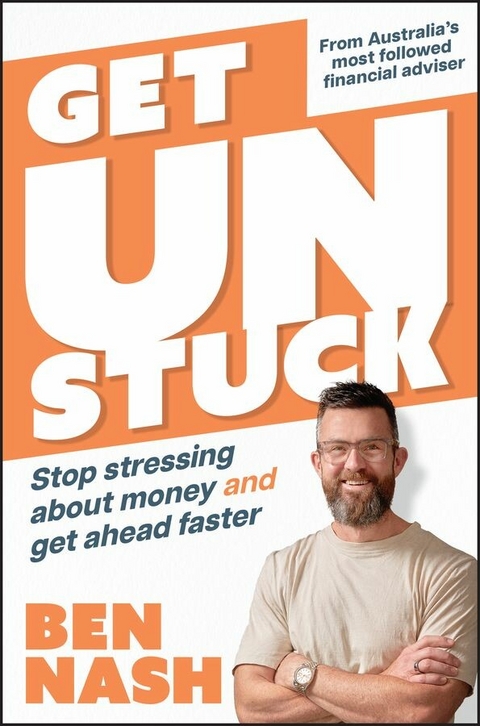
Get Unstuck (eBook)
301 Seiten
John Wiley & Sons (Verlag)
978-1-394-26946-4 (ISBN)
Get your finances sorted and create a life not limited by money
Does managing your money leave you feeling stressed, overwhelmed, or anxious? Are you looking for tactics and strategies to get on top of your money and get ahead faster? In Get Unstuck, bestselling author Ben Nash covers the three key frameworks you can use to create a winning money mindset, make saving and investing easy, and get the results you want. Discover how your thoughts and emotions influence your money behaviours and spending, and learn how you can hack your thinking to set yourself up for financial success.
The truth is that success with money is simple. You need to spend less than you earn - and start investing intelligently. We all know that isn't as easy as it sounds. But having the right systems in place will make your progress easier. In this book, you'll learn the money behaviours you need for true financial security. You'll develop the thinking you need to make your money actually work for you - and build the systems that will help you plan, save, and invest. All while you live well today.
With Get Unstuck, you'll learn how to:
- Overcome information overload, procrastination, and analysis paralysis
- Set up your banking so it's easier to save more WHILE you spend guilt-free
- Get started investing - and avoid mistakes and setbacks
- Create a clear and easy-to-follow plan for the financial future you want
You don't need to know everything about money right now. You just need to know enough to take your next step. Get Unstuck will help you take that step with confidence.
BEN NASH is Australia's most followed financial adviser and the founder of Pivot Wealth, Australia's most awarded financial advice company. Ben is the host of the Mo Money podcast, the bestselling author of Replace Your Salary by Investing and the lead financial educator for leading Australian corporates such as the National Rugby League (NRL). Over the last fifteen years, Ben has helped his clients create over a billion dollars in wealth with his practical and easy-to-follow advice.
Get your finances sorted and create a life not limited by money Does managing your money leave you feeling stressed, overwhelmed, or anxious? Are you looking for tactics and strategies to get on top of your money and get ahead faster? In Get Unstuck, bestselling author Ben Nash covers the three key frameworks you can use to create a winning money mindset, make saving and investing easy, and get the results you want. Discover how your thoughts and emotions influence your money behaviours and spending, and learn how you can hack your thinking to set yourself up for financial success. The truth is that success with money is simple. You need to spend less than you earn and start investing intelligently. We all know that isn t as easy as it sounds. But having the right systems in place will make your progress easier. In this book, you ll learn the money behaviours you need for true financial security. You ll develop the thinking you need to make your money actually work for you and build the systems that will help you plan, save, and invest. All while you live well today. With Get Unstuck, you ll learn how to: Overcome information overload, procrastination, and analysis paralysis Set up your banking so it s easier to save more WHILE you spend guilt-free Get started investing and avoid mistakes and setbacks Create a clear and easy-to-follow plan for the financial future you want You don t need to know everything about money right now. You just need to know enough to take your next step. Get Unstuck will help you take that step with confidence.
Introduction
My interest in money started by chance the day my nan gave me a book. The book was Rich Dad, Poor Dad by Robert Kiyosaki, and I was drawn to the simplicity with which Kiyosaki explained financial concepts I’d previously found confusing.
This book sparked an interest, and I’m a bit of a reader — so I started buying up all the personal finance books I could get my hands on. Shortly afterwards, I decided to go back to uni and study finance. That led to a graduate role in a traditional ‘blue chip’ money management company that helped rich people get richer.
I enjoyed the work: every day was different. I got to work with some interesting high-profile peeps, and everything went along swimmingly. Then, a few years later, I left that company to join a small business in the Sydney CBD that focused on working with first home buyers.
When I started in the industry, I’d enjoyed helping people use the rules to keep more of their money. But there’s something slightly more rewarding about helping people buy their first home and set up their family’s (or potential family’s) future than there is about helping some super-rich dude save $200k in tax so he can buy a bigger boat.
I joined this small business to build their financial advice arm, so I went to work creating a service that would be valuable to people in their 20s and 30s. I asked our clients about the problems they were facing; and, while everyone’s situation was unique, I definitely saw some common themes in their problems, including:
- Being overwhelmed by too many options and too much information
- Not being able to effectively balance financial success and enjoy an epic lifestyle at the same time
- Being time-poor and not wanting to waste their precious spare time doing something they weren’t good at and didn’t enjoy
They didn’t know what information was important or what to do with the information they had. They were scared of doing the wrong thing, so they did … NOTHING!
It’s so easy to fall into what I call ‘the inaction trap’ with money. Most financial benefits only come from taking ACTION. So if you fall into this trap, you end up missing the opportunity to get your income, savings and investments all working harder for you and moving you closer to the lifestyle you want.
Once I recognised this, I created a financial planning and advice service to help people solve these problems. I’d look at their income and spending, plus what was left over and their existing assets, and help them to create a strategy for putting their money to work. The output was a plan that showed them the path from where they were that day to the money (and non-money) results they wanted.
And when I first started doing this, I looked at the numbers and got really excited.
I could see that my plan gave my clients the potential to very quickly grow their savings, investments and assets. I was stoked. They were going to grow some epic cash over time, which meant they could live a great lifestyle.
Then, when I showed my clients the plan, I could see their excitement build as they imagined all the things they could do with this cash. I asked them about the difference this money would make to them, and they started telling me about all the things they wanted to do. The epic trips overseas. The ability to look after their parents. The flexibility around their work. And the list went on.
I told them how much they’d need to save to make the plans happen, and what to do with their savings to get the results in their plan. Then I normally suggested we book in another check-in with them in six months’ time.
In the month before the first check-in was scheduled, I found myself imagining the meetings in my mind. I pictured big congratulations, high fives, maybe even a bear hug or two. I figured my clients would be so happy with their progress — from saving almost nothing to crushing it — that they might even consider naming their firstborn after me.
That wasn’t what happened.
I still remember the first meeting. As the clients came into the office and I greeted them, there were no high fives. The clients were fairly quiet, though, so I just chalked it up to personality.
When we sat down, I was all smiles. They, however, weren’t. In fact, they looked nervous and a little upset. Definitely no bear hugs or offers to name their children after me. And when I asked the clients how they were going, they said, ‘Not well.’
Concerned, I asked more questions; and they went on to tell me about the long list of things that had ‘come up’ and stopped them getting the results they needed. It felt like a confessional. I could tell my clients were frustrated.
Then, when I looked at the numbers, I could see my clients weren’t on track. They weren’t even close. They’d increased their savings a tiny bit, but also increased spending on credit. Overall, they’d gone BACKWARDS. I was shocked.
We talked about the impact of this setback, and I showed them the disastrous effect that continuing on this path would have on their original plan. They weren’t happy, but they told me that these issues were one-off exceptions, and wouldn’t be an ongoing thing.
So we reset their strategy and targets, and confirmed what they’d need to do over the next six months to get back on track. By the end of the meeting, my clients were feeling much better, and they left once again pumped up to go out and get their planned results.
This was only my first review meeting, so I figured it was a one-off. But, over more and more meetings, I discovered that the majority of my clients also weren’t on track. They all had similar stories about what had come up to stop them sticking to the plan we’d set. Their reasons were different: little Jimmy needed special shoes, they had an ‘emergency’ getaway to reduce stress levels, or they NEEDED a new wood-fire pizza oven for their house. But very few of my clients had hit the targets they’d set for themselves.
In fact, only one person had managed it: an actuary who was already pretty good with money and just needed help to get to the next level. This client was all over it. Most, however, weren’t.
I got quite concerned at this point: both for my clients, and for the advice I was giving. I had no interest in helping people build awesome plans that never actually came together. So I started trying to figure out why this had happened, and what I could do to fix it.
I came up with a few questions and started asking my clients for feedback. Pretty much all of them told me that they knew what to do, but actually doing it was hard work. They were spending a bunch of time trying to manage their money, but it was going everywhere. They were constantly ‘juggling’ money from one place to another, and pushing to get the results they’d planned for.
Because there was so much work, they lost motivation over time and just gave up. I asked what would make getting results easier, and the feedback was almost unanimous. People needed a structured process to make it easy to save and invest their money the way they’d planned.
Now we were getting somewhere.
I’m a process nut. I think that with enough thought and attention, most things in life can be broken down into a clear, easy-to-follow process. Creating these sorts of processes is one of my strengths, so I went to work creating a spending, saving and banking system to make money management easy.
It took a lot of effort to get there: almost five years of tweaking and refining the process. But the results speak for themselves. The recent statistics I’ve pulled on my clients’ savings show that people who follow this process save — on average — over 35 per cent of their income. That’s more than seven times the Australian national savings average of 4.7 per cent.
And the impact? As you’ll learn through this book, the power of time and money is a beautiful thing. If the average 30-year-old saved this much extra income and invested it, they’d have an additional $3.4m by age 60.
I believe that every single person should be able to live ‘a life not limited by money’. But if you’re like most young people today, this isn’t easy. You want it all without sacrificing anything. You want a life that fulfils you and makes you happy. And you can have one.
How? Having that life means realising that money doesn’t solve problems, but it does create options. Those options empower you with choices to do the things you want and live the life you want. Because, unless your dream life is living off the land in a forest or jungle somewhere, you need money to make it possible.
Again, it’s not easy. Writing this book took me down a rabbit hole of complexities, options and choices around saving, investing, property, insurance and money in general. It was overwhelming.
There are tens of thousands of investment options just in Australia, and hundreds of thousands across global markets. And that’s just investments. There are even more options for banking, retirement, property, and other investments and financial products. And then you have the strategy options. Pay down debt, contribute to super, buy shares, don’t buy shares, invest...
| Erscheint lt. Verlag | 29.5.2024 |
|---|---|
| Sprache | englisch |
| Themenwelt | Sachbuch/Ratgeber ► Beruf / Finanzen / Recht / Wirtschaft ► Geld / Bank / Börse |
| Recht / Steuern ► Wirtschaftsrecht | |
| Wirtschaft ► Betriebswirtschaft / Management | |
| Schlagworte | Australian personal finance • automate banking • automate wealth • bentalksmoney • Budgeting • Finance & Investments • Finanz- u. Anlagewesen • Geldanlage • get out of debt • how to invest • Investieren • investing guide • Investition • manage money • Money Management • personal finance • personal finance book • personal finance for Australians • pivotben • pivot wealth • Private Finanzplanung • property investing • psychology of money • replace your salary by investing • save money • Self-Help • share investing |
| ISBN-10 | 1-394-26946-3 / 1394269463 |
| ISBN-13 | 978-1-394-26946-4 / 9781394269464 |
| Informationen gemäß Produktsicherheitsverordnung (GPSR) | |
| Haben Sie eine Frage zum Produkt? |
 EPUB (Adobe DRM)
Kopierschutz: Adobe-DRM
Adobe-DRM ist ein Kopierschutz, der das eBook vor Mißbrauch schützen soll. Dabei wird das eBook bereits beim Download auf Ihre persönliche Adobe-ID autorisiert. Lesen können Sie das eBook dann nur auf den Geräten, welche ebenfalls auf Ihre Adobe-ID registriert sind.
Details zum Adobe-DRM
Dateiformat: EPUB (Electronic Publication)
EPUB ist ein offener Standard für eBooks und eignet sich besonders zur Darstellung von Belletristik und Sachbüchern. Der Fließtext wird dynamisch an die Display- und Schriftgröße angepasst. Auch für mobile Lesegeräte ist EPUB daher gut geeignet.
Systemvoraussetzungen:
PC/Mac: Mit einem PC oder Mac können Sie dieses eBook lesen. Sie benötigen eine
eReader: Dieses eBook kann mit (fast) allen eBook-Readern gelesen werden. Mit dem amazon-Kindle ist es aber nicht kompatibel.
Smartphone/Tablet: Egal ob Apple oder Android, dieses eBook können Sie lesen. Sie benötigen eine
Geräteliste und zusätzliche Hinweise
Buying eBooks from abroad
For tax law reasons we can sell eBooks just within Germany and Switzerland. Regrettably we cannot fulfill eBook-orders from other countries.
aus dem Bereich