


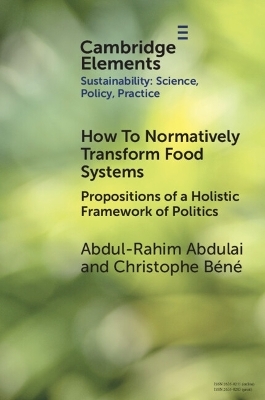
How To Normatively Transform Food Systems
Propositions of a Holistic Framework of Politics
Seiten
2025
Cambridge University Press (Verlag)
978-1-009-50961-9 (ISBN)
Cambridge University Press (Verlag)
978-1-009-50961-9 (ISBN)
Draws from an extensive literature review on food politics to propose a Framework of Holistic Politics for Food System Transformation. The Framework underscores the need for normative and goal-oriented processes, the multi-dimensionality of politics, and the normative driving environment in governance food systems transformation.
Draws from an extensive literature review on food politics to propose a Framework of Holistic Politics for Food System Transformation. The Framework posits that food systems transformation would be a process/outcome of interrelated political configurations of actions across four processes or stages: 1) Identifying resistance to change in the current regime, 2) Creating and sustaining new momentum, 3) Converting new momentum into sustainable options; -and cross-cutting, 4) Managing trade-offs, reducing incoherence, and prioritization. At each stage, four domains of politics must be considered, including 1) Power, the political economy of actors, knowledge, and evidence; 2) Cultural dynamics, norms, and behavior; 3) Capacity and financial resources; and 4) Technological innovations). To deliver normative transformation, these actions must be carried out in four distinct processes. The Framework underscores the need for normative and goal-oriented processes, the multi-dimensionality of politics, and the normative driving environment in governance food systems transformation.
Draws from an extensive literature review on food politics to propose a Framework of Holistic Politics for Food System Transformation. The Framework posits that food systems transformation would be a process/outcome of interrelated political configurations of actions across four processes or stages: 1) Identifying resistance to change in the current regime, 2) Creating and sustaining new momentum, 3) Converting new momentum into sustainable options; -and cross-cutting, 4) Managing trade-offs, reducing incoherence, and prioritization. At each stage, four domains of politics must be considered, including 1) Power, the political economy of actors, knowledge, and evidence; 2) Cultural dynamics, norms, and behavior; 3) Capacity and financial resources; and 4) Technological innovations). To deliver normative transformation, these actions must be carried out in four distinct processes. The Framework underscores the need for normative and goal-oriented processes, the multi-dimensionality of politics, and the normative driving environment in governance food systems transformation.
1. Introduction; 2. The foundational frameworks; 3. A holistic framework of politics for food systems transformation; 4. The political (in)actions within domains and processes of food systems transformation; 5. Delivering normative food systems transformation-what the framework teaches us; 6. Concluding reflections; List of Abbreviations; References.
| Erscheinungsdatum | 01.06.2024 |
|---|---|
| Reihe/Serie | Elements of Sustainability: Science, Policy, Practice |
| Zusatzinfo | Worked examples or Exercises |
| Verlagsort | Cambridge |
| Sprache | englisch |
| Themenwelt | Naturwissenschaften ► Biologie ► Ökologie / Naturschutz |
| Wirtschaft ► Volkswirtschaftslehre | |
| ISBN-10 | 1-009-50961-6 / 1009509616 |
| ISBN-13 | 978-1-009-50961-9 / 9781009509619 |
| Zustand | Neuware |
| Informationen gemäß Produktsicherheitsverordnung (GPSR) | |
| Haben Sie eine Frage zum Produkt? |
Mehr entdecken
aus dem Bereich


aus dem Bereich
Methoden – Lösungen – Anwendungen
Buch | Hardcover (2025)
Hanser (Verlag)
CHF 69,95


