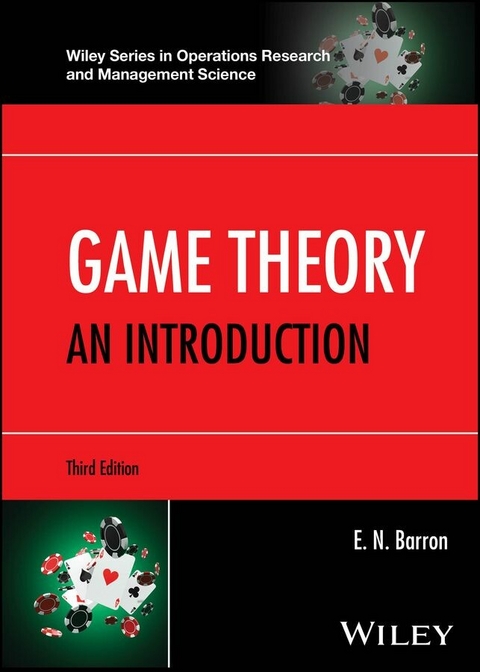
Game Theory (eBook)
1159 Seiten
Wiley (Verlag)
978-1-394-16912-2 (ISBN)
Authoritative and quantitative approach to modern game theory with applications from areas including economics, political science, computer science, and engineering
Game Theory acknowledges the role of mathematics in making logical and advantageous decisions in adversarial situations and provides a balanced treatment of the subject that is both conceptual and applied. This newly updated and revised Third Edition streamlines the text to introduce readers to the basic theories behind games in a less technical but still mathematically rigorous way, with many new real-world examples from various fields of study, including economics, political science, military science, finance, biological science, and general game playing.
The text introduces topics like repeated games, Bayesian equilibria, signaling games, bargaining games, evolutionary stable strategies, extensive games, and network and congestion games, which will be of interest across a wide range of disciplines. Separate sections in each chapter illustrate the use of Mathematica and Gambit software to create, analyze, and implement effective decision-making models.
A companion website contains the related Mathematica and Gambit data sets and code. Solutions, hints, and methods used to solve most problems to enable self-learning are in an Appendix.
Game Theory includes detailed information on:
- The von Neumann Minimax Theorem and methods for solving any 2-person zero sum matrix game.
- Two-person nonzero sum games solved for a Nash Equilibrium using nonlinear programming software or a calculus method. Nash Equilibria and Correlated Equilibria. Repeated games and punishment strategies to enforce cooperation
- Games in Extensive Form for solving Bayesian and perfect information games using Gambit.
- N-Person nonzero sum games, games with a continuum of strategies and many models in economics applications, duels, auctions, of Nash Equilibria, and the Stable Matching problem
- Coalitions and characteristic functions of cooperative games, an exact nucleolus for three-player games, bargaining
- Game theory in evolutionary processes and population games
A trusted and proven guide for students of mathematics, engineering, and economics, the Third Edition of Game Theory is also an excellent resource for researchers and practitioners in economics, finance, engineering, operations research, statistics, and computer science.
E. N. Barron, PhD, is Professor of Mathematics and Statistics in the Department of Mathematics and Statistics at Loyola University Chicago.
Authoritative and quantitative approach to modern game theory with applications from areas including economics, political science, computer science, and engineering Game Theory acknowledges the role of mathematics in making logical and advantageous decisions in adversarial situations and provides a balanced treatment of the subject that is both conceptual and applied. This newly updated and revised Third Edition streamlines the text to introduce readers to the basic theories behind games in a less technical but still mathematically rigorous way, with many new real-world examples from various fields of study, including economics, political science, military science, finance, biological science, and general game playing. The text introduces topics like repeated games, Bayesian equilibria, signaling games, bargaining games, evolutionary stable strategies, extensive games, and network and congestion games, which will be of interest across a wide range of disciplines. Separate sections in each chapter illustrate the use of Mathematica and Gambit software to create, analyze, and implement effective decision-making models. A companion website contains the related Mathematica and Gambit data sets and code. Solutions, hints, and methods used to solve most problems to enable self-learning are in an Appendix. Game Theory includes detailed information on: The von Neumann Minimax Theorem and methods for solving any 2-person zero sum matrix game. Two-person nonzero sum games solved for a Nash Equilibrium using nonlinear programming software or a calculus method. Nash Equilibria and Correlated Equilibria. Repeated games and punishment strategies to enforce cooperation Games in Extensive Form for solving Bayesian and perfect information games using Gambit. N-Person nonzero sum games, games with a continuum of strategies and many models in economics applications, duels, auctions, of Nash Equilibria, and the Stable Matching problem Coalitions and characteristic functions of cooperative games, an exact nucleolus for three-player games, bargaining Game theory in evolutionary processes and population games A trusted and proven guide for students of mathematics, engineering, and economics, the Third Edition of Game Theory is also an excellent resource for researchers and practitioners in economics, finance, engineering, operations research, statistics, and computer science.
Introduction
Mostly for the Instructor
My goal is to present the basic concepts of noncooperative and cooperative game theory and introduce students to a very important application of mathematics. In addition, this course introduces students to an understandable theory created by geniuses in many different fields that even today has a low cost of entry.
My experience is that the students who enroll in game theory are primarily mathematics students interested in applications, with about one‐third to one‐half of the class majoring in economics or other disciplines (such as biology or biochemistry or physics). The modern economics and operations research curriculum requires more and more mathematics, and game theory is typically a required course in those fields. For economics students with a more mathematical background, this course is set at an ideal level. For mathematics students interested in a graduate degree in something other than mathematics, this course exposes them to another discipline in which they might be interested and that will enable them to further their studies, or simply to learn some fun mathematics. Many students get the impression that applied mathematics is physics or engineering, and this class shows that there are other areas of applications that are very interesting and that open up many other alternatives to a pure math or classical applied mathematics concentration.
Game theory can be divided into two broad classifications: noncooperative and cooperative. The sequence of main topics in this book is as follows:
- Two‐person zero sum matrix games.
- Nonzero sum games, both bimatrix, and with a continuum of strategies, Nash and correlated equilibria.
- Cooperative games, covering both the nucleolus concept and the Shapley value.
- Bargaining with and without threats.
- Evolution and population games and the merger with stability theory.
This is generally more than enough to fill one semester, but if time permits (which I doubt) or if the instructor would like to cover other topics (duels, auctions, economic growth, evolutionary stable strategies, population games) these are all presented at some level of depth in this book appropriate for the intended audience. Game theory has a lot of branches and these topics are the main branches, but not all of them. Combinatorial game theory is a branch that could be covered in a separate course but it is too different from the topics considered in this book to be consistent. Repeated games and stochastic games are two more important topics that are skipped as too advanced and too far afield.
This book begins with the classical zero sum two‐person matrix games, which is a very rich theory with many interesting results. I suggest that the first two chapters be covered in their entirety, although many of the examples can be chosen on the basis of time and the instructor's interest. For classes that are more mathematically oriented, one could cover the proofs given of the von Neumann minimax theorem. The use of linear programming as an algorithmic method for solving matrix games is essential, but one must be careful to avoid getting sucked into spending too much time on the simplex method. Linear programming is a course in itself, and as long as students understand the transformation of a game into a linear program, they get a flavor of the power of the method. It is a little magical when implemented in Mathematica, and I give two ways to do it, but there are reasons for preferring one over the other when doing it by hand.
The generalization to nonzero sum two‐person games comes next with the foundational idea of a Nash equilibrium introduced. It is an easy extension from a saddle point of a zero sum game to a Nash equilibrium for nonzero sum. Several methods are used to find the Nash equilibria from the use of calculus to full‐blown nonlinear programming. A short introduction to correlated equilibrium is presented with a conversion to a linear programming problem for solution. Again, Mathematica is an essential tool in the solution of these problems. Both linear and nonlinear programs are used in this course as a tool to study game theory, and not as a course to study the tools. I suggest that the entire chapter be covered.
It is essential that the instructor cover at least the main points in Chapters 1–7. Chapter 5 is a generalization of two‐person nonzero sum games with a finite number of strategies (basically matrix games) to games with a continuum of strategies. Calculus is the primary method used. The models included in Chapter 5 involve the standard economic models, the theory of duels, which are just games of timing, and the theory of auctions. An entire semester can be spent on this one chapter, so the instructor will probably want to select the applications for her or his own and the class's interest. Students find the economic problems particularly interesting and a very strong motivation for studying both mathematics and economics.
When cooperative games are covered, I present both the theory of the core, leading to the nucleolus, and the very popular Shapley value. Students find the nucleolus extremely computationally challenging because there are usually lots of inequalities to solve and one needs to find a special condition for which the constraints are nonempty. Doing this by hand is not trivial even though the algebra is easy. Once again, Mathematica can be used as a tool to assist in the solution for problems with four or more players, or even three players. In addition, the graphical abilities of software permit a demonstration of the actual shrinking or expanding of the core according to an adjustment of the dissatisfaction parameter. On the other hand, the use of software is not a procedure in which one simply inputs the characteristic function and out pops the answer. A student may use software to assist but not solve the problem.1 Chapter 6 ends with a presentation of the theory of bargaining in which nonlinear programming is used to solve the bargaining problem following Nash's ideas. In addition, the theory of bargaining with optimal threat strategies is included. This serves also as a review section because the concepts of matrix games are used for safety levels, saddle points, and so on.
The last chapter serves as a basic introduction to evolutionary stable strategies and population games. If you have a lot of biology or biochemistry majors in your class, you might want to make time for this chapter. The second half of the chapter does require an elementary class in ordinary differential equations. The connection between stability, Nash equilibria, and evolutionary stable strategies can be nicely illustrated with the assistance of the Mathematica differential equation packages, circumventing the need for finding the actual solution of the equations by hand. Testing for stability is a calculus method. One possible use of this chapter is for projects or extra credit.
My own experience is that I run out of time with a 14‐week semester after Chapter 6. Too many topics need to be skipped, but adjusting the topics in different terms makes the course fresh from semester to semester. Of course, topics can be chosen according to your own and the class's interests. On the other hand, this book is not meant to be exhaustive of the theory of games in any way.
The prerequisites for this course have been kept to a minimum. This course is presented in our mathematics department, but I have had many economics, biology, biochemistry, business, finance, political science, and physics majors. The prerequisites are listed as a class in probability, and a class in linear algebra, but very little of those subjects are actually used in the class. I tell students that if they know how to multiply two matrices together, they should do fine; and the probability aspects are usually nothing more than the definitions. The important prerequisite is really not being afraid of the concepts. I have had many students with a background of only two semesters of calculus, no probability or linear algebra, or only high school mathematics courses. Students range from sophomores to graduate students (but I have even taught this course to freshman honors students). As a minor reference I include appendixes on linear algebra, probability, and the major procedures in the text to Mathematica.
The use of software in this class is also optional, but then it is like learning multivariable calculus without an ability to graph the surfaces. It can be done, but it is more difficult. Why do that when the tool is available? That may be one of the main features of this book, because before the technology was available, this subject had to be presented in a very mathematical way or a very nonmathematical way. I have tried to take the middle road, and it is not a soft class. On the other hand, the new Chapter 4 on extensive games absolutely requires the use of GAMBIT because the interesting models are too complex to do by hand. I feel that this is appropriate considering that GAMBIT is free and runs on all machines. It is also possible for an instructor to skip this chapter entirely if so desired.
There are at least two important websites in game theory. The first is
which is a repository for all kinds of game theory stuff. I especially like the notes by T. Ferguson at UCLA, H. Moulin at Rice University, W. Bialis at SUNY Buffalo, and Y. Peres, at the University of California, Berkeley. The second site is
which contains the extremely useful open source software GAMBIT,...
| Erscheint lt. Verlag | 13.5.2024 |
|---|---|
| Reihe/Serie | Wiley Series in Operations Research and Management Science |
| Sprache | englisch |
| Themenwelt | Wirtschaft ► Betriebswirtschaft / Management ► Unternehmensführung / Management |
| Schlagworte | bargaining games • Bayesian equilibria • congestion games • decision trees • evolutionary stable strategies • extensive games • matlab game theory • network games • repeated games • Signaling Games • three player games • two player games |
| ISBN-10 | 1-394-16912-4 / 1394169124 |
| ISBN-13 | 978-1-394-16912-2 / 9781394169122 |
| Informationen gemäß Produktsicherheitsverordnung (GPSR) | |
| Haben Sie eine Frage zum Produkt? |
 EPUB (Adobe DRM)
Kopierschutz: Adobe-DRM
Adobe-DRM ist ein Kopierschutz, der das eBook vor Mißbrauch schützen soll. Dabei wird das eBook bereits beim Download auf Ihre persönliche Adobe-ID autorisiert. Lesen können Sie das eBook dann nur auf den Geräten, welche ebenfalls auf Ihre Adobe-ID registriert sind.
Details zum Adobe-DRM
Dateiformat: EPUB (Electronic Publication)
EPUB ist ein offener Standard für eBooks und eignet sich besonders zur Darstellung von Belletristik und Sachbüchern. Der Fließtext wird dynamisch an die Display- und Schriftgröße angepasst. Auch für mobile Lesegeräte ist EPUB daher gut geeignet.
Systemvoraussetzungen:
PC/Mac: Mit einem PC oder Mac können Sie dieses eBook lesen. Sie benötigen eine
eReader: Dieses eBook kann mit (fast) allen eBook-Readern gelesen werden. Mit dem amazon-Kindle ist es aber nicht kompatibel.
Smartphone/Tablet: Egal ob Apple oder Android, dieses eBook können Sie lesen. Sie benötigen eine
Geräteliste und zusätzliche Hinweise
Buying eBooks from abroad
For tax law reasons we can sell eBooks just within Germany and Switzerland. Regrettably we cannot fulfill eBook-orders from other countries.
aus dem Bereich