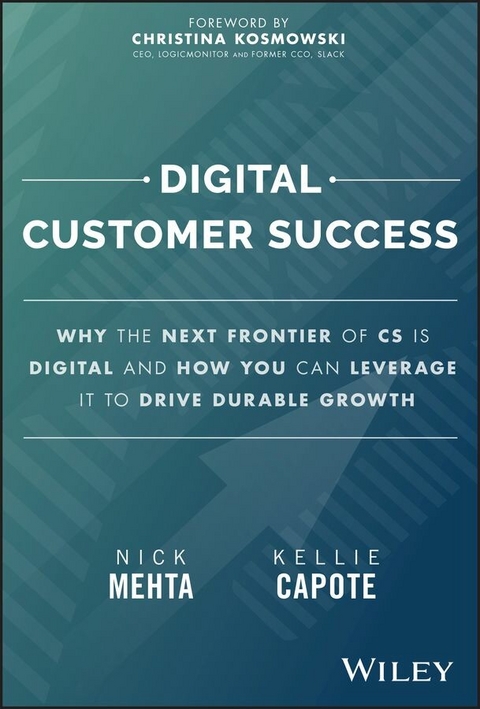
Digital Customer Success (eBook)
301 Seiten
John Wiley & Sons (Verlag)
978-1-394-20588-2 (ISBN)
Automate your Customer Success efforts to reduce churn and increase profits
In Digital Customer Success: The Next Frontier, a team of trailblazing Customer Success professionals and digital entrepreneurs delivers an insightful discussion of the next stage in Customer Success management. In the book, you'll discover how to design and deploy touchless and automated digital interventions that help your software users learn and grow as they use your product and unlock the value trapped within it - without ever needing to reach out to a live Customer Success Manager.
The authors provide a detailed 'How-To' guide to Digital Customer Success that explains how you can meet the needs of your customers, investors, and team members. You'll explore the basics of the authors' original Digital Customer Success Maturity Model and the core tenets of how to get started. After that, you'll find:
- Explanations of the ideal organizational structures to enable Digital Customer Success management
- Case studies and examples from real companies blazing new trails in Customer Success
- Critical success measurements and metrics you can use to determine if your company is on the right track or if it needs to reorient
Perfect for managers, executives, directors, founders, entrepreneurs, and other business leaders involved in the sale of digital and software products, Digital Customer Success is also a can't-miss resource for Customer Success professionals, sales leaders, marketers, product development professionals, and anyone else with a stake in reducing customer churn and increasing revenues.
NICK MEHTA is the CEO of Gainsight, a leading customer success company, and the bestselling co-author of Customer Success: How Innovative Companies Are Reducing Churn and Growing Recurring Revenue.
KELLIE CAPOTE is the Chief Customer Officer at Gainsight. She leads the post-sales organization that includes Customer Success Managers, Support, Professional Services, and Customer Success Operations. She has contributed to publications including Forbes, TechCrunch, CMSWire, and others.
Automate your Customer Success efforts to reduce churn and increase profits In Digital Customer Success: The Next Frontier, a team of trailblazing Customer Success professionals and digital entrepreneurs delivers an insightful discussion of the next stage in Customer Success management. In the book, you'll discover how to design and deploy touchless and automated digital interventions that help your software users learn and grow as they use your product and unlock the value trapped within it without ever needing to reach out to a live Customer Success Manager. The authors provide a detailed How-To guide to Digital Customer Success that explains how you can meet the needs of your customers, investors, and team members. You'll explore the basics of the authors' original Digital Customer Success Maturity Model and the core tenets of how to get started. After that, you'll find: Explanations of the ideal organizational structures to enable Digital Customer Success management Case studies and examples from real companies blazing new trails in Customer Success Critical success measurements and metrics you can use to determine if your company is on the right track or if it needs to reorient Perfect for managers, executives, directors, founders, entrepreneurs, and other business leaders involved in the sale of digital and software products, Digital Customer Success is also a can't-miss resource for Customer Success professionals, sales leaders, marketers, product development professionals, and anyone else with a stake in reducing customer churn and increasing revenues.
NICK MEHTA is the CEO of Gainsight, a leading customer success company, and the bestselling co-author of Customer Success: How Innovative Companies Are Reducing Churn and Growing Recurring Revenue. KELLIE CAPOTE is the Chief Customer Officer at Gainsight. She leads the post-sales organization that includes Customer Success Managers, Support, Professional Services, and Customer Success Operations. She has contributed to publications including Forbes, TechCrunch, CMSWire, and others.
Foreword vii
Chapter 1 The High-Speed Evolution of Customer Success 1
Chapter 2 Durable Business Strategies to Fuel Long-Term Success 19
Chapter 3 Digital Customer Success Is a Strategic Program 35
Chapter 4 The Digital Customer Success Maturity Model 53
Chapter 5 Launching the Proactive Phase of Your Digital CS Program 71
Chapter 6 Evolving to the Personalized Phase 93
Chapter 7 Evolving to the Predictive Phase 111
Chapter 8 Launching Your First Digital Initiative 129
Chapter 9 Company-Wide Digital Program Governance and Cross-Functional Collaboration 155
Chapter 10 Optimizing Your Digital Toolkit 175
Chapter 11 The Ability to Be More Human 197
Acknowledgments 205
About the Authors 207
Notes 209
Index 215
1
The High‐Speed Evolution of Customer Success
It's a Friday night, and you've just arrived at your favorite corner bistro. Inside, the host warmly greets you by name before escorting you to a choice table. There, a familiar waiter smiles just before you suggest (as always) that there's no need to recite the specials. You'll have your usual entrée paired with a glass of your favorite varietal.
Now, this is what makes life worth living. It's not merely the food, though the food is spectacular. It's not merely the atmosphere and the view from your favorite table. No, what really keeps you coming back week after week, year after year, is the personal service, delivered by people who seem to genuinely care that you are having a wonderful experience.
In an increasingly impersonal world, a world where artificial intelligence (AI) informs you that “people who bought the pinot noir also purchased camembert and water crackers” and where “talking” with a customer service agent means interacting with a chatbot decision tree, who can blame you for craving a personalized experience—for wanting to go “where everybody knows your name and they're always glad you came”? Given a choice, wouldn't all of us prefer to be treated like unique individuals instead of data sets?
At Gainsight, our purpose statement is “to be living proof you can win in business while being Human‐First.” It's so easy to forget that the person on the other side of the video meeting isn't just a candidate, employee, alumni, prospect, customer, or investor—they are a human being first. We need to always remember that. But this raises a seemingly intractable question for every company in the software‐as‐a‐service (SaaS) sector and beyond: How do you scale a Human‐First customer experience?
Your favorite restaurant provides personalized service because the staff works at a single location every night, serving a small number of regular customers. In the beginning, the same is true of almost every tech start‐up. Many founders talk to each of their early customers themselves. I remember one well‐known founder who said, “I bring my laptop to the customer, watch them work, and code what they want.” But once the owner of the restaurant or the start‐up needs to scale, personalized experiences are often jettisoned in favor of a more efficient—and more impersonal—experience.
As business leaders, we recognize that we must scale up to build our companies, and the way to do this is through automated systems and processes. But must we also lose the human touch? Can't we find ways to efficiently scale without treating our customers like fungible cogs? Can we find ways to enhance the customer experience via automation?
The Human vs. Digital Dilemma
In the case of the restaurant, the answer is a qualified yes. Although most of us would not want to visit a restaurant in which we had to interact with robot waiters instead of humans, many of us would love to book our reservations online, pay the bill with our smartphone, and contact the restaurant in advance to let them know we're celebrating a special event so they can surprise us with a special gesture. In fact, we might regard these digital capabilities as a pleasant blend of human‐led and digital‐led customer service. On one hand, we would continue to enjoy the social and psychological benefits that come with human interaction. On the other hand, digital technology would enable us to dispense with the less pleasant aspects of the experience more quickly.
That said, there is a good reason why we “qualified” our yes. In the restaurant, significant parts of the customer journey cannot be easily scaled—if they can be scaled at all. For example, while some customers may be happy using digital tech to facilitate reservations and payments, others might prefer to walk through the door without a reservation and pay their bill at the cashier's station. Satisfying both customer segments would require that the restaurant continue employing a cashier or a host, despite the added cost. And unless the owner were willing to install a buffet, customers seeking self‐service would have to go elsewhere.
Why are we talking about restaurants in a book about Customer Success?
It's because the restaurant is a good analogy for the dilemma that many SaaS companies and Customer Success (CS) organizations are struggling to resolve—how to deliver, more efficiently and at scale, a Human‐First customer experience using digital means.
Informed by the speed, convenience, and seamlessness of their transactions with business‐to‐consumer (B2C) ecommerce retailers such as Amazon and Spotify, business‐to‐business (B2B) customers are increasingly demanding a speedier, more seamless, and more personalized experience when they purchase products and services from companies like yours. But however much you may want to fulfill your customers' wishes for “the B2C experience,” achieving that goal is easier said than done.
For starters, unlike one‐time purchases of books and AAA‐battery 12‐packs on Amazon, complex B2B SaaS products require that you and the customer devote considerable resources to onboarding new users—a process that (you hope) will lead to widespread product adoption, which, in turn, will help the customer achieve their desired business outcomes. If the customer succeeds in achieving their outcomes while having a pleasant experience, you succeed. You transform a one‐time purchase into a subscription that generates revenue for years to come.
Turning one‐off purchasers into long‐term customers—customers who then buy more products and services from you, as well as advocating on your behalf—is the “prime directive” of every CS organization.
Now for the dilemma.
Most CS organizations and Customer Success Managers (CSMs) are neither prepared nor equipped to deliver the personalized customer experience their customers want, at least not in a way that is cost‐effective and scalable. Although the tools for achieving this goal are available—in the form of new and emerging digital technologies—most SaaS companies are stuck. They are trapped in a twilight zone between CS systems and processes that are either completely automated and impersonal or completely human‐led and unscalable.
And never the twain shall meet.
In fact, some CSMs maintain (to paraphrase Anna Karenina) that because “happy customers are all alike, but every unhappy customer is unhappy in their own way,” the entire concept of Digital Customer Success (Digital CS) is oxymoronic. In their view, SaaS firms can opt either for robotic, dehumanized interactions with their customers (a “tech‐touch” approach) or for strictly human‐led interactions (the “high‐touch” approach). However, because every customer and stakeholder is unique, no “robot” could possibly deliver the personalized CS interactions that today's customers crave.
Use cases closed.
Never mind that not every customer is seeking a Human‐First experience at every moment or a digital‐first experience at every moment. Like the customers of our hypothetical restaurant, most of your customers are seeking human interactions at certain times and digital interactions at others. Thus, the Anna Karenina argument is a straw man argument. The human versus digital conundrum cannot be solved with either/or thinking. It can be resolved only by harnessing technology to design an optimum blend of digital and human CS motions for all your customers.
Technology has evolved a great deal over the past decade, and because of this, we now have a third CS model to consider—a model that can provide a personalized, human experience via digital‐first methods. For this reason, we believe every company should now be thinking about how (not whether) to deliver a digital‐first customer experience. But before we dive into this topic, let's briefly recap how we arrived at the current crossroads—the intersection of the Human‐First and digital‐first approaches to growth and profitability.
How We Got Here
From the moment the SaaS industry was born, it was probably inevitable that Customer Success (or something very much like it) would be invented. As soon as consumers were able to purchase, install, and use new software solutions without first having to wave goodbye to a substantial up‐front investment, a third era of economic history had begun.
As Nick argued in The Customer Success Economy,1 the first economic era was the “making stuff” phase, which started with the Industrial Revolution. The second era was the “selling stuff” phase, which was disrupted and accelerated when the internet made it possible to sell stuff globally. From 1900 to 2000, making and selling stuff was the business model of pretty much every major corporation, and it drove the global economy. A sale was a one‐time activity, and anything “post‐sale” represented a cost to the company.
We are now in a third phase. Although we still need to make and sell things, that is no longer enough. In the modern economy,...
| Erscheint lt. Verlag | 30.4.2024 |
|---|---|
| Sprache | englisch |
| Themenwelt | Wirtschaft ► Betriebswirtschaft / Management |
| Schlagworte | auto customer support • automated customer success • Business & Management • customer success interventions • Customer success management • digital customer success interventions. Customer success professionals • Digitalisierung • Digital Sales • Kundendienst • Management • Reduce churn • touchless customer success • Wirtschaft u. Management |
| ISBN-10 | 1-394-20588-0 / 1394205880 |
| ISBN-13 | 978-1-394-20588-2 / 9781394205882 |
| Informationen gemäß Produktsicherheitsverordnung (GPSR) | |
| Haben Sie eine Frage zum Produkt? |
 EPUB (Adobe DRM)
Kopierschutz: Adobe-DRM
Adobe-DRM ist ein Kopierschutz, der das eBook vor Mißbrauch schützen soll. Dabei wird das eBook bereits beim Download auf Ihre persönliche Adobe-ID autorisiert. Lesen können Sie das eBook dann nur auf den Geräten, welche ebenfalls auf Ihre Adobe-ID registriert sind.
Details zum Adobe-DRM
Dateiformat: EPUB (Electronic Publication)
EPUB ist ein offener Standard für eBooks und eignet sich besonders zur Darstellung von Belletristik und Sachbüchern. Der Fließtext wird dynamisch an die Display- und Schriftgröße angepasst. Auch für mobile Lesegeräte ist EPUB daher gut geeignet.
Systemvoraussetzungen:
PC/Mac: Mit einem PC oder Mac können Sie dieses eBook lesen. Sie benötigen eine
eReader: Dieses eBook kann mit (fast) allen eBook-Readern gelesen werden. Mit dem amazon-Kindle ist es aber nicht kompatibel.
Smartphone/Tablet: Egal ob Apple oder Android, dieses eBook können Sie lesen. Sie benötigen eine
Geräteliste und zusätzliche Hinweise
Buying eBooks from abroad
For tax law reasons we can sell eBooks just within Germany and Switzerland. Regrettably we cannot fulfill eBook-orders from other countries.
aus dem Bereich