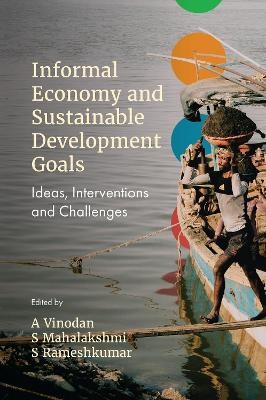
Informal Economy and Sustainable Development Goals
Emerald Publishing Limited (Verlag)
978-1-83753-981-9 (ISBN)
The implementation of the United Nations Sustainable Development Goals (UNSDGs or SDGs) is often discussed in terms of governmental policy or the contributions by global, multinational organisations, but what role does the informal economy have to play in SDG implementation?
The chapters collected here by a range of scholars explore this question in detail; exploring the ideas, interventions and challenges faced by the informal sector in contributing to the SDGs. With a wide range of chapters encompassing diverse topics such as food security, financial inclusion, waste management, gender disparity, and the impact of digital transformation, Informal Economy and Sustainable Development Goals offers a comprehensive exploration of the informal sector's role in various contexts and its potential for contributing to sustainable development.
By examining case studies and presenting empirical evidence based on both qualitative and quantitative assessment, the contributors shed light on the challenges faced by informal workers and the interventions needed to address these challenges. Informal Economy and Sustainable Development Goals appeals to a range of readers such as researchers, policymakers, and practitioners seeking to understand and address the complex dynamics of informal economies and their alignment with sustainable development goals.
A Vinodan is an Associate Professor in the Department of Commerce, Central University of Tamil Nadu, India. S Mahalakshmi is an Assistant Professor in the Department of Commerce, Central University of Tamil Nadu, India. S Rameshkumar is a Professor and Research Supervisor in the Department of Financial Administration, Central University of Punjab, India.
Ideas
Chapter 1. A conceptual framework for managing public services delivered by environmental enterprises in informal settlements; Yewande Adewunmi, Prisca Simbanegavi, and Malcolm Weaich
Chapter 2. Digital Transformation and Implications for the Informal Sector of Ghana; Anthony Acquah, Anthony Nkrumah Agyabeng, and James Kwame Mensah
Chapter 3. How do the socio-economic characteristics of migrant workers shape their financial behaviour?; Rameshkumar Subramanian, T P Arjun, and Ashique Ali K A
Chapter 4. Mapping the Invisible Pathways: A Bibliometric Study on Informal Lending in the Informal Economy; Ganesh R and Naresh G
Chapter 5. Industry 4.0, AI and Textile Sector in India; Manas Ranjan Bhowmik and Shantanu Baidya
Chapter 6. Persisting Industrial Concentration and Signs of Industrial Dispersion: Evidence from Formal and Informal Manufacturing Sector; Renjith Ramachandran
Chapter 7. Foreign Capital Inflow, Product Market Imperfection and the Informal Sector: A General Equilibrium Analysis; Sushobhan Mahata, Rohan Kanti Khan, Soumyajit Mandal, and Avishek Bose
Interventions
Chapter 8. Food Security in the Informal Sector: Interventions and Challenges for the SDGs; Bita Afsharinia and Anjula Gurtoo
Chapter 9. The Role of Self-Help Groups in Financial Inclusion in India; Debolina Saha and Razdan Alam
Chapter 10. Waste Management Practices in the Informal Settlement: Functionality of Local Assemblies; Anthony Nkrumah Agyabeng, James Kwame Mensah, and Anthony Acquah
Chapter 11. Inclusivity and Climate Action: City and Informal Waste Actors Collaboration in Accra; James Kwame Mensah and Anthony Nkrumah Agyabeng
Chapter 12. Strengthening Sustainable Rural Development through Entrepreneurship: An Indian Perspective; Kalpana Rajsinghot, Shashi Bala, and Puja Singhal
Challenges
Chapter 13. Flexibility, Vulnerability, and Inclusiveness in the Gig Economy: A Review of Indian Experience in the Context of Informalisation; K Jafar, Unnimaya U.G., and Umanath Malaiarasan
Chapter 14. Reconnoitring Vulnerabilities of Migrant Women Workers in the Urban Informal Labour Market; Nomita P. Kumar and Achala Srivastava
Chapter 15. Informal employment, gender patterns and policies in MENA countries; Philippe Adair, Shireen AlAzzawi, and Vladimir Hlasny
Chapter 16. Employment Status of Women in the Power Loom Sector: A case study of Varanasi, Uttar Pradesh; Nandani Yadav and Priyabrata Sahoo
Chapter 17. Identifying wage inequality in Indian urban informal labour market: A gender perspective; Shiba Shankar Pattayat and Sumit Haluwalia
Chapter 18. Gender Disparity in the Informal Sector Employment in India; B S Sumalatha and V. P Nirmal Roy
Chapter 19. Challenges of Women Workers in the Solid Waste Management Sector of Kerala: On the Path to Formalization; Fathima Sherin Ottakkam Thodukayil , Rahana Salahudeen Raseena, P.Udhayakumar, and Sigamani Panneer
| Erscheinungsdatum | 19.09.2024 |
|---|---|
| Verlagsort | Bingley |
| Sprache | englisch |
| Maße | 152 x 229 mm |
| Gewicht | 678 g |
| Themenwelt | Wirtschaft ► Volkswirtschaftslehre ► Makroökonomie |
| ISBN-10 | 1-83753-981-2 / 1837539812 |
| ISBN-13 | 978-1-83753-981-9 / 9781837539819 |
| Zustand | Neuware |
| Informationen gemäß Produktsicherheitsverordnung (GPSR) | |
| Haben Sie eine Frage zum Produkt? |
aus dem Bereich