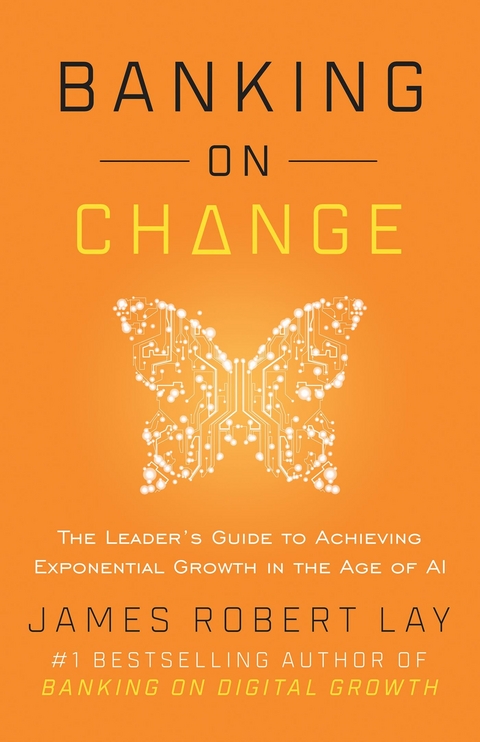
Banking on Change (eBook)
400 Seiten
Level Up Imprint (Verlag)
979-8-9900317-0-8 (ISBN)
James Robert Lay is one of the world's leading digital marketing authors, speakers, and advisors for financial brands. As a digital anthropologist, he wrote the bestselling book Banking on Digital Growth, and his weekly podcast educates financial brand leaders in more than 140 countries. As the founder and CEO of the Digital Growth Institute, James Robert teaches marketing and sales leaders at financial brands how to level up their loan and deposit growth. He has also been named a top global financial services influencer to follow by The Financial Brand, while his insights are frequently featured in outlets such as U.S. News & World Report, Quartz, American Banker, and Credit Union Times.
CHANGE IS HARD
Change is scary. Change is painful. This is even more true when change is exponential, as it has been, as it is, and as it will continue to be in the Age of AI.
You are reading this book because you’re part of a team leading your bank, credit union, or fintech on a journey of exponential growth. Perhaps you’re a mortgage lender or financial advisor who recognizes that the world around you is undergoing exponential change, so you are looking for clarity and a path forward beyond all the confusion, chaos, and complexity of the present moment. Or maybe you’re reading this right now because you’re a gifted executive leader or entrepreneur, and someone you trust recommended this book to help you guide your team and organization through exponential change.
Although I wrote this book especially for those in banking and financial services, the ideas and insights you’ll find through the following chapters can, in fact, be applied to any industry experiencing exponential change, from education and healthcare to manufacturing and retail services. That’s because none of us can escape the exponential changes we are experiencing in the Age of AI.
The good news: with exponential change comes new opportunities for exponential growth.
WHAT IS EXPONENTIAL GROWTH?
In the Age of AI, it’s important that we pause and take the time to really ponder this question. Let’s start with what we know beyond a shadow of doubt: we are already experiencing exponential change, and it’s bound to continue. Change can feel uncomfortable, to put it mildly. We were all reminded of this in a fundamental way when the COVID-19 pandemic swept the country and the whole world in 2020, throwing many of our previously held assumptions—about work, health, and much more—into question.
But on the flip side, exponential change presents us with opportunities to grow in ways we never thought possible both personally and professionally. The two must be addressed at the same time because when you’re struggling on a personal level, whatever you’re going through is very likely to impact you professionally. And vice versa.
While COVID-19 ushered in what some call “The Great Reset,” I have observed a great awakening in human potential—rooted in human transformation—as one of the greatest lessons among many to emerge from the COVID era in that our personal and professional lives are no longer independent of each other. Of course, this trend was already evident to many of us, at least in business circles. But now it’s clearer than ever that the days of work–life balance are over. Rather, the name of the game is work–life integration, brought about in large part by the rise of digital tools and technologies that, for better or worse, have created always-on, 24-7 access. But what exactly is “work–life integration”? As Stephen Kohler, CEO and founder of Audira Labs, notes: “Work–life balance is focused on keeping your work life and your personal life separate, but equal, whereas work–life integration is centered on the belief that there is no distinction between the two and that both must coexist in harmony.”
Sometimes this blending of personal and professional lives can create friction, frustration, and conflict, and these feelings are amplified when the world around us is going through exponential change. I have struggled with adapting to the confusing, chaotic new landscape, and in the pages ahead I will share my own story of navigating exponential change. As you will see in my journey—as well as those of numerous financial brand leaders whom I spoke to for this book—exponential change does pose new, often extreme challenges. It’s important to remember that exponential change also presents us with exciting opportunities for exponential growth.
As a digital anthropologist studying the intersection of marketing, sales, technology, and human behavior through the lens of financial services and banking, the ongoing exponential changes in the Age of AI have been my primary focus and area of study for the past two decades now. Over this time, what I’ve observed and concluded, beyond any shadow of doubt, is when it comes to the inherent chaos and complexity of exponential change, the greatest challenges for financial brands are rooted not in technology but in human behavior.
Consider for a moment that historically 60 to 85 percent of all digital transformation initiatives at a global level have either failed completely or at least failed to meet expectations. These dismal numbers don’t reflect problems with the technology. Instead, they stem from human beings, the people in charge of analyzing, acquiring, and applying all the fancy new tools. Inherent to the introduction of such technologies in any workplace or human arena is how they bring about, or even force, some change in human behavior. Or as Maurice Lisi, head of Direct Channels at BPER Banca in Italy, puts it: “Digital transformation is not about introducing new technology; it’s about people and culture transformation.”
I’ve had a front-row seat to these issues around human behavior, having watched transformation after transformation fail. In fact, I used to be part of the problem, at least back when my firm, the Digital Growth Institute, still used the traditional consulting model. In those early days, we would take financial brands through our standard discovery and diagnostic process, provide them with findings and recommendations, and then try to guide them forward to a better place. What’s wrong with that, you ask? Well, at a certain point, I started noticing a very troubling pattern: only one or two out of every ten brands would actually apply our findings and recommendations for maximizing their future growth potential. The other eight would do little or nothing at all, and so inevitably, their future became their predictable past. Their potential for exponential growth was neutered, and that’s because of a fundamental disconnect: the future they were building was based on present-day actions, habits, and beliefs.
When I began to observe this unfortunate pattern, a light bulb turned on in my head. I realized that just because an individual, team, or organization had gained perspective into their current situation and where they could go next, that didn’t mean they would necessarily act on that insight to progress to a better place. Clearly, something was still holding these financial brands back from committing to an exponential growth journey and moving forward with courage and confidence.
Gradually, I identified a common culprit in these scenarios, which was the lack of clarity. But behind this problem was a deeper one: fear of the unknown. Almost all these brands—that took our findings and recommendations but then did nothing with them—struggled with the same obstacle: internally and institutionally they lacked the foundational knowledge and awareness to apply the recommendations they had been given. So after hundreds of hours of research, testing, and refining our own methodology, we landed on a solution, a path out of the chaos and confusion toward genuine exponential success for individuals, teams, and organizations. Our new approach was rooted in a transformational model of education and coaching, and that made all the difference. The financial brands we worked with were now really starting to see things differently, not just paying lip service to our ideas and advice. Eventually, not only was their thinking transformed but entire belief systems and structures were as well, resulting in their commitment to take action to create an even bigger, better, and brighter future.
Our new attention on coaching also created a culture of accountability to prevent leaders and their teams from falling back on old habits and behaviors. Now, finally, they were actually putting to use the knowledge they had gained and seeing some traction on their exponential growth journey. The way they perceived the world had changed and, thrillingly for them, their perception was becoming reality.
It’s important to note here that perception and reality are not the same, but our perceptions can help shape our reality. Perception can also function as a filter through which we see and feel our present reality. When we are on a journey to achieve exponential growth, our perception helps us gain perspective into the present while also analyzing the past and coming to clear conclusions about the future. Through this process, we learn how to apply our knowledge to confidently navigate the complexities of exponential change—and ultimately achieve exponential growth.
A large percentage—60 to 85 percent—of all digital transformation initiatives at a global level have either failed completely or failed to meet expectations. As the world moves ever further into the exponential changes brought on by the Age of AI, perhaps the biggest exponential leap we’ve seen in human history so far, how can you not only defy those historical odds but transform challenges into opportunities, lemons into lemonade, and create a growth that is exponential and enduring?
THE EXPONENTIAL PACE OF EXPONENTIAL CHANGE
If we look back over the course of our history, we find four pivotal moments when exponential change transformed culture and humanity:
- Hundreds of thousands of years ago, we learned to harness the power of fire. This led to exponential advances in human evolution. Now, fire could provide not only light, warmth, and protection, but also more advanced tools and...
| Erscheint lt. Verlag | 30.4.2024 |
|---|---|
| Sprache | englisch |
| Themenwelt | Wirtschaft ► Betriebswirtschaft / Management ► Unternehmensführung / Management |
| ISBN-13 | 979-8-9900317-0-8 / 9798990031708 |
| Informationen gemäß Produktsicherheitsverordnung (GPSR) | |
| Haben Sie eine Frage zum Produkt? |
 EPUB (Ohne DRM)
Größe: 4,5 MB
Digital Rights Management: ohne DRM
Dieses eBook enthält kein DRM oder Kopierschutz. Eine Weitergabe an Dritte ist jedoch rechtlich nicht zulässig, weil Sie beim Kauf nur die Rechte an der persönlichen Nutzung erwerben.
Dateiformat: EPUB (Electronic Publication)
EPUB ist ein offener Standard für eBooks und eignet sich besonders zur Darstellung von Belletristik und Sachbüchern. Der Fließtext wird dynamisch an die Display- und Schriftgröße angepasst. Auch für mobile Lesegeräte ist EPUB daher gut geeignet.
Systemvoraussetzungen:
PC/Mac: Mit einem PC oder Mac können Sie dieses eBook lesen. Sie benötigen dafür die kostenlose Software Adobe Digital Editions.
eReader: Dieses eBook kann mit (fast) allen eBook-Readern gelesen werden. Mit dem amazon-Kindle ist es aber nicht kompatibel.
Smartphone/Tablet: Egal ob Apple oder Android, dieses eBook können Sie lesen. Sie benötigen dafür eine kostenlose App.
Geräteliste und zusätzliche Hinweise
Buying eBooks from abroad
For tax law reasons we can sell eBooks just within Germany and Switzerland. Regrettably we cannot fulfill eBook-orders from other countries.
aus dem Bereich