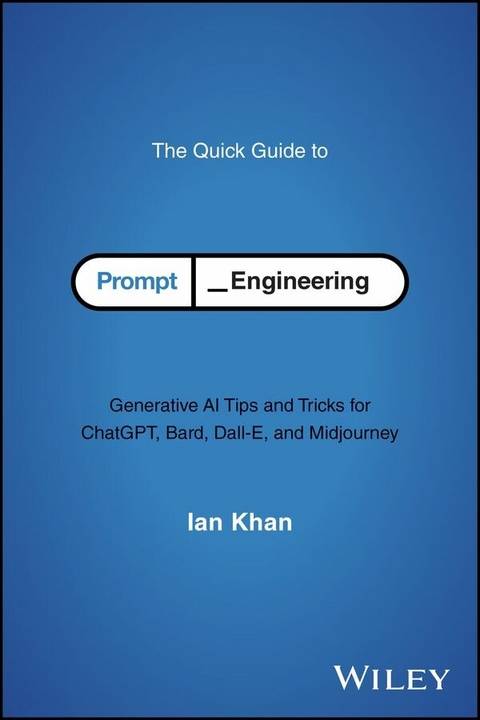
The Quick Guide to Prompt Engineering (eBook)
541 Seiten
John Wiley & Sons (Verlag)
9781394243334 (ISBN)
Design and use generative AI prompts that get helpful and practical results
In The Quick Guide to Prompt Engineering, renowned technology futurist, management consultant, and AI thought leader Ian Khan delivers a practical and insightful discussion on taking the first steps in understanding and learning how to use generative AI. In this concise and quick start guide, you will learn how to design and use prompts to get the most out of Large Language Model generative AI applications like ChatGPT, DALL-E, Google's Bard, and more. In the book, you'll explore how to understand generative artificial intelligence and how to engineer prompts in a wide variety of industry use cases. You'll also find thoughtful and illuminating case studies and hands-on exercises, as well as step-by-step guides, to get you up to speed on prompt engineering in no time at all. The book has been written for the non-technical user to take the first steps in the world of generative AI.
Along with a helpful glossary of common terms, lists of useful additional reading and resources, and other resources, you'll get:
- Explanations of the basics of generative artificial intelligence that help you to learn what's going on under the hood of ChatGPT and other LLMs
- Stepwise guides to creating effective, efficient, and ethical prompts that help you get the most utility possible from these exciting new tools
- Strategies for generating text, images, video, voice, music, and other audio from various publicly available artificial intelligence tools
Perfect for anyone with an interest in one of the newest and most practical technological advancements recently released to the public, The Quick Guide to Prompt Engineering is a must-read for tech enthusiasts, marketers, content creators, technical professionals, data experts, and anyone else expected to understand and use generative AI at work or at home. No previous experience is required.
Design and use generative AI prompts that get helpful and practical results in this concise and quick start guide. In The Quick Guide to Prompt Engineering, renowned technology futurist and AI thought leader Ian Khan delivers a practical and insightful resource for taking the first steps in understanding and learning how to use generative AI. You will learn how to design and use prompts to get the most out of Large Language Model generative AI applications like ChatGPT, DALL-E, Google s Bard, and explore how to understand generative artificial intelligence and how to engineer prompts in a wide variety of industry use cases. You ll also find illuminating case studies and hands-on exercises, as well as step-by-step guides, to get you up to speed on prompt engineering in no time at all. The book has been written for the non-technical user to take the first steps in the world of generative AI. Along with a helpful glossary of common terms, lists of useful additional reading and resources, and other resources, you ll get: Explanations of the basics of generative artificial intelligence that help you to learn what s going on under the hood of ChatGPT and other LLMs Stepwise guides to creating effective, efficient, and ethical prompts that help you get the most utility possible from these exciting new tools Strategies for generating text, images, video, voice, music, and other audio from various publicly available artificial intelligence tools Perfect for anyone with an interest in one of the newest and most practical technological advancements recently released to the public, The Quick Guide to Prompt Engineering is a must-read for tech enthusiasts, marketers, content creators, technical professionals, data experts, and anyone else expected to understand and use generative AI at work or at home. No previous experience is required.
Preface xi
Chapter 1 The Basics of Generative Artificial Intelligence 1
Chapter 2 The Role of Prompts in Generative AI 19
Chapter 3 A Step-by-Step Guide to Creating Effective Prompts 33
Chapter 4 Diving Deeper: Structure and Nuances of Prompts 47
Chapter 5 Prompt Engineering across Industry 63
Chapter 6 Practical Guide to Prompt Engineering 83
Chapter 7 Ethical Considerations in Prompt Engineering 103
Chapter 8 Application- Specific Prompt Engineering 123
Chapter 9 Advanced Topics in Prompt Engineering 143
Chapter 10 Prompt Engineering with OpenAI ChatGPT 163
Chapter 11 Exploring Prompts with ChatGPT 177
Chapter 12 Getting Creative with DALL- E 193
Chapter 13 Text Synthesis with CTRL 205
Chapter 14 Learning Languages with T2T (Tensor2Tensor) 217
Chapter 15 Building Blocks with BERT 231
Chapter 16 Voice Synthesis with Tacotron 245
Chapter 17 Transformers in Music with MuseNet 259
Chapter 18 Generating Images with BigGAN 273
Chapter 19 Creating Code with Codex 287
Chapter 20 Generating 3D Art with RunwayML 303
Chapter 21 DeepArt and Artistic Prompts 319
Chapter 22 Midjourney 333
Chapter 23 Google Bard 345
Chapter 24 Deepfaking with DeepFaceLab 357
Chapter 25 Image Editing with DeepArt Effects 373
Chapter 26 Content Generation with AIVA 387
Chapter 27 Audio Synthesis with WaveNet 401
Chapter 28 Image Classification with ImageNet 415
Chapter 29 Video Synthesis with VQ- VAE 429
Chapter 30 Your Future in Prompt Engineering 445
Acknowledgments 461
Ian Khan--The Futurist 463
1
The Basics of Generative Artificial Intelligence
Table of Contents
- Understanding AI, Machine Learning, and Deep Learning
Understanding AI, Machine Learning, and Deep Learning
What Is AI
Artificial intelligence (AI) is a branch of computer science that aims to create machines capable of mimicking human intelligence. Unlike traditional systems that follow explicit instructions, AI systems are designed to process information and make decisions or predictions based on the data they're given. The overarching goal of AI is to develop algorithms and models that allow machines to perform tasks—ranging from recognizing patterns to decision-making—that would usually require human cognition. AI's scope spans various technologies, including robotics, natural language processing (NLP), and expert systems. Its applications are evident in daily life, with systems such as virtual assistants, facial recognition software, and autonomous vehicles. AI's impact is transformative, redefining how industries operate and how we interact with technology.
Historical Development The journey of AI began in the 1940s and 1950s with the development of the first electronic computers. The 1980s saw the rise of machine learning (ML), where algorithms learn directly from data rather than relying on explicit programming. Neural networks, a subset of ML, faced challenges until the 2000s when computational power and data availability grew. This resurgence, now termed deep learning, uses multilayered neural networks to process vast datasets. The game-changing breakthroughs, such as Deep Blue's chess victory in 1997 and AlphaGo's win in 2016, marked significant milestones. Today, AI encompasses a blend of these techniques, continuously evolving with advancements in computation, data, and algorithms.
Applications of AI AI has woven its way into a multitude of sectors, revolutionizing processes and augmenting human capabilities. In health care, AI algorithms are being used to diagnose diseases, sometimes with accuracy surpassing human doctors. In finance, it powers fraud detection systems, optimizing security. The automotive industry is witnessing a transformation with AI-driven autonomous vehicles. In entertainment, recommendation systems such as those in Netflix or Spotify customize user experiences. E-commerce platforms use AI for predicting consumer behavior, enhancing sales strategies. Virtual assistants such as Siri and Alexa employ AI to comprehend and respond to user commands. In manufacturing, AI-driven robots optimize assembly lines, increasing efficiency. Additionally, in the realm of research, AI aids in complex simulations and data analysis. From smart homes to predictive text on smartphones, the applications of AI are vast, continuously expanding, and making an indelible mark on how society functions and evolves.
AI Today The current landscape of AI is characterized by rapid advancements and widespread adoption across various sectors. Breakthroughs in machine learning, especially deep learning, have propelled AI capabilities, making tasks such as image and speech recognition more accurate than ever before. AI models, such as GPT-3 and BERT, have revolutionized natural language processing, enabling seamless human-computer interactions. The growth of big data and enhanced computational power, through GPUs, has further accelerated AI research and applications. Today's businesses leverage AI for predictive analytics, customer insights, and automation. Ethical concerns, such as biases in AI models and privacy issues, have prompted discussions and regulations. Innovations in AI have also sparked debates on the future of employment, as automation replaces certain job functions. However, alongside challenges, AI offers immense potential to drive efficiency, innovation, and growth in the 21st century.
The Future of AI The future of AI holds immense potential and is poised to be transformational across various domains. As AI algorithms become more sophisticated, we'll see further personalization in services, from tailored education platforms to individualized health monitoring. The continued convergence of AI with fields such as quantum computing could redefine computational limits, allowing for the solving of currently insurmountable problems. Ethical considerations will gain prominence, with emphasis on transparency, fairness, and avoiding biases in AI systems. There will also be a focus on achieving general AI, a system with cognitive abilities akin to human intelligence. As AI integrates more deeply with our daily lives, new job roles and industries will emerge, while others adapt or phase out. Lastly, international collaborations and regulations will play a crucial role in ensuring AI's safe and equitable development and deployment.
What Is Machine Learning
Machine learning (ML) is a subset of artificial intelligence that focuses on the development of algorithms that allow computers to learn from and make decisions based on data. Rather than being explicitly programmed for a specific task, ML models use statistical techniques to understand patterns in data. By processing large amounts of data, these models can make predictions or decisions without human intervention. For example, a machine learning model can be trained to recognize images of cats by being shown many images of cats and non-cats. Over time, it fine-tunes its understanding and improves its accuracy. The essence of ML lies in its iterative nature; as more data becomes available, the model adjusts and evolves. This ability to learn from data makes machine learning integral in today's AI-driven world, fueling advancements in fields ranging from health care to finance.
What Is Deep Learning
Deep learning is a specialized subset of machine learning inspired by the structure and function of the human brain, specifically neural networks. It employs artificial neural networks, especially deep neural networks with multiple layers, to analyze various factors of data. Deep learning models are particularly powerful for tasks such as image and speech recognition. For instance, when processing an image, the model might first identify edges, then shapes, and eventually complex features such as faces or objects. The “deep” in deep learning refers to the number of layers in the neural network. Traditional neural networks might contain two or three layers, while deep networks can have hundreds. These intricate architectures allow deep learning models to automatically extract features and learn intricate patterns from vast amounts of data, often outperforming other machine learning models in accuracy and efficiency, especially when dealing with large-scale data.
What Is Generative AI
Generative AI refers to a subset of artificial intelligence models that are designed to generate new data samples that are similar in nature to a given set of input data. In essence, these models “learn” the underlying patterns, structures, and features of input data and then use this knowledge to create entirely new data samples. The resulting outputs, whether they are images, texts, or sounds, are often indistinguishable from real-world data. A quintessential example is the generative adversarial network (GAN), where two neural networks—a generator and a discriminator—are pitted against each other. The generator strives to produce data, while the discriminator evaluates its authenticity. Through iterative training, the generator improves its outputs. Beyond GANs, other generative models such as variational autoencoders (VAEs) also find extensive applications in tasks such as image synthesis and style transfer. The appeal of generative AI lies in its potential to craft novel yet coherent creations by understanding and mimicking complex data distributions.
Early Beginnings of Generative AI The genesis of generative AI dates back to the mid-20th century, rooted in foundational statistical modeling and pattern recognition techniques. Early forms of generative models included Gaussian mixture models (GMMs) and hidden Markov models (HMMs), which were pivotal in speech recognition and computational biology. While these models demonstrated the concept of capturing data distributions, their real-world applications were somewhat limited due to computational constraints and...
| Erscheint lt. Verlag | 19.3.2024 |
|---|---|
| Sprache | englisch |
| Themenwelt | Wirtschaft ► Betriebswirtschaft / Management |
| Schlagworte | AI guide • Beginners guide • Business & Management • Business Self-Help • ChatGPT • chatGPT basics • ChatGPT tips • DALL-E • gai • GenAI • generative AI • generative AI basics • generative ai prompt engineering • generative artificial intelligence • generative KI • Google Bard • how to use chatgpt • how to use DALL-E • how to use gen ai • how to use midjourney • ian khan • Large Language Models • llm prompt engineering • LLMS • Midjourney • prompt engineer • Prompt Engineering • prompt engineering basics • prompt engineering book • Ratgeber Wirtschaft • Wirtschaft /Ratgeber • Wirtschaft u. Management |
| ISBN-13 | 9781394243334 / 9781394243334 |
| Informationen gemäß Produktsicherheitsverordnung (GPSR) | |
| Haben Sie eine Frage zum Produkt? |
 EPUB (Adobe DRM)
Kopierschutz: Adobe-DRM
Adobe-DRM ist ein Kopierschutz, der das eBook vor Mißbrauch schützen soll. Dabei wird das eBook bereits beim Download auf Ihre persönliche Adobe-ID autorisiert. Lesen können Sie das eBook dann nur auf den Geräten, welche ebenfalls auf Ihre Adobe-ID registriert sind.
Details zum Adobe-DRM
Dateiformat: EPUB (Electronic Publication)
EPUB ist ein offener Standard für eBooks und eignet sich besonders zur Darstellung von Belletristik und Sachbüchern. Der Fließtext wird dynamisch an die Display- und Schriftgröße angepasst. Auch für mobile Lesegeräte ist EPUB daher gut geeignet.
Systemvoraussetzungen:
PC/Mac: Mit einem PC oder Mac können Sie dieses eBook lesen. Sie benötigen eine
eReader: Dieses eBook kann mit (fast) allen eBook-Readern gelesen werden. Mit dem amazon-Kindle ist es aber nicht kompatibel.
Smartphone/Tablet: Egal ob Apple oder Android, dieses eBook können Sie lesen. Sie benötigen eine
Geräteliste und zusätzliche Hinweise
Buying eBooks from abroad
For tax law reasons we can sell eBooks just within Germany and Switzerland. Regrettably we cannot fulfill eBook-orders from other countries.
aus dem Bereich