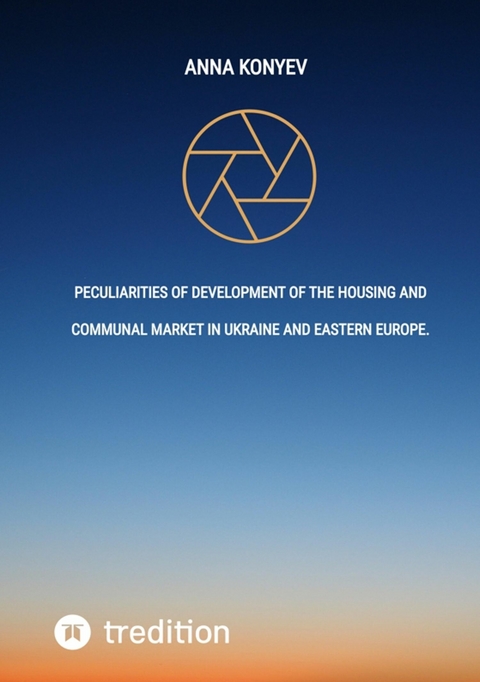
Peculiarities of development of the housing and communal market in Ukraine and Eastern Europe. (eBook)
316 Seiten
tredition (Verlag)
978-3-384-09626-5 (ISBN)
Anna Konyev ist 1985 geboren und hat Betriebsmanagement an der Nationalen Akademie in der Ukraine studiert und daraufhin promoviert. Heute ist sie verheiratet, hat einen Sohn und lebt in Heilbronn. Konyev arbeitet als Institutsassistentin für das Institut für Digitalisierung und Elektrisch Antriebe an der Hochschule Heilbronn. Seit ihrer Kindheit ist Konyev fasziniert von der Literatur, schreibt eigene Prosa und Gedichte und verarbeitet so ihr Gefühlsleben. Vor kurzem hat sie sich ihren Traum erfüllt, bereiste die schönsten Gegenden der Provence und verliebte sich in sie auf den ersten Blick. Diese Berührung mit der Harmonie zweier Sphären zwischen Traum und Realität hat sie in ihrer Erzählung verarbeitet und verwirklichte so ihr Lebensmotto: 'Das Leben ist einzig und unwiederholbar, man sollte dieses so ausfüllen, dass aus jedem isoliert betrachteten Moment ein eigenes Werk entstehen würde.' Konyev hat gelernt, dass man, um die Provence zu lieben - ähnlich einer bedingungslosen Hingabe zum Menschen-, Zeit braucht, die auch Konyev sich genommen hat: Nahezu zehn Jahre lang hat sie sich mit der französischen Sprache, Kultur und Traditionen vertraut gemacht und Freunde in Frankreich gefunden. Mit jedem Augenblick, den Konyev der Provence gewidmet hat, wurde ihre Verbundenheit stärker und ihre Liebe inniger, bis Konyev bereit war 'einen Teil [ihres] Geheimnisses - den Ort an dem [ihr] Haus 'gebaut' wurde [- zu lüften].'
Anna Konyev ist 1985 geboren und hat Betriebsmanagement an der Nationalen Akademie in der Ukraine studiert und daraufhin promoviert. Heute ist sie verheiratet, hat einen Sohn und lebt in Heilbronn. Konyev arbeitet als Institutsassistentin für das Institut für Digitalisierung und Elektrisch Antriebe an der Hochschule Heilbronn. Seit ihrer Kindheit ist Konyev fasziniert von der Literatur, schreibt eigene Prosa und Gedichte und verarbeitet so ihr Gefühlsleben. Vor kurzem hat sie sich ihren Traum erfüllt, bereiste die schönsten Gegenden der Provence und verliebte sich in sie auf den ersten Blick. Diese Berührung mit der Harmonie zweier Sphären zwischen Traum und Realität hat sie in ihrer Erzählung verarbeitet und verwirklichte so ihr Lebensmotto: "Das Leben ist einzig und unwiederholbar, man sollte dieses so ausfüllen, dass aus jedem isoliert betrachteten Moment ein eigenes Werk entstehen würde." Konyev hat gelernt, dass man, um die Provence zu lieben – ähnlich einer bedingungslosen Hingabe zum Menschen –, Zeit braucht, die auch Konyev sich genommen hat: Nahezu zehn Jahre lang hat sie sich mit der französischen Sprache, Kultur und Traditionen vertraut gemacht und Freunde in Frankreich gefunden. Mit jedem Augenblick, den Konyev der Provence gewidmet hat, wurde ihre Verbundenheit stärker und ihre Liebe inniger, bis Konyev bereit war "einen Teil [ihres] Geheimnisses – den Ort an dem [ihr] Haus 'gebaut' wurde [– zu lüften]."
Section 2. Methodological support of housing and communal services management.
2.1. Development of corporate-real-estate-management in Europe
In housing and communal services, due to the low level of regulation and control on the part of executive authorities and local self-government, there are practically no incentives for high-quality housing or communal services for the population, growth in labor productivity, introduction of new technologies, or competent management. The housing and communal services of Ukraine are characterized by low investment attractiveness and require the attraction of large investments for modernization and development. An important condition for the implementation of the reform of housing and communal services in Ukraine is the study of European experience in the management and provision of housing and communal services. The reason for the increase in negative trends in the sphere of reforming housing and communal services is a decrease in the efficiency of the functioning of public administration mechanisms. This is caused by unplanned organizational changes, the lack of effective programs for the development of housing and communal services management, deficiencies in the regulatory framework, the lack of foreign investment, and the low quality of management of top managers. The purpose of this study is to determine effective directions for the development of housing and communal services management in Ukraine, considering the study and analysis of European experience.
In the last decade, the economy of several developed countries with its special form of interaction between business and government has emerged. The outcome was a mixture of public and private partnerships, which makes it possible to increase the efficiency of management of the housing and communal complex. Foreign experience testifies to the existence of various forms of public-private partnership. Public utilities in European countries are predominantly municipal (Arbeitsunterlage der Kommissionsdienststellen SWD, 2016). At the same time, the experience of using concessions in public utilities is widespread. In most European countries, such as France, Hungary, Germany, etc., management in the field of housing and communal services is viewed as a separate type of entrepreneurial activity, for which the management organization receives remuneration from the owners of the premises.
The main management decisions, first, on the management of finances and the conclusion of contracts for the purchase of goods and services, are made not by the manager, but by the governing bodies of the association of homeowners (Die FEANTSA ist der Europäische Dachverband der Wohnungslosenhilfe, 2017). The manager prepares and substantiates recommendations for the management of the association. In most Western countries, such as Germany, France, Italy, Spain, etc., citizens consider the purchase of homeownership as an investment and make sure that the value of an apartment does not decrease over time and, if possible, increases. As a rule, the market itself forms the requirements for management companies, failure to comply makes the company uncompetitive.
The specialization of companies in Europe in real estate development has become extremely important in recent years. The main reason for this is the increasing complexity of the services associated with planning, realizing, and marketing real estate. As diverse as these services and differentiated the tasks depending on the specific real estate to be developed, so are the views on the delimitation of the content of real estate project development (Brauer, 2003).
The goal of the owner's perspective is to maximize the wealth invested in real estate. In contrast to the perspective of the renter, the interests of the owners are directed directly towards the cash flow that result from the property. According to James A. Graaskamp's concept, real estate should be viewed as "space and money over time". Institutional terms such as "Real Estate Investment Management" or "Real Estate Portfolio Management" are understood to mean concepts in which real estate is primarily understood as a form of capital investment with the resulting special problem areas (Pfnür, 2011).
Corporate Real Estate Management (CREM) is understood to mean a management concept that strategically deals with the real estate portfolio of non-property companies, i.e., companies whose original business purpose is outside the real estate sector (Gondring, 2009). The CREM, which is also translated as "corporate real estate management", combines usage and return-oriented objectives. And, also, according to a definition by SCHÄFERS, it can be understood as a "management concept for the real estate dimension in non-property companies at the center of which is a special process which, based on the company's strategic objectives, aims to contribute to the company's sustainable competitiveness through systematic planning, management, and control of all real estate-related company activities" (Schäfers, 1997). According to the definition, the CREM approach aims to support the core business of a company by identifying and realizing property-related cost reduction and efficiency potential.
A group of researchers at the Massachusetts Institute of Technology developed a five-step model intending to describe the development towards strategically oriented corporate real estate management - in which real estate and corporate strategy are closely linked. From the first to the fifth level of the model, the corporate real estate management of a company should go through a continuous process to optimize the operational real estate portfolio concerning the long-term company orientation (Pfnür, 2011). In the lowest development stage of corporate real estate management, the focus is on technical tasks in building construction and management. The real estate department acts on the registered space requirements of the users; the tasks are therefore to be characterized as reactive; strategic thinking is not required.
The costs associated with the use of real estate are considered as overhead costs in the company's accounting. In the second stage, the focus is on real estate-related cost management: Cost-analytical methods help to carry out measures to reduce costs. Besides, closer cooperation with the users/business areas is sought, firstly by determining the short-term and long-term space requirements for real estate space more efficiently and, secondly, by encouraging the users to deal more economically with real estate through internal transfer prices in the amount of annual depreciation. The generation of value creation potentials through (re)structuring of the real estate portfolio as well as the identification and exploitation of real estate not required for business is the focus of the third stage.
Benchmarking is also used to carry out market comparisons concerning costs, space consumption, and room standards to uncover further savings potential and minimize usage costs. The internal rents are set at the full cost prices, considering imputed costs - such as opportunity costs of the capital tied up in the real estate. In the fourth stage of the development model, real estate management is integrated into the strategic planning of the company. Resource planning in the real estate area is geared towards this, and consequently, proactive action is guaranteed. Real estate management is organized as an independent profit center, which demands market prices from the corporate units for the services provided based on external comparisons.
The real estate services are partially exposed to external competition; they can be outsourced or offered on the market yourself. The understanding of real estate management in the highest development stage of corporate real estate management is achieved through close cooperation between the management level, the strategic corporate units, and the real estate business unit in the form of "integrated corporate and real estate planning" (Schäfers, 1997). Economic and technical trends are to be recognized, assessed, and integrated into the future structure of the real estate portfolio, considering the company's strategic challenges.
Figure 9: Basic concept of modern real estate management.
The differentiation and synthesis of real estate management tasks require an analytical classification criterion. In the past, the attempts outlined above to bring order to the subject area of real estate economics have shown that empirical research can currently only provide clues for a structure formation. The high dynamic of challenges, organizational models, and terminology make every attempt obsolete faster than it originated. In the absence of an empirical alternative, a generic structure of real estate management must be based on theoretical concepts (Teichmann, 2007). There are multiple views of a basic concept of modern real estate management, which systematizes the activities directed towards real estate as an empirical object of business administration within the framework of business administration. On one hand, there are the roles that economic subjects assume about the object of experience of real estate. On the other hand, there are appropriate management concepts as a synthesis criterion.
Based on the synthesis of real estate management tasks according to roles is undoubtedly the further criterion, the following is initially structured accordingly. The activities of real estate management can be divided into the following three areas according to the respective role played by an actor (Fig. 9) (Pfnür, 2011). Typical deficits in the implementation of CRE management in...
| Erscheint lt. Verlag | 11.3.2024 |
|---|---|
| Verlagsort | Ahrensburg |
| Sprache | englisch |
| Themenwelt | Wirtschaft ► Betriebswirtschaft / Management ► Unternehmensführung / Management |
| Schlagworte | Development • Enterprise • Europa • housing and communal market • housing and communal services • Management • Real Estate Management • Ukraine • VUCA |
| ISBN-10 | 3-384-09626-6 / 3384096266 |
| ISBN-13 | 978-3-384-09626-5 / 9783384096265 |
| Informationen gemäß Produktsicherheitsverordnung (GPSR) | |
| Haben Sie eine Frage zum Produkt? |
 EPUB (Wasserzeichen)
DRM: Digitales Wasserzeichen
Dieses eBook enthält ein digitales Wasserzeichen und ist damit für Sie personalisiert. Bei einer missbräuchlichen Weitergabe des eBooks an Dritte ist eine Rückverfolgung an die Quelle möglich.
Dateiformat: EPUB (Electronic Publication)
EPUB ist ein offener Standard für eBooks und eignet sich besonders zur Darstellung von Belletristik und Sachbüchern. Der Fließtext wird dynamisch an die Display- und Schriftgröße angepasst. Auch für mobile Lesegeräte ist EPUB daher gut geeignet.
Systemvoraussetzungen:
PC/Mac: Mit einem PC oder Mac können Sie dieses eBook lesen. Sie benötigen dafür die kostenlose Software Adobe Digital Editions.
eReader: Dieses eBook kann mit (fast) allen eBook-Readern gelesen werden. Mit dem amazon-Kindle ist es aber nicht kompatibel.
Smartphone/Tablet: Egal ob Apple oder Android, dieses eBook können Sie lesen. Sie benötigen dafür eine kostenlose App.
Geräteliste und zusätzliche Hinweise
Buying eBooks from abroad
For tax law reasons we can sell eBooks just within Germany and Switzerland. Regrettably we cannot fulfill eBook-orders from other countries.
aus dem Bereich