


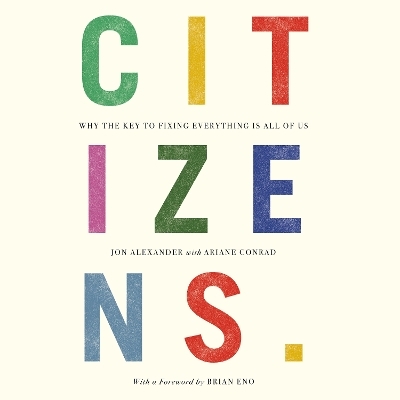
Citizens
Canbury (Verlag)
978-1-914487-04-0 (ISBN)
Citizens by Jon Alexander is a bold, uplifting wake‑up call for anyone who feels that democracy, community, and everyday life have been reduced to clicking, buying, complaining — and waiting for “them” to fix it. If you’re tired of politics-as-performance, brands-as-saviours, and institutions that treat people like customers or problems to manage, this book hands you a different lens: the Citizen inside every one of us.
Alexander’s core idea is brilliantly simple and deeply practical: to change the future, we must change the story. He reveals the hidden narratives shaping modern society — and why so many well‑meaning reforms fail because they keep the same assumptions in place.
The three stories:
• The Consumer Story: we’re users, consumers, taxpayers, and voters-as-buyers. We demand, choose, and rate while organisations compete to “serve” us.
• The Subject Story: in fear and uncertainty, we trade agency for protection — hierarchy, obedience, surveillance, and strongman certainty.
• The Citizen Story: we are interdependent, creative, empathic people who can participate, collaborate, and co‑create solutions. Citizenship becomes a verb: engagement, responsibility, belonging, contribution.
With a foreword by Brian Eno and praise from leading voices in democracy, business, and social change, Citizens makes a persuasive case that the Citizen Story is already rising — often beneath the media radar. From citizens self‑organising in crisis to neighbourhood renewal, Alexander shows how citizen power and collective intelligence can outperform “top‑down” command or “market fixes” when challenges are complex: climate change, inequality, polarisation, loneliness, and loss of trust.
What you’ll get from this book:
• A fresh, memorable framework for democratic renewal, civic participation, and citizen-led change (ideal for readers of politics, social science, and systems thinking)
• A clear diagnosis of why consumerism can’t solve the problems it created — and why “change without consequences” is a dangerous fantasy
• Real-world stories of ordinary people doing extraordinary work —f rom Birmingham and Berlin to Kibera, London, and Grimsby—proving that citizenship is not rare; it’s human
• Practical pathways to participatory democracy: citizens’ assemblies, deliberative democracy, participatory budgeting, community organising, volunteering, crowdfunding, civic tech, and open innovation
• A sector-by-sector roadmap for transforming the institutions that shape our lives: Citizen NGOs, Citizen Business, and Citizen Government
• “Social acupuncture” tools for leaders, organisers, and teams: find the leverage points where energy for a new way is ready to flow, then unlock it
Grounded in the work of the New Citizenship Project, this is essential reading for anyone interested in community building, local governance, civic leadership, public service reform, ethical leadership, corporate responsibility, stakeholder capitalism, employee engagement, and rebuilding trust through transparency and participation.
Citizens is designed to be used, not just admired. It’s equally valuable for public servants, educators, nonprofit leaders, business leaders, community organisers, activists, and social entrepreneurs. It also includes questions for discussion and reflection — ideal for book clubs, classrooms, leadership teams, and civic groups.
If you want hope without hand‑waving — and a practical, inspiring guide to participation, collaboration, and rebuilding democracy from the ground up — Citizens will change how you see people, power, and possibility. It’s a manifesto for democratic innovation and civic imagination: moving from passive consumption to active citizenship, from endless outrage to shared responsibility, and from isolated individuals to resilient communities. Step out of the Consumer mindset. Claim your role as a Citizen. Start building the future, together.
JON ALEXANDER began his career with success in advertising, winning the prestigious Big Creative Idea of the Year before making a dramatic change. Driven by a deep need to understand the impact on society of 3,000 commercial messages a day, he gathered three Masters degrees, exploring consumerism and its alternatives from every angle. In 2014, he co-founded the New Citizenship Project to bring the resulting ideas into contact with reality. In Citizens, he is ready to share them with the world. ARIANE CONRAD has built a career turning big ideas into books that change the world. Known as the Book Doula, she has co-written several New York Times bestsellers. BRIAN ENO is an artist, philosopher, Citizen and author of What Art Does, who has played a critical part in British culture since the early 1970s. He is a deep believer in the power of ideas and the possibility of a better world, beliefs which manifest both in his audio and visual art, and in his deep engagement with social, political and environmental issues.
Foreword. Brian Eno sets out the value of Citizens in framing a new, optimistic cooperative story for our age, as opposed to the two other options: authoritarian states such as China and "Siliconia" - "a Consumer state with centralised power and deep surveillance". Mentions Citizen Story
1. Opening. Jon Alexander sets out the need to 'step into' the Citizen Story so that we can deal with the many challenges of our age: economic insecurity, ecological emergency, public health threats, political polarisation, and more. Mentions citizens, economic insecurity, ecological emergency
2. Citizens Everywhere. How humans are bound together through interdependence and reciprocity, and in turn have a deep bond with nature, which conventional big business cannot understand. Picks apart the self-dependence and utilitarian philosophy of tech billionaires Peter Thiel and Mark Zuckerberg
3. Citizens By Nature. Central to the Citizen Story is a belief in ourselves and in human nature as creative, capable, and caring, rather than lazy, self-interested, and competitive within a zero-sum framework. Any redesign of institutions will fail if we haven’t embraced this fundamental belief
4. We're All Consumers Now. The launch of the consumer age, by way of Apple's advert for its new Macintosh at the US SuperBowl in 1984. Mentions Apple Macintosh, Ridley Scott, consumer demand, Consumer Story, George Orwell 1984, Virgin Atlantic, Richard Branson, IKEA, Walmart, Virgin Galactic
5. Once We Were Subjects. Before the Consumer, there was another story: the Subject, as in ‘subjects of the king.’ In this story, the Great Man – the Chief, Pope, King, Boss, Father – knows best. The rest of us are innocents, ignorant of important matters. Mentions King Sargon of Akkad and Mesopotamia
6. Citizen NGOs. The Consumer Story is falling apart, but the truth alone is not enough to ensure it passes to the Citizen Story. We must act too, to seize control of our futures, and to ensure that we actually have a future. Case studies include the National Trust in the UK
7. Citizen Business. How businesses can harness the power of the Citizen Story to make their workings more popular and inclusive, and to drive forward societal change. Case studies include the brewery BrewDog in Stonehaven, Scotland. Mentions Martin Dickie, Tesco, craft beer, Equity Punks
8. Citizen Government. Taiwan has pioneered the application of citizen government, in stark comparison to Communist China, which offers a vision of an alternative, authoritarian future. Mentions Taiwan, Taipei, Economic Power Up Plan, Tarek el-Tayeb Mohamed Bouazizi, Arab Spring, Sunflower Revolution
9. Closing. A new Citizen movement is building. Examples include Paris approving a standing Citizens' Assembly and Chile's Citizen-driven Constitutional Convention. Mentions Delian Aspourhov, Restor, Founders Fund, Varda Space Industries, Francis Suarez, Elon Musk, Balaji Srinavasaran
Writing Citizens. The book has been a collaborative process involving several different sets of people and organisations, including not least the New Citizenship Project team
References. The author thanks, among others, Jo Hunter, Emma Ashru Jones, Tendai Chetse, Anna Maria Hosford, National Trust, Helen Meech, Fallon advertising agency, Iris Schönherr, Ariane Conrad, OuiShare Fest, Food Ethics Council, Chris Seeley
Index. A full index of terms used in the book, such as participatory democracy, Certified B Corporations, citizens assemblies, and sortition
| Erscheinungsdatum | 20.02.2024 |
|---|---|
| Co-Autor | Ariane Conrad |
| Vorwort | Brian Eno |
| Zusatzinfo | 1 Index; 3 Diagrams |
| Sprache | englisch |
| Themenwelt | Sozialwissenschaften ► Politik / Verwaltung |
| Sozialwissenschaften ► Soziologie | |
| Wirtschaft ► Betriebswirtschaft / Management ► Planung / Organisation | |
| ISBN-10 | 1-914487-04-4 / 1914487044 |
| ISBN-13 | 978-1-914487-04-0 / 9781914487040 |
| Zustand | Neuware |
| Informationen gemäß Produktsicherheitsverordnung (GPSR) | |
| Haben Sie eine Frage zum Produkt? |


