


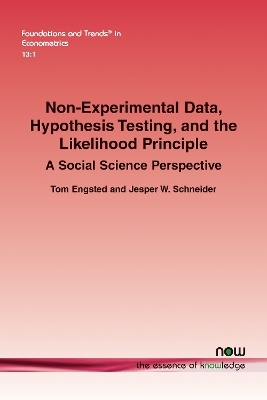
Non-Experimental Data, Hypothesis Testing, and the Likelihood Principle
A Social Science Perspective
Seiten
2024
now publishers Inc (Verlag)
978-1-63828-324-9 (ISBN)
now publishers Inc (Verlag)
978-1-63828-324-9 (ISBN)
- Titel ist leider vergriffen;
keine Neuauflage - Artikel merken
Argues that frequentist hypothesis testing - the dominant statistical evaluation paradigm in empirical research - is fundamentally unsuited for analysis of the non-experimental data prevalent in economics and other social sciences. The authors sketch the ideas of an alternative paradigm.
Non-Experimental Data, Hypothesis Testing, and the Likelihood Principle: A Social Science Perspective argues that frequentist hypothesis testing - the dominant statistical evaluation paradigm in empirical research - is fundamentally unsuited for analysis of the non-experimental data prevalent in economics and other social sciences. Frequentist tests comprise incompatible repeated sampling frameworks that do not obey the Likelihood Principle (LP). For probabilistic inference, methods that are guided by the LP, that do not rely on repeated sampling, and that focus on model comparison instead of testing (e.g., subjectivist Bayesian methods) are better suited for passively observed social science data and are better able to accommodate the huge model uncertainty and highly approximative nature of structural models in the social sciences. In addition to formal probabilistic inference, informal model evaluation along relevant substantive and practical dimensions should play a leading role. The authors sketch the ideas of an alternative paradigm containing these elements.
Non-Experimental Data, Hypothesis Testing, and the Likelihood Principle: A Social Science Perspective argues that frequentist hypothesis testing - the dominant statistical evaluation paradigm in empirical research - is fundamentally unsuited for analysis of the non-experimental data prevalent in economics and other social sciences. Frequentist tests comprise incompatible repeated sampling frameworks that do not obey the Likelihood Principle (LP). For probabilistic inference, methods that are guided by the LP, that do not rely on repeated sampling, and that focus on model comparison instead of testing (e.g., subjectivist Bayesian methods) are better suited for passively observed social science data and are better able to accommodate the huge model uncertainty and highly approximative nature of structural models in the social sciences. In addition to formal probabilistic inference, informal model evaluation along relevant substantive and practical dimensions should play a leading role. The authors sketch the ideas of an alternative paradigm containing these elements.
1. Introduction
2. Testing Methodologies
3. Non-Experimental Social Science Data
4. An Alternative Paradigm for the Social Sciences
References
| Erscheinungsdatum | 20.02.2024 |
|---|---|
| Reihe/Serie | Foundations and Trends® in Econometrics |
| Verlagsort | Hanover |
| Sprache | englisch |
| Maße | 156 x 234 mm |
| Gewicht | 121 g |
| Themenwelt | Wirtschaft ► Volkswirtschaftslehre ► Ökonometrie |
| ISBN-10 | 1-63828-324-9 / 1638283249 |
| ISBN-13 | 978-1-63828-324-9 / 9781638283249 |
| Zustand | Neuware |
| Informationen gemäß Produktsicherheitsverordnung (GPSR) | |
| Haben Sie eine Frage zum Produkt? |
Mehr entdecken
aus dem Bereich


aus dem Bereich
Nachhaltigkeit und Megatrends
Buch | Softcover (2025)
De Gruyter Oldenbourg (Verlag)
CHF 55,90
Set aus Lehr- und Arbeitsbuch
Buch | Softcover (2022)
De Gruyter Oldenbourg (Verlag)
CHF 49,95
Buch | Softcover (2024)
Vahlen, Franz (Verlag)
CHF 62,85


