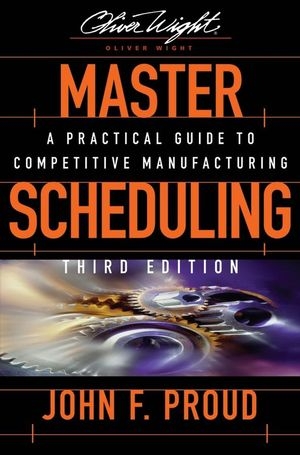
Master Scheduling
John Wiley & Sons Inc (Verlag)
978-0-471-75727-6 (ISBN)
- Titel erscheint in neuer Auflage
- Artikel merken
John F. Proud is a Principal of Oliver Wight Americas, Inc., where he consults with a variety of companies and leads courses on master scheduling and integrated demand-driven supply chain management. He is also a contributing author to the ABCD Checklist for Operational Excellence from Wiley.
Acknowledgments xii
Foreword xvii
Introduction xix
1 Chaos in Manufacturing 1
Problems in Manufacturing 3
Symptoms of Master Scheduling Problems 3
The Inaccurate Forecast 4
And the Solutions 7
The Case of the Overloaded Master Schedule 12
Getting Out of the Overloaded Master Schedule 17
2 Why Master Scheduling? 23
Between Strategy and Execution 25
What Is the Master Schedule? 29
Maximizing, Minimizing, and Optimizing 30
The Challenge for the Master Scheduler 31
MPS, MRPII, ERP, and SCM 33
Enterprise Resource Planning 39
Supply Chain Management 41
Where Have All the Orders Gone? 42
The Four Cornerstones of Manufacturing Revisited 45
So, Why Master Scheduling? 46
3 The Mechanics of Master Scheduling 49
The Master Schedule Matrix 50
Master Scheduling in Action 57
How Master Scheduling Drives Material Planning 63
The What, Why, and How of Safety Stock 71
Planning Time Fence 75
Demand Time Fence 80
Master Schedule Design Criteria 82
4 Managing with the Master Schedule 85
The Master Scheduler’s Job 88
Moving a Customer Order to an Earlier Date 90
Action and Exception Messages 93
Six Key Questions to Answer 97
Answering the Six Questions 100
Time Zones as Aids to Decision Making 101
Moving a Manufacturing Order to an Earlier Date 103
Planning Within Policy 106
No Past Dues 109
Managing with Planning Time Fences 109
Load- Leveling in Manufacturing 115
Lean Manufacturing and Continuous Improvement 118
Mixed- Model Scheduling 119
Planned Plant Shutdowns 123
The Production Shutdown 125
5 Using the MPS Output in a Make- to-Stock Environment 129
The Master Schedule Screen 130
Working a Make- to-Stock Master Schedule 137
Time Phasing the Bill- of-Material 140
Understanding the Action Messages 142
Bridging Data and Judgment 149
Seasonality and Inventory Buildup 151
The Six Key Questions Revisited 154
Scheduling in a World of Many Schedules 154
From Master Scheduling to Material Requirements Planning 164
6 What to Master Schedule 171
Manufacturing Strategies 172
Choosing the Right Strategy 174
Master Scheduling and Product Structures 177
Multilevel Master Scheduling 180
Tying the Master Schedule and the Production Plan Together 182
Master Scheduling Capacities, Activities, and Events 184
7 Scheduling in a Flow Environment 186
Different Manufacturing Environments 188
Similarities between Intermittent and Flow Environments 191
Product Definition 196
The Planning Process 200
An Extended Example 206
Catalysts and Recovered Material 211
Line Scheduling 213
8 Planning Bills 216
The Overly Complex Bill- of-Material 218
Anatomy of a Planning Bill 227
Creating Demand at the Master Schedule Level 232
Restructuring Company Bills into Planning Bills: A Case Study 233
9 Two- Level MPS and Other Advanced Techniques 240
The Backlog Curve 240
Scheduling and the Backlog Curve Zones 244
Identifying Demand 244
Creating the Master Schedule in a Make- to-Order Environment 251
Option Overplanning 255
Calculating Projected Available Balance 258
Calculating Available- to-Promise 259
Using ATP to Commit Customer Orders 260
Option Overplanning in the Make- to-Stock Environment 267
Master Scheduling in Make- to-Order and Make- to-Stock
Environments: A Comparison 271
10 Using MPS Output in a Make- to-Order Environment 274
Using Planning Bills to Simplify Option Scheduling 276
The Scheduling Process 278
The Common- Items Master Schedule 282
Analyzing the Detail Data 287
Balancing the Sold- Out Zone for Common Items 288
Handling Abnormal Demand 290
Action Messages 292
Working the Pseudo Options 293
Master Scheduling a Purchased Item in the Planning Bill 304
Linking Master Schedule and Material Plan 310
11 Master Scheduling in Custom- Product Environments 315
The Unique Challenges of the ETO Environment 316
The Case of New- Product Introductions 318
Master Scheduling Activities and Events 320
Launching a New Product 321
Prices and Promises to Keep 326
What Can Go Wrong 327
Integrating Design and Operation Activities 328
Plan Down, Replan Up 332
Capacity- Driven Environments 336
Make- to-Contract Environments 341
The Need for Standards 342
When Supply Can’t Satisfy Demand 346
12 Finishing Schedules 348
Manufacturing Strategy and Finishing Schedules 349
Manufacturing Approaches 350
Other Manufacturing Issues 353
Sequencing 354
Traditional Means of Communicating the Schedule 355
Do We Really Need These Computers? 356
The Kanban System 357
Tying It All Together 361
Final Assembly or Process Routings 365
Confi guring and Building to a Customer Order 367
Finishing or Final Assembly Combined Materials and
Operations List 370
Choosing the Most Effective Approach 372
Finishing Schedules versus Master Schedules 373
13 Sales and Operations Planning 375
Workable, Adjustable Plans 378
S&OP and the Master Schedule 380
The Case of S&OP at AutoTek 381
Synchronizing Demand and Supply 394
14 Rough Cut Capacity Planning 400
Know Before You Go 401
Rough Cut Revealed 402
The Rough Cut Process 403
Creating Resource Profi les 406
Finalizing the Resource Profi le 412
Capacity Inputs 413
Overloading Demonstrated Capacity 419
Rough Cut at the Master Scheduling Level 421
Working the Rough Cut Capacity Plan 428
What- If Analysis and Rough Cut Capacity Planning 433
Screen and Report Formats 435
The Limitations and Benefits of Rough Cut Capacity Planning 438
Implementing the Rough Cut Process 440
Final Thoughts 442
15 Supply Management 445
Supply Management in Action 450
Product- Driven, Aggregated Inventory Planning 452
Will the Plan Work? 456
Product- Driven, Disaggregated Inventory Planning 458
Product- Driven, Aggregated Backlog Planning 462
Product- Driven, Disaggregated Backlog Planning 467
Production- Driven Environments 471
Interplant Integration 473
Should Companies Have Supply Managers? 478
16 Demand Management 482
What Is Demand Management? 482
The Role of Forecasting in the Company: The Case of Hastings & Brown 485
Problems with Forecasting 488
Coping with Forecast Inaccuracies 488
It’s about Quantities 489
It’s about Time 491
Small Numbers and the Master Schedule 494
Demand and Forecast Adjustment 495
Computer Alert 499
The Problem of Abnormal Demand 502
Customer Linking 504
Getting Pipeline Control 507
Distribution Resource/Requirements Planning 509
Multiplant Communications 516
Tell Us What You Want, and We’ll Do the Rest, Sir 518
Available- to-Promise 519
ATP with Two Demand Streams 522
Should Companies Have Demand Managers? 526
17 Effective Implementation 531
Proven Path to Successful Operational Excellence 532
The Decision Point 534
Going on the Air 535
The Path to Master Scheduling Implementation 536
Stage 1: Evaluation and Preparation 538
Master Scheduling Vision Statement (A Sample) 541
Stage 2: Design and Action 546
Business Meeting Agenda (A Sample) 548
Master Scheduling Policy (A Sample) 553
Master Schedule Procedure Action Message Review (A Sample) 554
Stage 3: Launch and Cutover 557
Who’s in Control of the Software? 558
Deterrents to Successful Implementation of the Master Scheduling Process 565
The Master Scheduler’s List of Responsibilities 566
Master Scheduler Position Description 567
Epilogue
Order from Chaos 570
Appendix A Class A Master Scheduling Process and Performance Checklists 573
Appendix B Master Scheduling Sample Implementation Task List 581
Appendix C Master Scheduling Policy, Procedure, and Flow Diagram Listing 593
Appendix D Master Scheduling Sample Process Flow Diagram 596
Glossary 598
Index 637
| Erscheint lt. Verlag | 12.8.2013 |
|---|---|
| Reihe/Serie | Oliver Wight Manufacturing |
| Verlagsort | New York |
| Sprache | englisch |
| Maße | 163 x 232 mm |
| Gewicht | 953 g |
| Themenwelt | Wirtschaft ► Betriebswirtschaft / Management ► Logistik / Produktion |
| ISBN-10 | 0-471-75727-6 / 0471757276 |
| ISBN-13 | 978-0-471-75727-6 / 9780471757276 |
| Zustand | Neuware |
| Informationen gemäß Produktsicherheitsverordnung (GPSR) | |
| Haben Sie eine Frage zum Produkt? |
aus dem Bereich