


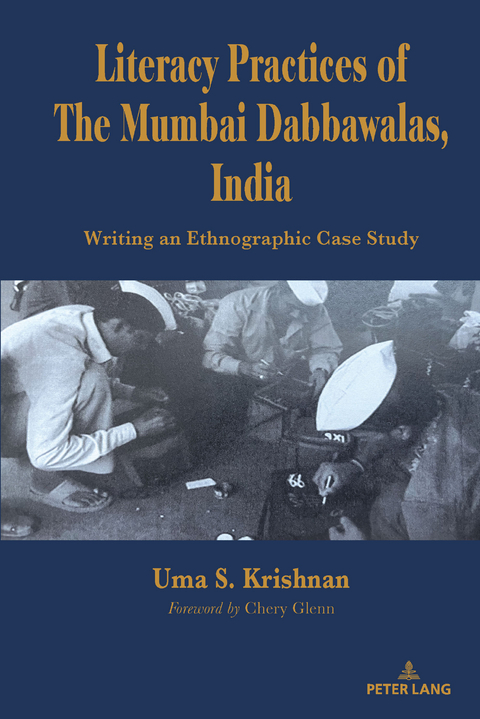
Literacy Practices of The Mumbai Dabbawalas, India
Peter Lang Publishing Inc (Verlag)
978-1-4331-8313-3 (ISBN)
This book explores the Mumbai Dabbawalas, an indigenous group in India, and their literacy practices within their business world. The author aims to demonstrate how she conducted her ethnographic case study as a model for others to follow in their own research. She takes the readers on a narrative journey, chronicling her decision to conduct the study and the completion of her dissertation. Through this journey, she highlights the influence of "literacy" definitions, particularly the autonomous model, on non-Western and indigenous groups, and how these definitions have impacted their literacy practices.
Using qualitative research methods, the author provides readers with insights into conducting a cross-cultural international ethnographic case study. She offers detailed explanations of her coding process and how she analyzed the extensive data to support her argument that the Dabbawalas' literacy practices contribute to their success. Additionally, Dr. Krishnan's cross-cultural study adds a new dimension to the field of ethnographic case study and challenges the autonomous model of literacy.
Uma S. Krishnan is a Professor of English at Kent State University, where she heads the Writing Internship Program and serves as the Associate Writing Program Coordinator. Additionally, she serves as honorary faculty in the Religion Studies-Minor Program. Outside of her academic responsibilities, she serves as the Assistant Chair of the CCCC standing Group on Global/Non-Western Standing Group. Over the years, Krishnan has received numerous awards for her teaching and research, including James Berlin Memorial Outstanding Dissertation Award, Honorable Mention, and STARTALK national recognition for Hindi Language Pedagogy.
Table of Contents - Part 1 – Dream - 1. Visualizing the research topic/project - 2. Narrowing and Providing rationale for choosing a specific topic - 3. Choosing a dissertation director - 4. Formatting the research question - 5. Developing a rough sketch of methods section - 6. Passing the Citi Test and Writing the IRB: What is an IRB? Why IRB? - 7. Preparing the prospectus or proposal for submission to the committee - Part 2 – Design - 1. Understanding the methodology - 2. Choosing the location and participants - 3. Chalking out other aspects of the study in minute details- including writing field notes - 4. Arriving at the location – Bounding the study - 5. Designing the data collection - Part 3 – Develop - 1. Unpacking all aspects of the field notes including Transcribing and Translating - 2. Beginning of Coding-fracturing and reducing: From data dump to data saturation to data theorization - 3. Recognizing the complexity and beauty in coding through personal memos and Deciphering the larger picture to overcome frustration - 4. Crosschecking and ensuring ethical practices: Triangulation and New discovery – triangle becomes cyclical - 5. Findings based on selective coding and deciphering the larger picture - 6. Writing the Ethnographic case study and feeling Upsilamba - Part 4 – Demonstrate - 1. Sending the chapters to the committee - 2. Preparing for the defense - 3. Developing confidence and defending your brainchild - 4. Succeeding in your efforts and congratulating yourself on a job well done - 5. Submitting to the national repository- Official completion of M.A/Ph.D
| Erscheinungsdatum | 07.02.2024 |
|---|---|
| Zusatzinfo | 40 Illustrations |
| Verlagsort | New York |
| Sprache | englisch |
| Maße | 152 x 229 mm |
| Gewicht | 491 g |
| Themenwelt | Geisteswissenschaften ► Sprach- / Literaturwissenschaft ► Sprachwissenschaft |
| Wirtschaft ► Volkswirtschaftslehre | |
| ISBN-10 | 1-4331-8313-7 / 1433183137 |
| ISBN-13 | 978-1-4331-8313-3 / 9781433183133 |
| Zustand | Neuware |
| Informationen gemäß Produktsicherheitsverordnung (GPSR) | |
| Haben Sie eine Frage zum Produkt? |
aus dem Bereich


