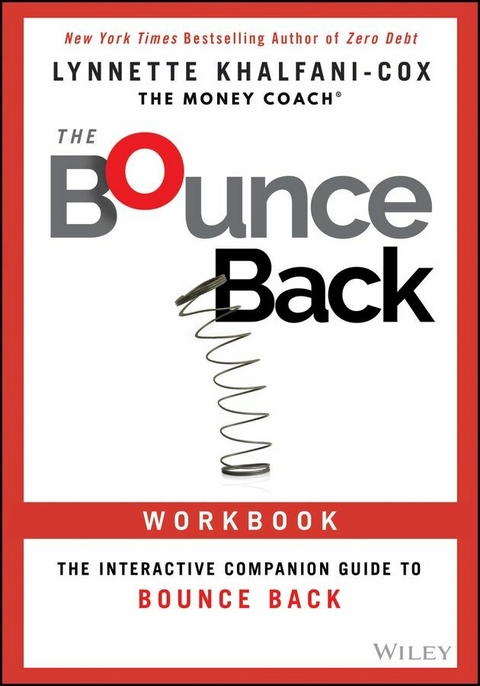
The Bounce Back Workbook (eBook)
John Wiley & Sons (Verlag)
978-1-394-20520-2 (ISBN)
Put the practical insights from Bounce Back to use with this companion workbook to financial resilience
Dive deeper into the lessons from Lynnette Khalfani-Cox's popular book, Bounce Back: The Ultimate Guide to Financial Resilience, and rebound financially with this workbook. A noted personal finance coach and New York Times bestselling author, Lynnette maps out a course for navigating some of life's toughest obstacles and walks you through hands-on activities you can take to recover from the 'Dreaded Ds,' including debt, downsizing from a job, divorce, the death of a loved one, disability, discrimination, and more.
With The Bounce Back Workbook, you'll learn to rise from setbacks with renewed emotional and financial strength. Lynnette offers the practical strategies, encouragement, inspiration, and tools specifically designed to support your progress, making this workbook more than just a valuable guide - it's a transformative experience.
Inside, you'll discover:
- Customizable self-assessments, reflection questions, writing prompts, tests and quizzes, goal-trackers, and more that personalize your journey
- Personal stories and inspirational case studies of people who have been in your position and triumphed over adversity
- A deeper understanding of yourself and your personal relationship with money
Whether as a companion to Bounce Back or a stand-alone resource, The Bounce Back Workbook is a must-read for anyone preparing for, or navigating through, the many challenges life throws our way. Use The Bounce Back Workbook to empower yourself with the tools and insights needed for both emotional and financial growth.
LYNNETTE KHALFANI-COX is a personal finance expert, keynote speaker, and the widely read author of 16 money-management books, including the New York Times bestseller Zero Debt: The Ultimate Guide to Financial Freedom. She's a former financial news journalist and co-owner of TheMoneyCoach.net LLC, a financial education company that offers financial education consulting, financial workshops, training programs, and more.
LYNNETTE KHALFANI-COX is a personal finance expert, keynote speaker, and the widely read author of 16 money-management books, including the New York Times bestseller Zero Debt: The Ultimate Guide to Financial Freedom. She's a former financial news journalist and co-owner of TheMoneyCoach.net LLC, a financial education company that offers financial education consulting, financial workshops, training programs, and more.
About the Author ix
Introduction xi
Chapter 1: Resilience and Grit 1
Chapter 2: Building Your Resilience 19
Chapter 3: Downsized from a Job 39
Chapter 4: Divorce 65
Chapter 5: Death of a Loved One 87
Chapter 6: Disability 101
Chapter 7: Disease 125
Chapter 8: Disasters 143
Chapter 9: Debt 159
Chapter 10: Damaged Credit 179
Chapter 11: Dollar Deficits 191
Chapter 12: Discrimination 203
Research Resources 215
Appendix A: Budget Worksheet 219
Appendix B: Net Worth Statement 223
Index 225
Chapter 1
Resilience and Grit
In the main Bounce Back book, we explored the concept of the Dreaded Ds and how they can be viewed as transitions in our lives. In this chapter of The Bounce Back Workbook, we'll start by diving deeper into the three stages of transition: the ending, neutral zone, and new beginnings, as proposed by change expert William Bridges. These stages provide a framework for understanding and navigating the emotional, psychological, and personal aspects of change.
Remember: change is something external, which happens to you, and it's often abrupt. Transition is something internal, which happens within you, and it typically takes months or sometimes years. You may not have a say‐so in whether or not something changes in your life—such as getting laid off or enduring the death of a relative. But you absolutely can shape your own transition, and how you process that change. One way to do that is to reframe your thinking. As awful as it is to get downsized from a job or to lose a loved one, for example, it's also true that life's toughest changes provide opportunities for positive transformation.
Reflection Activity: A Major Change in My Life
Instructions: Take time to reflect on a major change in your life and the resulting transition you faced. The change could be one of the 10 Dreaded Ds, or something else—such as retirement, marriage, finishing college, the birth of a child, or a big move to a new location. Consider the ending stage, neutral zone, and new beginnings stage as described in the Bridges Model. Write down your thoughts and feelings about each stage and how you navigated through them.
The specific change I experienced was: __________________________.
The change was (fill in the blank with “expected” or “unexpected”): __________________________.
When this change happened, I initially felt: __________________________.
Today, when I think of this change, I feel: __________________________.
When this change happened, other people told me: __________________________.
This change meant the end of: __________________________.
To deal with this change, I have done the following: __________________________.
At this point, I would describe my transition as: __________________________.
If I had to describe the level of stress I've experienced, I would say: __________________________.
Most changes in life—even when good things happen—present some level of stress. How has the stress of the change you described above affected you overall? Describe your reality below.
Here's how the change I experienced affected me physically, emotionally, personally, and financially: __________________________
__________________________.
__________________________.
TEST YOUR KNOWLEDGE
All stress is bad for you: true or false? (Circle one and explain your answer below)
____________________________________________________.
Are there any benefits to stress? If so, list at least one benefit. ____________________________________________________.
Benefit #1: ____________________________________________________.
Benefit #2: ____________________________________________________.
Benefit #3: ____________________________________________________.
(Hint: In Bounce Back, I cited information from Sudden Money Institute founder Susan Bradley, who offered three ways that stress helps you.)
Personal Storytelling: Sharing My Truth
How comfortable would you be sharing your own personal story of a significant change or transition you experienced? If you are able and have a trusted confidante, describe the ending, neutral zone, and new beginnings stages and how they impacted your life. Reflect on the lessons you learned and the growth you experienced during this process. If you don't have anyone you can tell, simply record yourself talking about your experiences.
In this exercise, you can also share a personal story of a significant change or transition you have experienced where you have made it to the other side. Describe the ending stage, where you recognized the need to let go; the neutral zone stage, where you explored new possibilities; and the new beginnings stage, where you embraced a different future. Share how this transition has shaped you, what insights you gained, and how it contributed to your personal growth.
Goal Setting for Future Changes or Transitions
In Bounce Back, I explained that Certified Financial Transitionists are financial experts who help people get through various life transitions. These experts are certified by the Sudden Money Institute, whose founder added another stage to Bridges's theory of transition: a planning stage. A planning stage is helpful because “sometimes we get the ability to know beforehand that something is ending,” says Stephanie Genkin, a CFP and Certified Financial Transitionist. She adds: “Many of us are in a state of financial transition and anticipation. We're anticipating events that we know are going to occur, like retirement, selling a business, or the death of an ill family member.”
Identify one change or transition you are currently facing or anticipate in the near future.
What would help you get through this experience? What kind of support do you need to feel better? Additionally, if you knew that the change was inevitable, and there was nothing you could do to stop it, what goals would you have for each stage of the transition process? Write your answers to these questions below. As you establish goals, consider the skills, support, and resources you will need along the way. Feel free to also add actionable steps you can take to move through each stage and create a new beginning that aligns with your values and aspirations.
____________________________________________________
____________________________________________________
____________________________________________________.
Writing Prompt: I Did That! Exploring My Own Resilience and Grit
Instructions: Resilience and grit play vital roles in navigating transitions and bouncing back from challenges. But sometimes we may not realize the existing strengths we possess or how we have successfully recovered from past setbacks. So reflect on your own resilience and grit by answering a series of self‐reflection questions below. Explore how you have demonstrated resilience in the face of adversity and how grit has fueled your determination to overcome past obstacles. Identify areas where you can further develop resilience or cultivate a resilient mindset.
What does resilience mean to you, particularly financial resilience? How would you personally define financial resilience?
____________________________________________________
____________________________________________________
____________________________________________________.
Reflect on your own level of financial resilience. Do you consider yourself financially resilient? Why or why not?
____________________________________________________
____________________________________________________
____________________________________________________.
In what ways have you demonstrated financial resilience in the face of unexpected financial challenges or setbacks? Can you recall specific instances where you were able to bounce back from financial hardships? If so, how did you do it?
.
Consider the concepts of resilience and grit as discussed in Bounce Back based on work by experts such as psychologist Angela Duckworth. How do you see these traits playing a role in your pursuit of financial resilience? How can resilience and grit help you overcome obstacles and maintain balance in your financial life?
____________________________________________________
____________________________________________________
____________________________________________________.
Reflect on the definition of financial health provided by the Financial Health Network. These are based on how well you save, spend, borrow, and plan. How many of the eight indicators of financial health align with your current circumstances? Which areas do you excel in, and which areas could benefit from improvement? Put an X mark next to each one as appropriate.
| Needs Improvement | Doing Great |
|---|
| Saving indicator 1: you have sufficient liquid savings | __________________________ | __________________________ |
| Saving indicator 2: you have adequate long‐term savings | __________________________ | __________________________ |
| Spending indicator 3: you spend less than you earn | __________________________ | __________________________ |
| Spending indicator 4: you pay all bills on time | __________________________ | __________________________ |
| Borrowing indicator 5: you have manageable debt | __________________________ | __________________________ |
| Borrowing indicator 6: you have a prime credit score... |
| Erscheint lt. Verlag | 3.1.2024 |
|---|---|
| Sprache | englisch |
| Themenwelt | Sachbuch/Ratgeber ► Beruf / Finanzen / Recht / Wirtschaft ► Geld / Bank / Börse |
| Recht / Steuern ► Wirtschaftsrecht | |
| Wirtschaft ► Betriebswirtschaft / Management | |
| Schlagworte | Finance & Investments • financial self-help • Finanz- u. Anlagewesen • money advice • money tips • personal finance • personal finance advice • personal finance book • Personal finance guidance • personal finance self-help • Personal finance strategies • Personal finance tips • personal finance tools • Private Finanzplanung |
| ISBN-10 | 1-394-20520-1 / 1394205201 |
| ISBN-13 | 978-1-394-20520-2 / 9781394205202 |
| Informationen gemäß Produktsicherheitsverordnung (GPSR) | |
| Haben Sie eine Frage zum Produkt? |
 EPUB (Adobe DRM)
Kopierschutz: Adobe-DRM
Adobe-DRM ist ein Kopierschutz, der das eBook vor Mißbrauch schützen soll. Dabei wird das eBook bereits beim Download auf Ihre persönliche Adobe-ID autorisiert. Lesen können Sie das eBook dann nur auf den Geräten, welche ebenfalls auf Ihre Adobe-ID registriert sind.
Details zum Adobe-DRM
Dateiformat: EPUB (Electronic Publication)
EPUB ist ein offener Standard für eBooks und eignet sich besonders zur Darstellung von Belletristik und Sachbüchern. Der Fließtext wird dynamisch an die Display- und Schriftgröße angepasst. Auch für mobile Lesegeräte ist EPUB daher gut geeignet.
Systemvoraussetzungen:
PC/Mac: Mit einem PC oder Mac können Sie dieses eBook lesen. Sie benötigen eine
eReader: Dieses eBook kann mit (fast) allen eBook-Readern gelesen werden. Mit dem amazon-Kindle ist es aber nicht kompatibel.
Smartphone/Tablet: Egal ob Apple oder Android, dieses eBook können Sie lesen. Sie benötigen eine
Geräteliste und zusätzliche Hinweise
Buying eBooks from abroad
For tax law reasons we can sell eBooks just within Germany and Switzerland. Regrettably we cannot fulfill eBook-orders from other countries.
aus dem Bereich