


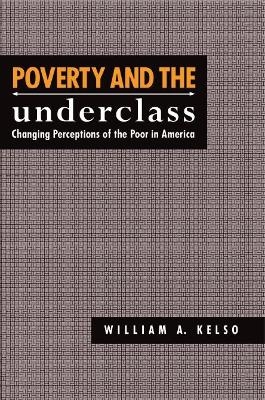
Poverty and the Underclass
Changing Perceptions of the Poor in America
Seiten
1994
New York University Press (Verlag)
978-0-8147-4658-5 (ISBN)
New York University Press (Verlag)
978-0-8147-4658-5 (ISBN)
This text argues for a new synthesis of liberal, conservative and radical views concerning poverty in order to appreciate its origins and to attack the problem effectively. The arguments of left and right are seen as misguided and new explanations for the persistence of poverty are offered.
Explains the failure—on both sides of the aisle—of the War on Poverty
The much-heralded War on Poverty has failed. The number of children living in poverty is steadily on the rise and an increasingly destructive underclass brutalizes urban neighborhoods. America's patience with the poor seems to have run out: even cities that have traditionally been havens for the homeless are arresting, harassing, and expelling their street people.
In this timely work, William Kelso analyzes how the persistence of poverty has resulted in a reversal of liberal and conservative positions during the last thirty years. While liberals in the 1960s hoped to eliminate the causes of poverty, today they increasingly seem resigned to merely treating its effects. The original liberal objective of giving the poor a helping hand by promoting equal opportunity has given way to a new agenda of entitlements and equal results. In contrast, conservatives who once suggested that trying to eliminate poverty was futile, now seek ways to eradicate the actual causes of poverty.
Poverty and the Underclass suggests that the arguments of both the left and right are misguided and offers new explanations for the persistence of poverty. Looking beyond the codewords that have come to obscure the debate—underclass, family values, the culture of poverty,—Kelso emphasizes that poverty is not a monolithic condition, but a vast and multidimensional problem.
During his Presidential campaign, Bill Clinton called for an overhaul of the welfare system and spoke of a new covenant to unite both the left and right in developing a common agenda for fighting poverty. In this urgent, landmark work, William Kelso merges conservative, radical, and liberal ideals to suggest how the intractable problem of poverty may be solved at long last by implementing the principles of this new covenant.
Explains the failure—on both sides of the aisle—of the War on Poverty
The much-heralded War on Poverty has failed. The number of children living in poverty is steadily on the rise and an increasingly destructive underclass brutalizes urban neighborhoods. America's patience with the poor seems to have run out: even cities that have traditionally been havens for the homeless are arresting, harassing, and expelling their street people.
In this timely work, William Kelso analyzes how the persistence of poverty has resulted in a reversal of liberal and conservative positions during the last thirty years. While liberals in the 1960s hoped to eliminate the causes of poverty, today they increasingly seem resigned to merely treating its effects. The original liberal objective of giving the poor a helping hand by promoting equal opportunity has given way to a new agenda of entitlements and equal results. In contrast, conservatives who once suggested that trying to eliminate poverty was futile, now seek ways to eradicate the actual causes of poverty.
Poverty and the Underclass suggests that the arguments of both the left and right are misguided and offers new explanations for the persistence of poverty. Looking beyond the codewords that have come to obscure the debate—underclass, family values, the culture of poverty,—Kelso emphasizes that poverty is not a monolithic condition, but a vast and multidimensional problem.
During his Presidential campaign, Bill Clinton called for an overhaul of the welfare system and spoke of a new covenant to unite both the left and right in developing a common agenda for fighting poverty. In this urgent, landmark work, William Kelso merges conservative, radical, and liberal ideals to suggest how the intractable problem of poverty may be solved at long last by implementing the principles of this new covenant.
William A. Kelso teaches political science at the University of Florida and is the author of American Democratic Theory: Pluralism and Its Critics.
| Erscheint lt. Verlag | 1.10.1994 |
|---|---|
| Verlagsort | New York |
| Sprache | englisch |
| Maße | 153 x 229 mm |
| Themenwelt | Sozialwissenschaften ► Soziologie ► Makrosoziologie |
| Wirtschaft ► Volkswirtschaftslehre | |
| ISBN-10 | 0-8147-4658-6 / 0814746586 |
| ISBN-13 | 978-0-8147-4658-5 / 9780814746585 |
| Zustand | Neuware |
| Informationen gemäß Produktsicherheitsverordnung (GPSR) | |
| Haben Sie eine Frage zum Produkt? |
Mehr entdecken
aus dem Bereich


aus dem Bereich
wie Sie unvergessliche Events und transformative Meetings gestalten
Buch | Softcover (2025)
Vahlen (Verlag)
CHF 34,85


