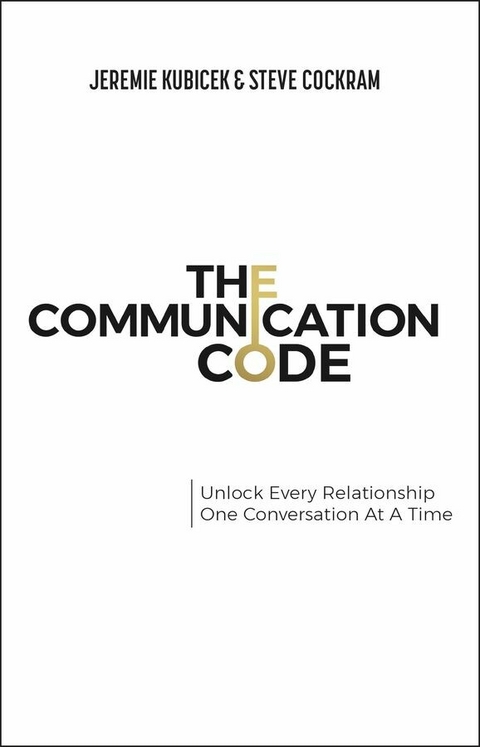
The Communication Code (eBook)
John Wiley & Sons (Verlag)
978-1-394-15054-0 (ISBN)
Provides a proven series of skills and techniques that anyone can use to make their relationships thrive
Healthy communication is essential in any professional or personal relationship. When the lines of communication are frayed or broken, the resulting drama, unnecessary conflict, and inefficiency often lead to 'dropping the ball'. Better communication yields better results. It's a no-brainer-honest conversations build deeper, more productive relationships. It may seem simple in theory, but healthy communication is one of the most challenging things to master in practice.
The Communication Code helps you set up conversations and communication in a way that creates a win-win scenario for everyone involved. In this real-world guide, bestselling authors and international speakers Jeremie Kubicek and Steve Cockram share their simple but powerful strategies for boosting your emotional intelligence and elevating your interpersonal communication skills. Step by step, you will learn to integrate Care, Celebration, Collaboration, Critique, and Clarification into your communication toolbox. Using one of these 5 Cs, you can verbally ask someone to respond in the way that you most want, and as a result, facilitate a successful interaction.
Written by the team that brought you The 100X Leader, The 5 Voices, and The 5 Gears, this must-have book will help you:
- Connect and communicate effectively with your team, your family, and your friends
- Define the parameters of a conversation from the outset to avoid any misunderstandings
- Understand the power dynamics of an interaction to eliminate the fear of honest conversation
- Offer constructive criticism without offending or disappointing the person on the other side
- Maximize your situational awareness and collaborate like a pro
- Prevent communication attacks and restore healthy communication flow
The Communication Code: Unlock Every Relationship, One Conversation at a Time offers a practical, easy-to-implement solution for decreasing or eliminating miscommunication. It is essential reading for anyone wanting to improve the health of their relationships through clear and authentic communication.
JEREMIE KUBICEK is Executive Chairman and co-Founder of GiANT Worldwide. He is a global speaker, serial entrepreneur and Wall Street Journal bestselling author of Making Your Leadership Come Alive and The Peace Index. He is co-author of The 100X Leader, The 5 Voices, and The 5 Gears.
STEVE COCKRAM is an international speaker, author, and consultant to international executives and leaders. He is a subject matter expert on organizational leadership, emotional intelligence, and interpersonal communication. He is a co-Founder of GiANT Worldwide and GiANT London.
JEREMIE KUBICEK is Executive Chairman and co-Founder of GiANT Worldwide. He is a global speaker, serial entrepreneur and Wall Street Journal bestselling author of Making Your Leadership Come Alive and The Peace Index. He is co-author of The 100X Leader, The 5 Voices, and The 5 Gears. STEVE COCKRAM is an international speaker, author, and consultant to international executives and leaders. He is a subject matter expert on organizational leadership, emotional intelligence, and interpersonal communication. He is a co-Founder of GiANT Worldwide and GiANT London.
Acknowledgments xi
Introduction xiii
Chapter 1 The Secret of Relational Codes 1
Chapter 2 The Power of the Past 15
Chapter 3 The Communication Code 35
Chapter 4 Why Celebrating Works 51
Chapter 5 Why You Should Care 75
Chapter 6 The Superpower of Clarity 93
Chapter 7 Collaborating to Win 105
Chapter 8 How to Critique Without Being Critical 117
Chapter 9 People Whispering 133
Chapter 10 Is It Worth It? 151
Chapter 11 Re- Establishing Communication 167
Chapter 12 Your Communication Plan 183
About the Authors 189
Index 191
1
The Secret of Relational Codes
People are enigmas. They are mysterious, puzzling, and sometimes challenging to understand. Knowing their thoughts or motives for doing certain things is typically quite tricky.
Everyone has a complex Communication Code that needs to be unlocked if trust is to be established in a relationship and if communication is to flow freely. Most people are blissfully unaware of this fact; consequently, they don't know how to help you connect with them.
The enigma is found in the complexity of how to fully know someone—to be allowed in at the deepest levels of their life.
“People are an enigma, wrapped in a mystery, shrouded in riddles, and coated in layers of complexity.”
—Anand Nav
You are just as puzzling as anyone else. Just as you don't understand them, people in your life may not fully understand you either, nor how you operate, which makes the game of relationships tiring, frustrating, and thrilling at the same time.
In this chapter you will learn what communication is, how people engage in relationship‐centric communication, and how to establish the trust needed to unlock others.
Complexity Is Complex
The complexity of our communication exists due to the nature of our personality, our nurtured upbringing, and the expectations of others. Add that the choices we have made affecting our outcomes mean that every human being, like a snowflake, is truly unique.
Our life experiences (nurture) lead us to make particular choices. When life hurts or disappoints us, we add another layer of complexity to our code, making it harder for people to connect with us because they don't know how to read us.
Over time, the Communication Code inside relationships can become impenetrable, and communication can become impossible, which might cause someone to pull away and think, “It isn't worth getting that close to them.”
When people pull away, the result can create an unease in relationships and loneliness can set in. Loneliness is the despair of our age. We have never been more connected digitally yet more isolated relationally.
We have a way to change that!
Understanding Communication
Transmission of information is not communication. You can send a message repeatedly, but if the recipient doesn't understand the transmission, decode it properly, and confirm they have received it, then your message is only a one‐way transmission.
Effective communication happens when the person receiving our transmission is aware of our expectations and intent, and can respond appropriately.
Communication, then, is the transmission of expectation or intent during this exchange. It involves a Sender + a Message + a Recipient, just like one satellite sends a message and another receives it.
Communication between two parties aims to ensure that we are on the same page, relationally and transactionally. The better the relationship, the more transparent the communication. Conversely, the lower the relational trust, the less effective the communication. Repeated frustrations in trying to communicate eventually lead us to stop trying.
Communication is the transmission and receiving of expectation or intent.
If you want better communication, you must understand how to unlock others and communicate your intent and expectations.
Missed Communication
Two co‐workers, Ian and Jane, worked in the same department of a large corporation. Ian was responsible for collecting and analyzing data, while Jane created reports based on that data.
Ian was a very intelligent person, but he was not very good at communicating with others. He often sent Jane his reports without context or explanation, assuming she would understand everything independently.
Jane was different. She was an amiable and outgoing person who loved collaborating. However, she found it challenging to work with Ian because of his lack of communication. She would often have to spend hours trying to decipher his reports and would sometimes make incorrect assumptions, which would lead to errors in her work.
Despite Jane's attempts to share her frustrations with Ian, he never seemed to understand the problem. He continued to transmit his thoughts through long emails without any context or explanation, and their working relationship continued to suffer.
Over time, the tension between Ian and Jane grew, and they began to avoid each other whenever possible. This affected their work and the team's morale, and other colleagues noticed the strain between them.
Their manager noticed the problem and tried intervening, but Ian resisted. He felt that his reports were clear and concise, and he did not see the need to provide any additional explanation.
As time passed, Jane became increasingly frustrated with the situation. She started to dread receiving reports from Ian, knowing she would have to spend hours deciphering them. She tried to find ways to work around Ian, but it wasn't easy because their work was interconnected.
Unfortunately, their relationship never improved. Despite attempts by their manager to mediate, Ian remained stubborn and unwilling to change. Jane eventually left the company, unable to work in an environment where effective communication was not valued.
Two smart people needed help understanding the fundamental reality that the transmission of information is not communication. It takes two people to receive the intent and confirm their understanding.
Why People Create Codes
People create codes to protect themselves because relationships can be emotionally intense, and individuals may feel vulnerable or exposed inside these relationships.
Our relational codes can change over time as we experience life. When we are hurt, we add a new level of complexity to the code to avoid experiencing that pain again. This avoidance explains why people growing up in safe and healthy families have more straightforward relational codes to crack. Conversely, abuse, trauma, heartbreak, and loss can cause humans to add complexity to their relational code.
Self‐awareness allows us to share our relational code clearly with others. It helps them understand how to connect more effectively.
Relational dynamics are complex, and the work has to start with each of us individually. What's it like to be on the other side of you in a relationship? What happens when you are accidental? How do you make it hard for people to relate and connect with you? The answers will differ for each of us, but it is important to understand.
For instance, I, Jeremie, am a Connector, Creative, Pioneer (ENFP in Myers Briggs). Steve is a Pioneer, Connector (ENTP in Myers Briggs). Human behavior is far more predictable than you would think, for us being able to share our Voice order communicates a considerable part of our relational code.
GiANT, the company we founded, has excellent tools and lenses to help you understand your personality better. If you're unfamiliar with it, we suggest you take the 5 Voices assessment (details are in the endnotes).1
Maintaining healthy and vibrant long‐term relationships requires understanding the relational dynamics of those in your life, and to do that, well, you will need tools and lenses to properly understand others.
Because people are not self‐aware enough to share their codes, people remain complex enigmas, even to those closest to them. Occasionally, they appear to crack the other person's code, and communication is healthy. Still, neither party knows why, so it's hard to repeat. Ultimately, communication in the relationship remains frustrating, expectations diminish over time, and people either settle for the status quo or move on and try again with someone else.
The Most Complex Codes
In World War II, Germany created the ultimate code machine, called Enigma. It was built to encrypt and keep their communications safe so others couldn't decipher their top‐secret maneuvers—just like people do to protect themselves from other people.
This machine was an electromechanical cipher machine that used a series of rotors to encrypt and decrypt messages. It has a keyboard for inputting text like a typewriter and a lamp board displaying the ciphertext. Each letter typed on the keypad would be transformed into a different letter or symbol, which made cracking the code nearly impossible.
The Allies considered the Enigma machine to be unbreakable. However, a team of codebreakers led by Alan Turing at Bletchley Park in England broke the Enigma code through ingenuity, advanced technology, and luck.
One of the techniques Turing and his team used was developing a machine called the Bombe. This machine was used to determine the settings of the rotors on the Enigma machine by simulating the encryption process and looking for patterns in the cipher text. The movie The Imitation Game highlights the team's dramatic approach to cracking the Enigma code.
Turing and his team were able to break the Enigma code regularly, which provided valuable intelligence to the Allies. They were a significant factor in the outcome of World War II. They shortened the war by several years and saved countless lives.
So why the history lesson? Precisely because some of your most important relationships may feel like the Enigma...
| Erscheint lt. Verlag | 1.11.2023 |
|---|---|
| Sprache | englisch |
| Themenwelt | Sachbuch/Ratgeber ► Beruf / Finanzen / Recht / Wirtschaft ► Bewerbung / Karriere |
| Wirtschaft ► Betriebswirtschaft / Management | |
| Schlagworte | Business & Management • Business Self-Help • Communication • interpersonal communication techniques • Leadership Communication • leadership communication development • leadership communication guide • Leadership communication techniques • leadership conversation techniques • leadership relationship techniques • Ratgeber Wirtschaft • Wirtschaft /Ratgeber • Wirtschaft u. Management |
| ISBN-10 | 1-394-15054-7 / 1394150547 |
| ISBN-13 | 978-1-394-15054-0 / 9781394150540 |
| Informationen gemäß Produktsicherheitsverordnung (GPSR) | |
| Haben Sie eine Frage zum Produkt? |
 EPUB (Adobe DRM)
Kopierschutz: Adobe-DRM
Adobe-DRM ist ein Kopierschutz, der das eBook vor Mißbrauch schützen soll. Dabei wird das eBook bereits beim Download auf Ihre persönliche Adobe-ID autorisiert. Lesen können Sie das eBook dann nur auf den Geräten, welche ebenfalls auf Ihre Adobe-ID registriert sind.
Details zum Adobe-DRM
Dateiformat: EPUB (Electronic Publication)
EPUB ist ein offener Standard für eBooks und eignet sich besonders zur Darstellung von Belletristik und Sachbüchern. Der Fließtext wird dynamisch an die Display- und Schriftgröße angepasst. Auch für mobile Lesegeräte ist EPUB daher gut geeignet.
Systemvoraussetzungen:
PC/Mac: Mit einem PC oder Mac können Sie dieses eBook lesen. Sie benötigen eine
eReader: Dieses eBook kann mit (fast) allen eBook-Readern gelesen werden. Mit dem amazon-Kindle ist es aber nicht kompatibel.
Smartphone/Tablet: Egal ob Apple oder Android, dieses eBook können Sie lesen. Sie benötigen eine
Geräteliste und zusätzliche Hinweise
Buying eBooks from abroad
For tax law reasons we can sell eBooks just within Germany and Switzerland. Regrettably we cannot fulfill eBook-orders from other countries.
aus dem Bereich