


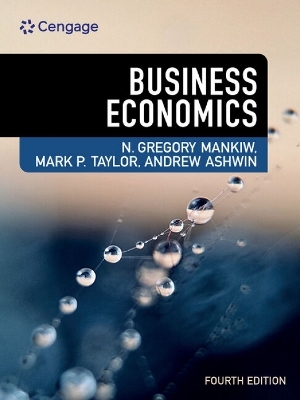
Business Economics
Cengage Learning EMEA (Verlag)
978-1-4737-9131-2 (ISBN)
All the Mankiw titles are known for their friendly and accessible approach which is retained in this new edition’s unique business perspective, enabling economic theory to be applied to real world scenarios. Such an active learning approach ensures academic skills can be easily absorbed and transferred to the workplace.
This edition includes new chapters on business organization, supply chains and sustainability, together with a wealth of new and updated case studies and ‘In the News’ features throughout.
This title is supported by MindTap, a flexible online learning platform that provides students with all the tools they need to succeed including an interactive eReader, engaging multimedia, practice questions, assessment materials, revision aids, and analytics to help you track their progress.
N. Gregory Mankiw is the Robert M. Beren Professor of Economics at Harvard University. As a student, he studied economics at Princeton University and the Massachusetts Institute of Technology. As a teacher, he has taught macroeconomics, microeconomics, statistics and principles of economics. Professor Mankiw is a prolific writer and a regular participant in academic and policy debates. In addition to his teaching, research and writing, Professor Mankiw has been a research associate of the National Bureau of Economic Research and an advisor to the Federal Reserve Banks of Boston and New York and the Congressional Budget Office. From 2003 to 2005, he served as chairman of the US President’s Council of Economic Advisors and was an advisor to presidential candidate Mitt Romney during the 2012 US presidential election. Mark P. Taylor is the Donald Danforth, Jr Distinguished Professor of Finance at the Olin Business School at Washington University in St Louis, USA. He was previously Dean of the Olin Business School and, before that, Dean and Professor of Finance and Economics at of Warwick Business School at the University of Warwick, UK. He obtained his first degree in philosophy, politics and economics from Oxford University and a Master’s and Doctoral degrees in economics and finance from London University.. Professor Taylor has taught economics at various universities (including Warwick, Oxford, Marseille and New York), at various levels (from principles courses to advanced graduate and MBA courses) and in various fields (including macroeconomics, microeconomics and econometrics). He has also worked as a senior economist at the International Monetary Fund and at the Bank of England and as a managing director at BlackRock, the world’s largest financial asset manager, where he ran a global investment fund based on macroeconomic analysis. His work has been extensively published in scholarly journals, such as the Journal of Political Economy and the Economic Journal, and he is today one of the most highly cited economists in the world in economic research. In addition, Professor Taylor has acted as an advisor to the International Monetary Fund, the World Bank, the Bank of England, the European Commission and to senior members of the UK government. He is a research fellow of the Centre for Economic Policy Research, a member of council of the Royal Economic Society and a fellow of both the Royal Statistical Society and the Royal Society of Arts. Andrew Ashwin is an Associate Lecturer in the Department of Management in the Lincoln International Business School, at the University of Lincoln in the UK. Andrew teaches and supports students doing undergraduate degrees and MBAs in Leadership and Management across a range of modules and also teaches Commercial and Operational Management to students following master's degrees in the Lincoln Institute for Agricultural Technology. He has an MBA from the University of Hull and a PhD in assessment and the notion of threshold concepts in economics from the University of Leicester. Andrew is an experienced author, writing a number of texts for students at different levels, and journal publications related to his PhD research as well as working on the development of online learning materials at the University of Bristol’s Institute of Learning and Research Technologies. Andrew was Chair of Examiners for a major awarding body for business and economics in England and is a subject specialist consultant in economics for the UK regulator, Ofqual. Andrew has a keen interest in assessment and learning in economics and has received accreditation as a Chartered Assessor with the Chartered Institute of Educational Assessors. He has also edited the journal of the Economics, Business and Enterprise Association.
PART I. THE ECONOMIC AND BUSINESS ENVIRONMENT
1. What is business economics?
2. Economics and business decision making
3. The business environment
PART II. MICROECONOMICS: THE MARKET SYSTEM
4. Supply and demand: How markets work
5. Elasticity and its applications
6. Taxes and subsidies
PART III. MICROECONOMICS: THE LIMITATIONS OF MARKETS
7. Market failure
8. The consumer and consumer behaviour
PART IV. MICROECONOMICS: THE ECONOMICS OF FIRMS IN MARKETS
9. Costs and revenues in production
10. Business goals and behaviour
11. Business organization
12. Market structures: Perfect competition
13. Market structures: Monopoly
14. Market structures: Imperfect or monopolistic competition
15. Market structures: Oligopoly
16. Corporate strategy and pricing policy
17. Supply chains
PART V. MICROECONOMICS: FACTOR MARKETS
18. Labour markets
19. Financial markets
PART VI. INTRODUCTION TO MACROECONOMICS
20. The macroeconomic environment
21. Aggregate demand and aggregate supply as a model to describe the economy
22. Government economic policy and the effect on business: Fiscal, monetary and supply side policy
PART VII. GLOBAL BUSINESS AND ECONOMICS
23. Business and trade
24. Global influences on business behaviour
25. Business and Europe
26. Sustainability
| Erscheinungsdatum | 06.01.2024 |
|---|---|
| Verlagsort | London |
| Sprache | englisch |
| Maße | 194 x 22 mm |
| Gewicht | 1020 g |
| Themenwelt | Sozialwissenschaften ► Pädagogik |
| Wirtschaft ► Betriebswirtschaft / Management | |
| Wirtschaft ► Volkswirtschaftslehre | |
| ISBN-10 | 1-4737-9131-6 / 1473791316 |
| ISBN-13 | 978-1-4737-9131-2 / 9781473791312 |
| Zustand | Neuware |
| Informationen gemäß Produktsicherheitsverordnung (GPSR) | |
| Haben Sie eine Frage zum Produkt? |
aus dem Bereich


