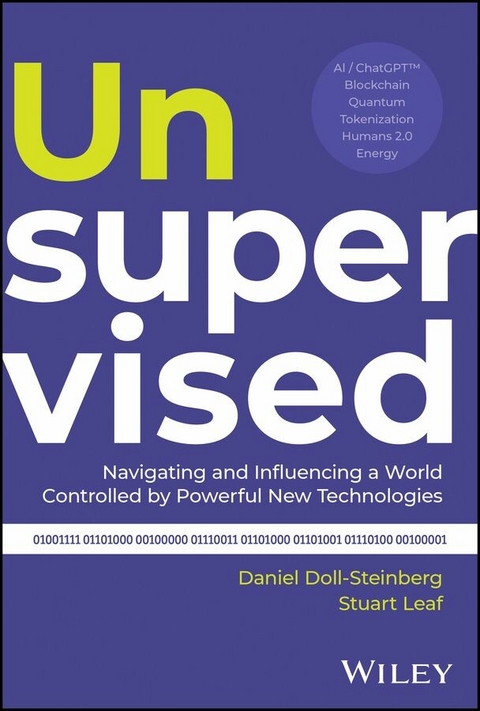
Unsupervised (eBook)
John Wiley & Sons (Verlag)
978-1-394-20991-0 (ISBN)
Unsupervised: Navigating and Influencing a World Controlled by Powerful New Technologies examines the fast-emerging technologies and tools that are already starting to completely revolutionize our world. Beyond that, the book takes an in-depth look at how we have arrived at this dizzying point in our history, who holds the reins of these formidable technologies, mostly without any supervision. It explains why we as business leaders, entrepreneurs, academics, educators, lawmakers, investors or users and all responsible citizens must act now to influence and help oversee the future of a technological world. Quantum computing, artificial intelligence, blockchain, decentralization, virtual and augmented reality, and permanent connectivity are just a few of the technologies and trends considered, but the book delves much deeper, too. You'll find a thorough analysis of energy and medical technologies, as well as cogent predictions for how new tech will redefine your work, your money, your entertainment, your transportation and your home and cities, and what you need to know to harness and prosper from these technologies.
Authors Daniel Doll-Steinberg and Stuart Leaf draw on their decades of building and implementing disruptive technologies, investing and deploying funds, and advising business leaders, governments and supranational bodies on change management, the future of work, innovation and disruption, education and the economy to consider how every area of our lives, society, economy and government will likely witness incredible changes in the coming decade. When we look just a bit further into the future, we can see that the task facing us is to completely reinvent life as we know it-work, resources, war, and even humanity itself will undergo redefinition, thanks to these new and emerging tools. In Unsupervised, you'll consider what these redefinitions might look like, and how we as individuals, and part of society, can prevent powerful new technologies from falling into the wrong hands or be built to harm us.
- Get a primer on the foundational technologies that are reshaping business, pleasure, and life as we know it
- Learn about the lesser known, yet astonishing, technologies set to revolutionize medicine, agriculture, and beyond
- Consider the potential impact of new tech across business sectors-and what it means for you
- Gain the knowledge and inspiration you need to harness your own power and push the future in the direction of good for all of us not just the few
- Explore the best ways to invest in the changes these technologies of the future will bring about
This is a remarkably thorough and comprehensive look at the future of technology and everything it touches. Shining a light on many unsupervised technologies and their unsupervised oligarchy of masters.
DANIEL DOLL-STEINBERG, after a career in the early days of global derivatives technology industry, he created one of the first global standards for digital rights management, securing and delivering activation keys and content direct to customers, which helped transform the software industry. Specializing in disruptive technologies, he focused on Blockchain and AI, investing in and transforming real world products and companies with these transformative technologies and in 2017 cofounded the Atari Token Metaverse project. Daniel was appointed by the European Commission, and then the UK government, an expert advisor specializing in education, growth, disruption, and Future of Work policy.
STUART LEAF started his career at Merrill Lynch Capital Markets and Goldman Sachs. He held senior positions in smaller real estate, private equity, and asset management firms, before co-founding Cadogan Management, a Fund of Hedge Funds, in 1994. Investing around the world in a range of different strategies, including a significant exposure to technology, he and his partners grew the funds to $7.5 billion in assets.
How a broad range of new immensely powerful technologies is disrupting and transforming every corner of our reality and why you must act and adapt Unsupervised: Navigating and Influencing a World Controlled by Powerful New Technologies examines the fast-emerging technologies and tools that are already starting to completely revolutionize our world. Beyond that, the book takes an in-depth look at how we have arrived at this dizzying point in our history, who holds the reins of these formidable technologies, mostly without any supervision. It explains why we as business leaders, entrepreneurs, academics, educators, lawmakers, investors or users and all responsible citizens must act now to influence and help oversee the future of a technological world. Quantum computing, artificial intelligence, blockchain, decentralization, virtual and augmented reality, and permanent connectivity are just a few of the technologies and trends considered, but the book delves much deeper, too. You'll find a thorough analysis of energy and medical technologies, as well as cogent predictions for how new tech will redefine your work, your money, your entertainment, your transportation and your home and cities, and what you need to know to harness and prosper from these technologies. Authors Daniel Doll-Steinberg and Stuart Leaf draw on their decades of building and implementing disruptive technologies, investing and deploying funds, and advising business leaders, governments and supranational bodies on change management, the future of work, innovation and disruption, education and the economy to consider how every area of our lives, society, economy and government will likely witness incredible changes in the coming decade. When we look just a bit further into the future, we can see that the task facing us is to completely reinvent life as we know it work, resources, war, and even humanity itself will undergo redefinition, thanks to these new and emerging tools. In Unsupervised, you'll consider what these redefinitions might look like, and how we as individuals, and part of society, can prevent powerful new technologies from falling into the wrong hands or be built to harm us. Get a primer on the foundational technologies that are reshaping business, pleasure, and life as we know it Learn about the lesser known, yet astonishing, technologies set to revolutionize medicine, agriculture, and beyond Consider the potential impact of new tech across business sectors and what it means for you Gain the knowledge and inspiration you need to harness your own power and push the future in the direction of good for all of us not just the few Explore the best ways to invest in the changes these technologies of the future will bring about This is a remarkably thorough and comprehensive look at the future of technology and everything it touches. Shining a light on many unsupervised technologies and their unsupervised oligarchy of masters.
DANIEL DOLL-STEINBERG, after a career in the early days of global derivatives technology industry, he created one of the first global standards for digital rights management, securing and delivering activation keys and content direct to customers, which helped transform the software industry. Specializing in disruptive technologies, he focused on Blockchain and AI, investing in and transforming real world products and companies with these transformative technologies and in 2017 cofounded the Atari Token Metaverse project. Daniel was appointed by the European Commission, and then the UK government, an expert advisor specializing in education, growth, disruption, and Future of Work policy. STUART LEAF started his career at Merrill Lynch Capital Markets and Goldman Sachs. He held senior positions in smaller real estate, private equity, and asset management firms, before co-founding Cadogan Management, a Fund of Hedge Funds, in 1994. Investing around the world in a range of different strategies, including a significant exposure to technology, he and his partners grew the funds to $7.5 billion in assets.
Foreword viii
Preface x
Introduction xv
Suggested Reading xxx
Part I Important Technologies You Cannot Ignore 1
Chapter 1 Foundational Technologies 7
Chapter 2 Enabling Technology 43
Chapter 3 Consumer-Facing Hardware Technologies 77
Chapter 4 Important Uses of Technologies You Cannot Ignore 97
Part II The Impact and Implications on Humanity of Disruptive Technologies 137
Chapter 5 Reinventing the Economy 141
Chapter 6 Reinventing Work 171
Chapter 7 Reinventing Education 197
Chapter 8 Reinventing Information and Communication 207
Chapter 9 Reinventing Control 227
Chapter 10 Reinventing the Planet 247
Chapter 11 Reinventing Humans and Humanity 263
Chapter 12 Technology Reinventing Itself 279
Chapter 13 Key Influencers on Frontier Technologies 295
Part III Final Thoughts 327
Chapter 14 Ethics and Policy 329
Chapter 15 Conclusion 339
Chapter 16 Final Word 351
About the Authors 355
Index 357
Introduction
“The greatest victory is that which requires no battle.”
—Sun Tzu
Where the World Is Now
At the start of this project in late 2020, we believed that by 2025, the world would start to “reboot” due to a range of disruptive frontier technologies. It is only 2023, and the process is already underway on many fronts. These include the following:
- The rapid evolution of AI, including the public launch of ChatGPT from OpenAI—a technology few had heard of two years ago when it could not even execute simple mathematical equations for us—that could be accessed and used by millions whatever their technical level, simply through a command prompt becoming truly general purpose. It can now independently conduct research and write papers at graduate-student levels. Each new release promises to be many times more sophisticated.
- An acceleration in funding and real progress in quantum computing.
- The ability for computers to create art—so good it has been banned on certain marketing platforms.
- AI computer code generators starting to match many of the best developers in the world. GitHub Copilot can create usable computer code so impressive, Andrej Karpathy, the previous director of AI and autopilot vision at Tesla, tweeted that he uses it to write about 80 percent of his code.
- A new system called VALL-E was announced that can use a mere 3-second sample to accurately simulate anyone's voice.
And combined, all of these lead toward a concentration of power not seen since the Industrial Revolution.
The Industrial Revolution started in the United Kingdom in the late 1700s with Thomas Newcomen's prototype of the first modern steam engine. By the 1830s, it led to mechanization and the modern factory systems of Europe and the United States and started to replace manual workers. The Industrial Revolution effectively and rapidly replicated and then bettered human beings’ physical capabilities starting in manufacturing and farming and led to more than 200 years of astounding human achievement. It has not, however, been without massive dislocation on every front. In the early 1800s, 90 percent of the U.S. population lived on farms; it is now around 1 percent.1 Humanity has adapted. And just as the developed world has settled in and the developing world is looking to follow, the rules have changed, and there is nothing gradual about it.
The increase in computational power and explosion of new technologies is often referred to as the Fourth Industrial Revolution (4IR), but this term greatly understates its seismic impact. It is forcing, at breathtaking pace, an entire shift in paradigm. Our cognitive abilities are being copied, matched, and replaced by technologies—the capabilities of which grow exponentially, while our own increase only linearly, if at all. Today, we are actually in the early stages of the Cognitive Revolution. Entrepreneurs, Big Tech, and governments are spending billions a year, racing to replace what humans have done for millennia, and we are now integrating these technologies into every aspect of our lives and world. As frontier technologies become increasingly general purpose (i.e., not requiring domain experts to create them), more and more people will be able to deliver and deploy them, making them virtually unstoppable. This has enormous upside potential, but also creates considerable challenges. As during every previous leap forward, there will be numerous externalities and unintended consequences.
Over time, technologies will increasingly simulate the world and the human brain more accurately, allowing them to fully execute human processes and activities. Over the past five decades, every 18 months to 2 years, the power of these technologies has doubled. This could slow, but the odds are much stronger that it will accelerate, perhaps at unimaginable rates.
Then there is, of course, the added possibility these technologies become sentient, in which case everything changes—an event referred to as the Singularity.
The Cognitive Revolution has already seen technologies take over human roles in agriculture, industry, and even post-industrial domains. This has delivered and will continue to generate huge benefits. But who will gain, and who will lose?
Much of this book focuses on technology and data, but understanding the relative impact on capital and labor is also important. There are two specific lenses:
- Productivity and disruption
- Economic and innovation cycles
By overlaying these two, we can begin to understand the drivers of why the world is entering a period of such enormous and significant change.
Before embarking on this journey, we should underline that the technologies we discuss are almost all designed by people who strive to achieve “technology for good.” And there is little doubt the past couple of decades have seen some of the greatest improvements in human living standards in recorded history, by almost every metric—lifespan, healthcare, child mortality, decreased famine, among untold others. Also, after years of ecological neglect since the Industrial Revolution, we have begun to take serious steps toward reversing the damage. Technology is clearly one of the primary drivers behind sustainability and continues to offer powerful solutions in most areas of our lives. The concerns aired in this book address the very important issue that technology is neither inherently good nor bad; it depends completely on how it is used and by whom. In the wrong hands, much damage can be done.
We must all pay attention.
2030: A New Future
“When it rains, look for rainbows. When it’s dark, look for stars.”
—Oscar Wilde
By 2030 the AI component alone of new frontier technologies could deliver an almost $16 trillion contribution to the global economy and replace up to 30 percent of current total hours worked, hugely impacting as many as one billion people.2 Such a market value is almost as large as the United States’ economy today, and it is growing much faster.
To put these numbers in perspective, the COVID-19 global lockdowns of 2020 were estimated to have temporarily cost the global economy 4 percent of the gross domestic product (GDP), or around $4.6 trillion,3 and furloughed 400 million jobs. Yet merely converting to driverless transportation could replace as much as 8 to 10 percent of global jobs.4
New frontier technologies are starting to replicate our cognitive abilities and are quickly becoming general purpose, with the potential to boost productivity in every industry—and fast. Two years ago, OpenAI's Generative Pre-trained Transformer version 3 (GPT-3) had just launched, and our tests showed that while it was an amazing technical achievement, it was rather basic. Today, it writes chapters like this one—and soon will probably do so much better than we can.
Founded in 2015, OpenAI made ChatGPT public in November 2022, and it immediately became a major focus of attention because it forced leaders in every sector (and users around the world) to focus on how much technologies like this will impact so much of our lives. In fact, some in the education sector have already called for it to be banned. The Italian government even instituted a ban (now reversed) on ChatGPT over concerns it had processed and used Italian data, citing the EU's General Data Protection Regulations. Even Elon Musk, a cofounder of ChatGPT, along with more than 1,000 other signatories, including AI professors and researchers at DeepMind, signed a letter calling for a 6-month pause on training systems more powerful than GPT-4. But it's too late. This is a battle among the new oligarchs. Each new version released biannually has been exponentially more powerful (particularly when used in conjunction with other evolving frontier technologies that are now being rapidly developed to augment it). At this rate, by 2030 it will be on version 7 and most likely thousands, or even millions, of times more powerful. Licensed by Microsoft, it is becoming clear the technology behind ChatGPT (and others currently in development) is already at a point that industries will be forced to adopt them or languish. Even the current version is truly transformative—both empowering and potentially devastating.
Most people think the next generation of technologies will be limited to AI like ChatGPT; many transformative applications, however, have already hit the mainstream. LEGO's Mindstorm range, which successfully abstracts and simplifies the complexities of building machines, has long enabled teens to quickly create relatively complex robotics with a combination of hardware and software elements that are easy to assemble and customize. Innovative LEGO creations have included ATMs, vending machines, guitar and piano players, and even T-shirt folders, knitting machines, and mini LEGO car-making assembly lines.
Even though so much of our life has already been changed by technology, most people dramatically underestimate the full impact on the global economy. This stems from three key concepts:
- Tesler's Theorem. AI is whatever hasn't been done yet.
- Amara's Law. We overestimate technology in the short term but underestimate it in the long term.
- Metcalfe's Law. As any network grows linearly in size and data, it becomes...
| Erscheint lt. Verlag | 25.7.2023 |
|---|---|
| Sprache | englisch |
| Themenwelt | Sachbuch/Ratgeber ► Geschichte / Politik ► Politik / Gesellschaft |
| Sozialwissenschaften ► Politik / Verwaltung | |
| Wirtschaft ► Betriebswirtschaft / Management | |
| Schlagworte | AI • Blockchain • blockchain revolution • Business & Management • Business & Society • Business Disruption • Crypto • Digital transformation • Disruptive technology • fourth industrial revolution • future tech • future technology • Futurism • gpt • machine learning • metaverse • tech books • Technologie • technology books • Wirtschaft • Wirtschaft u. Gesellschaft • Wirtschaft u. Management |
| ISBN-10 | 1-394-20991-6 / 1394209916 |
| ISBN-13 | 978-1-394-20991-0 / 9781394209910 |
| Informationen gemäß Produktsicherheitsverordnung (GPSR) | |
| Haben Sie eine Frage zum Produkt? |
 EPUB (Adobe DRM)
Kopierschutz: Adobe-DRM
Adobe-DRM ist ein Kopierschutz, der das eBook vor Mißbrauch schützen soll. Dabei wird das eBook bereits beim Download auf Ihre persönliche Adobe-ID autorisiert. Lesen können Sie das eBook dann nur auf den Geräten, welche ebenfalls auf Ihre Adobe-ID registriert sind.
Details zum Adobe-DRM
Dateiformat: EPUB (Electronic Publication)
EPUB ist ein offener Standard für eBooks und eignet sich besonders zur Darstellung von Belletristik und Sachbüchern. Der Fließtext wird dynamisch an die Display- und Schriftgröße angepasst. Auch für mobile Lesegeräte ist EPUB daher gut geeignet.
Systemvoraussetzungen:
PC/Mac: Mit einem PC oder Mac können Sie dieses eBook lesen. Sie benötigen eine
eReader: Dieses eBook kann mit (fast) allen eBook-Readern gelesen werden. Mit dem amazon-Kindle ist es aber nicht kompatibel.
Smartphone/Tablet: Egal ob Apple oder Android, dieses eBook können Sie lesen. Sie benötigen eine
Geräteliste und zusätzliche Hinweise
Buying eBooks from abroad
For tax law reasons we can sell eBooks just within Germany and Switzerland. Regrettably we cannot fulfill eBook-orders from other countries.
aus dem Bereich