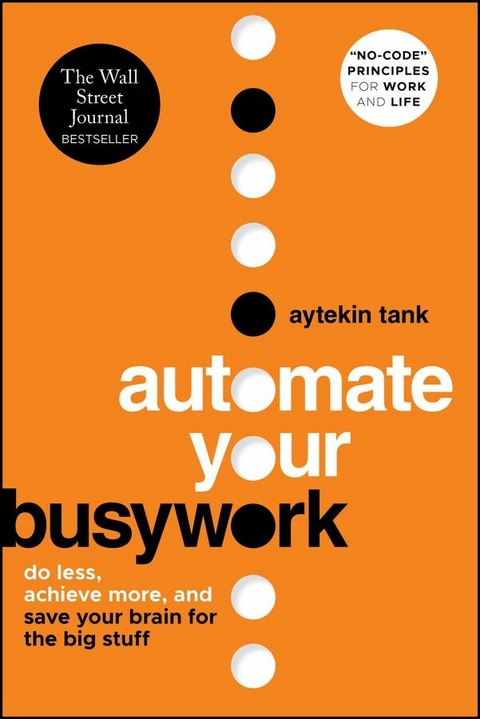
Automate Your Busywork (eBook)
John Wiley & Sons (Verlag)
978-1-119-90175-4 (ISBN)
Learn to automate your busywork and focus on what really matters
In Automate Your Busywork: Do Less, Achieve More, and Save Your Brain for the Big Stuff entrepreneur, founder, and CEO of Jotform Aytekin Tank delivers a can't-miss blueprint to help you make the most of your most precious asset: time. You'll explore what's possible when you offload repetitive tasks, why automation has democratized innovation, and how you can use cheap-or even completely free-no-code automation tools to transform your ability to focus on what truly matters in your business and life.
In the book, you'll discover:
- Why the future of business is no-code, and how you can use an automation-first mindset to unlock your productivity potential
- How to move from busywork to less work, and finally to having the time you need to accomplish your most important work
- How you can use delegation and automation to achieve 'timefulness,' the state of having enough time
A must-read handbook for every entrepreneur, founder, business owner, and freelancer who just doesn't have enough hours in the day, Automate Your Busywork will also earn a place in the libraries of managers, executives, and other business leaders looking to maximize their most valuable resource.
AYTEKIN TANK is the founder and CEO of Jotform, an online form builder with 20 million users. He regularly contributes to columns in Entrepreneur, Fast Company, and Lifehack.
AYTEKIN TANK is the founder and CEO of Jotform, an online form builder with 20 million users. He regularly contributes to columns in Entrepreneur, Fast Company, and Lifehack.
Introduction 1
The Revolution Will Be Automated 7
Chapter 1 Automation Fundamentals 13
Identify Your Busywork, Define Your Meaningful Work 14
Trash Your To-Do Lists 17
Introducing the Automation Flywheel 20
Chapter 2 Divide and Conquer 25
DIVIDE: Learning the Power of Workflows 30
Master Your Workflows, Master Your Work 32
Workflow Candidates 35
Workflow Models 36
Workflow Elements 38
Sorting Out the Steps 40
CONQUER: Spotting and Plotting Workflows 42
Developing an Automation-First Mindset 44
Corralling Your Workflow Candidates 48
Plotting Your Workflows 56
Chapter 3 Design and Implement 59
DESIGN: The Power of Maps 60
Visualize Your Workflows 61
Workflow Design in Action 66
Two Design Tips 71
Breaking Down Complicated Workflows 74
Common Business Workflows 78
Choosing Workflow Software 87
Elements of a Good Workflow 89
IMPLEMENT: From Design to Deployment 92
Take It Step by Step 94
Start Where You Are 95
Consider the Cloud 96
Choose Recommended Products 98
Conduct a SWOT Analysis 101
Chapter 4 Refine and Iterate 103
REFINE: Measure What Matters 105
Establish Your KPIs 106
Prioritize Your KPIs 107
Apply Systems Thinking 111
Improve the Outcome, Not the Output 113
Scale Your Expectations 115
ITERATE: Test, Change, and Innovate 117
Tools and Techniques of Process Improvement 117
Continuous Improvement 121
Iteration and Innovation 132
A Final Note About New Solutions 134
Chapter 5 Design a Life Without Busywork 137
Automate Your Memory 138
Automate Your Peace of Mind 144
Automate Your Communication 150
Automate Your Creativity 157
Automate Your Growth 163
Automate Your Happiness 168
Conclusion 175
Appendix 179
Technology Review Platforms 180
To-Do Lists (Individuals and Teams) 180
Personal Development/Self-Management 181
Communication: Incoming 183
Communication: Outgoing 186
Alerts and Reminders 188
Meetings and Events 189
Managing People 191
HR Concerns 193
Money and Finances (Personal and Business) 194
Content Development and Information Management 196
Online Presence 200
Sales and Marketing 204
Order Fulfillment/Customer Service 207
Miscellaneous Management and Automation 209
Notes 213
About the Author 221
Index 223
1
Automation Fundamentals
If you correct your mind, the rest of your life will fall into place.
—Lao Tzu
First, I want to share an assumption I've made while writing this book. I believe that some of you are so awash in busywork that you don't currently have time for thinking and plotting—you're just desperately seeking quick solutions. You'll find such solutions identified as Quick Fixes, and the first one is just ahead.
And yet, I also know from experience that deeply productive automation can't be simply unboxed and plugged in. To truly conquer your busywork, you'll need to put in time and effort to determine precisely what needs to be automated. But I promise you, the benefits will come back to you in spades—in part because you'll likely identify tasks that could be greatly reduced or even cut out completely. So I ask you to trust me. Take advantage of the quick fixes to save some time now, and then please also commit to designing and implementing the automations that will ultimately revolutionize your work life.
Identify Your Busywork, Define Your Meaningful Work
First, picture for a moment your most dreaded busywork—the stuff that just thinking about makes you want to leap into the ocean, never to be seen again. Pretending to tame your never‐ending to‐do list? Invoicing? Heading into yet another meeting? Invoicing?
No matter what your busywork is, there's a good chance it can be partially or even fully automated—if not now, then likely soon. As for right now: even if it's not yet possible to automate an entire task, it's almost certainly possible to automate parts of it. This is where mapping out your process comes in. By breaking each task into its smallest, most basic parts, it becomes more apparent which steps you can streamline or automate and which you can reduce or abandon. And once you've identified individual elements of a task, you might find that solutions for that element are already available. (We'll cover this process in detail in the DESIGN portion of Chapter 3).
Exercise: What Do You Want to Fix the Most?
In the appendix (starting on page 179) you'll find an extensive categorized list of digital solutions to various kinds of busywork. Peruse those that interest you. As you go through them, flag those you can imagine benefiting from at some point with the number 2. Flag with the number 1 any that you'd like to check out sooner. (We'll return to this in a later exercise.)
Next, grab a pen and paper. Or ask Siri, Alexa, or a digital assistant to take notes for you—this is a book about automation, after all. Take 15 minutes to describe or sketch out your vision of work that matters to you and your career. What do you enjoy doing the most? What would you like to save your brain to do more of? What delivers the most impact? Include as many details as possible. Don't worry about a perfect breakdown at this stage; just get down as much as you can.
As you continue through this book, keep this “meaningful work” vision nearby, and perfect it as you go. It will be a valuable compass on your journey through automation.
Now that you've identified part of what you're seeking, the first step of exploring the fundamentals of automation calls for shattering key myths about work and productivity. You've likely been given all sorts of advice about how to work and what “good” work can and should be—but all too often the guidance of even career experts and well‐meaning teachers and parents is actually counterproductive. So it's essential to face these narratives head‐on before you can create new ones for yourself.
As you'll come to see, slashing your busywork is as much a mental exercise as a technical one because, ultimately, there's no point in automating rote, repetitive tasks if you haven't addressed why you're doing them—or even if you need to do them at all.
- Myth #1: WE SHOULD ALWAYS BE AVAILABLE TO OUR COLLEAGUES, AND WE SHOULD RESPOND TO MESSAGES AS SOON AS THEY ARRIVE. (For some, this imperative refers to “during work hours”; for others this is expected 24/7.) Of course, speed and round‐the‐clock availability are critical for certain careers, such as, say, on‐call surgeons—but for the rest of us? Not essential.
- Solution to round‐the‐clock availability: BLOCK OUT PERIODS WHEN YOU FOCUS ON DEEP-THINKING WORK. Enlist your colleagues in determining both (1) that this approach is acceptable and (2) when such blocked‐out periods should and should not be scheduled. In other contexts it can be helpful to announce that you check your messages once per hour, or three times per day, or whatever suits you.
Exercise: Start Setting Boundaries
I didn't go from 0 to 100 overnight. Before I could even begin to eliminate my busywork, I had to set boundaries—which was hard. I turned off notifications when I left work and kept them off at home. I had to learn how to consciously switch my mind away from work. But over time it got easier. I didn't cringe every time I said “no” or “tomorrow, not today.” These might not sound like big steps, but when you're in reaction mode, doing anything with intention can feel revolutionary. I also realized that boundaries prioritize your attention. Instead of responding to an email the moment it hit my inbox, I chose to continue the critical work I was currently engaged in.
- Myth #2: PROCRASTINATION MUST CONSTANTLY BE KEPT AT BAY. The reasons we avoid a task, in any given moment, are extremely personal—and can be highly confounding. Countless experts have promoted how we can outwit our own avoidance tendencies, and over the years I've tried various techniques to battle my own procrastination. Eventually, I learned there was always a reason why I put off certain activities—which in turn revealed an underlying problem I needed to address.
- Solution to procrastination: AUTOMATION IS THE ULTIMATE PROCRASTINATION HACK. The more systems we establish, the less we can procrastinate. Automated expense submissions, for example, don't wait until they're in the mood to sort and classify receipts.
- I'm always reminded of the power of systems when I visit my family in rural Turkey. They own a small olive farm that runs like a well‐oiled machine. When we harvest the fruit, everyone knows what needs to happen and in what order. With no room for guesswork, we silently slip into our roles and get the job done.
- Success doesn't require extraordinary motivation. If you think something is boring or unpleasant, you need to take your feelings out of the equation and decide in advance exactly how and when it will get done. In other words, you need to automate it.
- Myth #3: MAKING A LIST AND CROSSING OUT COMPLETED TASKS IS THE BEST ANTIDOTE TO FEELING OVERWHELMED. It will feel great to check off each item, they say. When you reach the end, you'll be free, they say. But the truth is there is no end.
- Solution to feeling overwhelmed: Automation. Many of the items on your regular to‐do lists can be automated off your list.
Trash Your To‐Do Lists
You've probably heard the story of Sisyphus, a mortal who angered the Greek god Zeus and who, as punishment, was condemned to a life of battling an endless to‐do list. Every time it looked like poor Sisyphus might finally reach the end of the list, it would regenerate as if by magic—and he'd have no choice but to start again. It was a terribly cruel punishment, more arduous than, say, just pushing a boulder up a mountain. Every day.
Staring down the barrel of our own constantly regenerating to‐do lists, it's easy to wonder: What god did I anger? When will this end? The bad news: it doesn't end. The good news: you're not Sisyphus, and you're not chained to your to‐do list for all eternity.
One of the biggest problems with to‐do lists is that every item seems to carry the same amount of weight regardless of the time or focus needed to complete it. Putting TAKE OUT THE TRASH on the same list as APPLY TO GRAD SCHOOL is a bit like comparing an orange to a nuclear power plant. Whether a modest chore or a life‐changingly significant undertaking, in the end both earn the same checkmark. This unevenness often makes us prefer blasting through the easy items on our list rather than struggling through something difficult, even when that difficult task is meaningful. And because these throwaway tasks are never‐ending, it's very easy to avoid meaningful work indefinitely.
Some Truths About Productivity
- Studies show that most of us have trouble completing more than three hours of productive work each day. What's more, we tend to conflate urgency and importance, which is called the “urgency effect.”1 A series of studies published by the Journal of Consumer Research in 2018 found that, when given the choice of (1) easy tasks with short deadlines and small rewards and (2) easy tasks with longer deadlines and bigger rewards, people...
| Erscheint lt. Verlag | 4.5.2023 |
|---|---|
| Sprache | englisch |
| Themenwelt | Sachbuch/Ratgeber ► Beruf / Finanzen / Recht / Wirtschaft ► Bewerbung / Karriere |
| Wirtschaft ► Betriebswirtschaft / Management | |
| Schlagworte | Arbeitsorganisation • automating processes at work • automating work • Automation • automation tech • Business & Management • Business & Management Special Topics • busywork • Delegation • jotform • Low-Code • low-code automation • Management • No-Code • no-code automation • no-code automation tech • no-code tech • Organisations- u. Managementtheorie • Organization & Management Theory • Personal Career Development • Personalwesen • Productivity • productivity improvement • Robotic Process Automation • RPA • Spezialthemen Wirtschaft u. Management • task automation • Wirtschaft u. Management |
| ISBN-10 | 1-119-90175-8 / 1119901758 |
| ISBN-13 | 978-1-119-90175-4 / 9781119901754 |
| Informationen gemäß Produktsicherheitsverordnung (GPSR) | |
| Haben Sie eine Frage zum Produkt? |
 EPUB (Adobe DRM)
Kopierschutz: Adobe-DRM
Adobe-DRM ist ein Kopierschutz, der das eBook vor Mißbrauch schützen soll. Dabei wird das eBook bereits beim Download auf Ihre persönliche Adobe-ID autorisiert. Lesen können Sie das eBook dann nur auf den Geräten, welche ebenfalls auf Ihre Adobe-ID registriert sind.
Details zum Adobe-DRM
Dateiformat: EPUB (Electronic Publication)
EPUB ist ein offener Standard für eBooks und eignet sich besonders zur Darstellung von Belletristik und Sachbüchern. Der Fließtext wird dynamisch an die Display- und Schriftgröße angepasst. Auch für mobile Lesegeräte ist EPUB daher gut geeignet.
Systemvoraussetzungen:
PC/Mac: Mit einem PC oder Mac können Sie dieses eBook lesen. Sie benötigen eine
eReader: Dieses eBook kann mit (fast) allen eBook-Readern gelesen werden. Mit dem amazon-Kindle ist es aber nicht kompatibel.
Smartphone/Tablet: Egal ob Apple oder Android, dieses eBook können Sie lesen. Sie benötigen eine
Geräteliste und zusätzliche Hinweise
Buying eBooks from abroad
For tax law reasons we can sell eBooks just within Germany and Switzerland. Regrettably we cannot fulfill eBook-orders from other countries.
aus dem Bereich