Quick Leadership (eBook)
John Wiley & Sons (Verlag)
978-1-394-16095-2 (ISBN)
Hands-on, bite-sized strategies for improving your confidence
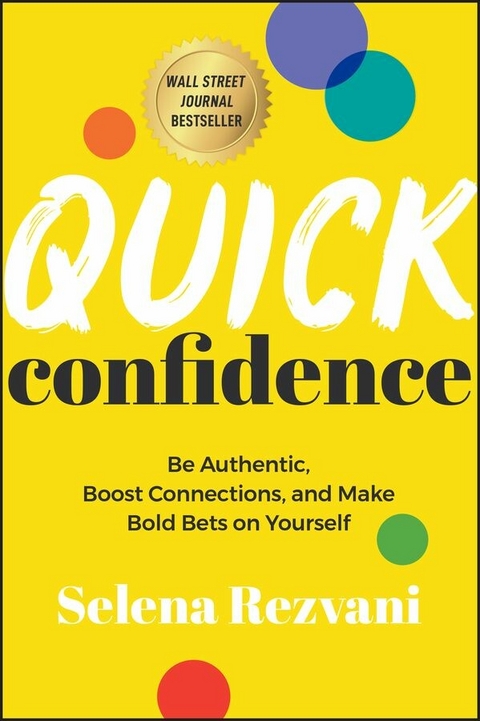
In Quick Confidence: Be Authentic, Create Connections and Make Bold Bets On Yourself, best-selling author and renowned leadership speaker Selena Rezvani delivers an effective and eye-opening new approach to building confidence and presence for professionals. In the book, the author walks you through-and helps you leap over-the 9 most common obstacles that stand in the way of building authentic confidence. She offers digestible actions, behaviors, and exercises you can use to change the way you think and the way you present yourself to others.
Relying on sound, scientifically validated data, the book helps you zero in on one actionable method at a time, from making a memorable entrance to stoking confidence in those around you. You'll also find:
- Mental, physical, and interpersonal routines that will lock in your new and confident persona for lasting change
- Techniques for using silence strategically and refusing to overexplain to enhance your credibility and presence
- Ways to overcome the intimidation factor that goes hand-in-hand with dealing with powerful people
A hands-on playbook for professionals at all stages looking for effective confidence-building advice that goes beyond 'fake it 'til you make it,' Quick Confidence is a fun and rewarding journey to a renewed self-image and enhanced well-being.
Selena Rezvani is a sought-after speaker, content creator, and commentator on leadership. She is focused on helping emerging leaders build confidence and self-advocacy skills, enabling them to elevate their presence-and others-along the way. She is the author of Pushback and The Next Generation of Women Leaders.
A WALL STREET JOURNAL BESTSELLERA PUBLISHERS WEEKLY BESTSELLERHands-on, bite-sized strategies for improving your confidence In Quick Confidence: Be Authentic, Create Connections and Make Bold Bets On Yourself, best-selling author and renowned leadership speaker Selena Rezvani delivers an effective and eye-opening new approach to building confidence and presence for professionals. In the book, the author walks you through and helps you leap over the 9 most common obstacles that stand in the way of building authentic confidence. She offers digestible actions, behaviors, and exercises you can use to change the way you think and the way you present yourself to others. Relying on sound, scientifically validated data, the book helps you zero in on one actionable method at a time, from making a memorable entrance to stoking confidence in those around you. You ll also find: Mental, physical, and interpersonal routines that will lock in your new and confident persona for lasting change Techniques for using silence strategically and refusing to overexplain to enhance your credibility and presence Ways to overcome the intimidation factor that goes hand-in-hand with dealing with powerful people A hands-on playbook for professionals at all stages looking for effective confidence-building advice that goes beyond fake it til you make it, Quick Confidence is a fun and rewarding journey to a renewed self-image and enhanced well-being.
Selena Rezvani is a sought-after speaker, content creator, and commentator on leadership. She is focused on helping emerging leaders build confidence and self-advocacy skills, enabling them to elevate their presence--and others--along the way. She is the author of Pushback and The Next Generation of Women Leaders.
Introduction 1
1 Make Strong First Impressions 11
2 Create Belonging Wherever You Go 33
3 Rebalance Power Dynamics 57
4 Release Overdoing, Overthinking, and Overexplaining 81
5 Negotiate Your Success 105
6 Harness High- Stakes Moments 129
7 Overcome Toxic People and Cultures 153
8 Rise above Fails and Setbacks 175
9 Scale Your Confidence 203
Endnotes 229
Acknowledgments 235
About the Author 237
Afterword 239
Index 241
1
Make Strong First Impressions
If you've ever sat there, sweating in a blazer, while people lob difficult questions at you, you get it. Those special things called job interviews are just one example of the first impressions that can feel “make-or-break” in your career. How is it that so much can ride on other peoples’ 30- or 60-minute assessment of you as a human being? And how can a simple Q&A have such a disproportionate impact on your bank account, résumé, and future? We job candidates have our own power and agency (like the ability to walk away or not apply in the first place), but it's easy at moments like this to feel like they have all the power.
It's no wonder that situations like this make our heads spin with tension! In so many career moments, you are being sized up by others in a matter of minutes. But what makes this even trickier is that the rules are ambiguous: at a networking event, for example, we're told to present ourselves in an assured, confident way—but at the same time, we shouldn't come off as over-rehearsed or like a try-hard. And in pursuing a new role, just because we may want a job, we shouldn't convey that we need the job. Then, on our first day of a new job, we should make sure to dress in a smart, polished way, but we're cautioned about looking overly formal or out of touch. Talk about mixed messages!
The human need to search for acceptance from others, even early on in an interaction, is real. We evolved in such a way that sharing resources with other members of our group led to stronger social bonds and helped a group's chances of survival. Part of today's challenge comes from the fact that meeting new people means negotiating lots of unknowns. As NYU researchers explain it, each new person we meet is “a source of ambiguous and complex information.”1 It's sitting with that ambiguity, along with our compulsion to be accepted, that can push and pull our confidence levels like warm taffy. As we try to find that ideal, Goldilocks level of confidence in first-time interactions—not too much and not too little—we can end up forgetting to bring our actual, full, living, breathing selves with us. Not just in interviews, but in any meaningful first-time interaction—introducing ourselves to a prospect, meeting our new boss, or at a coffee date with someone who has the job we dream of having.
This happened to me right at a time when I was trying to cement an important consulting assignment and build up my business. I had done a small job for a midsized tech company—helping to launch a new employee resource group. I now had the chance to pitch a bigger, more powerful leadership and inclusion project to the CEO and his team. In that meeting with the CEO, I worked so hard on making my first impression memorable that I practically tried to fill that vast, gray conference room with my years of knowledge! Armed with my 64 slides, I was so caught up in a gust of “experting,” I didn't leave many openings and spaces for his questions or comments. And slowly, I watched him kind of pull away from the conversation, literally backing his chair away from the table. As he did, my own negative self-talk went into overdrive—which caused me to give a particularly incoherent response to the single question he was able to ask! It hurts to admit, but as you probably can guess, I failed that day to both impress and make an impact.
Yes, it stung. But I can see more clearly now that any situation where you're driven by your insecurities and leading in someone else's style—not yours—will put you closer to losing your audience. Maybe you can relate? Have you ever played a false part initially—or watered yourself down to give others what you thought they wanted?
Part of the issue here is that we pressurize first impressions so much. After all—as undoubtedly you've heard—you never have a second chance to make a first impression, right? In the span of time it takes to bake brownies, we should somehow neatly downplay our flaws and peccadillos and showcase only our shiniest, most motivated, brilliant self.
Here's the thing. So many of the common narratives around making great first impressions are packed with covering up who you really are—and by extension, shaming the not-presentable parts. Well, I'm here to tell you that doesn't work. You do not need to pull one over on people to make it. And to think you should only hurts your confidence long term.
Drawing from my own lessons and from coaching and training thousands of leaders along the way, I'll illustrate how to show all the way up in these meaningful moments—get ready for it—as yourself. Whether you're trying to make a strong initial impression at a networking event—or on your first day at work, at college, or with a new client—you can do this best as you. And I can't wait to show you how.
Just Do You
So, let's update the mindset you're working with. Let's embrace a little thing called human, authentic first impressions. As we do, I hope you'll give yourself and others some latitude. Because who among us doesn't have “off” days and moments? Or doesn't stumble, stammer, or feel plain weird, sometimes, socially speaking?
While you're at it, make some room for the possibility that if things don't go just perfectly, the situation isn't chiseled permanently in marble. In fact, right now, cozy up to the idea that if you need to, you can deepen your existing impressions and relationships with people, even ask for a redo or strategize a comeback. And if for some reason you can't do those things, you know what? You'll learn that's survivable too.
Adopt Dog Code
Sometimes the best confidence lessons come from the most unlikely places. Here's a case in point: Have you ever noticed how dogs greet us humans? If they're anything like my Newfoundland pup Midnight, they don't hesitate. They don't overthink it. They don't talk it over with their friends before making a move.
A dog's nature is to be the first to make a connection. To come right up to you and greet you. And I think there's an important confidence insight we can take from that.
After navigating a pandemic, we're all acutely aware of the importance of something scientists call “Vitamin S.”2 The need to bring people together socially, whether virtually or in person, and to feel a sense of togetherness.
In fact, scientists have discovered even very subtle interactions with strangers improved well-being!3 For example, in experimental studies where subjects were instructed to greet, smile, or initiate a very brief conversation—a single encounter—the interaction boosted people's happiness. These little moments included interacting with a bus driver, with fellow commuters on a bus or train, and with a barista at a coffee shop—even or being with a fellow participant waiting to take part in an experiment. Here's what's cool: the short-term boost in happiness occurs not only in the person initiating the conversation, but also in the person whose social contact was sought!4
So how about it? Why not be the first to:
- Say hi and introduce yourself in a group?
- Invite your new colleague to a networking or learning session you're attending?
- Notice someone who's isolated and might appreciate an invitation to join you?
- Invite your new coworker to lunch?
- Be warm and welcoming to an employee your team's had a less-than-great relationship with in the past?
As you adopt “dog code,” you may need to be courageous. Sometimes it feels vulnerable to be the first. If you're more introverted or reserved, it might feel challenging to “go right up” to perfect strangers and start speaking. But you can still do it. You might also need courage to challenge the culture of your organization or team—especially if being friendly or “being the first” is not the norm. It takes nerve to buck the status quo! But when you proactively welcome others, you show humility, curiosity, bravery, and a collaborative mindset. These are some of the best traits of true leaders.
Dog code won't just raise up your confidence levels, it's a way to override similarity bias too. Also called “mini-me syndrome,” this cognitive bias explains our tendency to gravitate to people who look and think like us5—which of course narrows our world, our thinking, and our connections. When we adopt dog code, we get that much closer to halting bias and preferential treatment. To make this happen, we all must contribute to positive, welcoming environments and make inclusive first impressions a real thing.
Being the first is a great way to build confidence around other people. When you do, you make relationships a priority in your life—and the people around you will notice and remember.
Connect, Then Lead
Have you ever felt a kind of nibbling pressure to demonstrate you were smart? You know, to show people that you know things? I know I've been there—and my bullish performance in front of the CEO is a fitting example. When the stakes...
| Erscheint lt. Verlag | 2.5.2023 |
|---|---|
| Sprache | englisch |
| Themenwelt | Sachbuch/Ratgeber ► Beruf / Finanzen / Recht / Wirtschaft ► Bewerbung / Karriere |
| Wirtschaft ► Betriebswirtschaft / Management | |
| Schlagworte | best motivational books • build confidence • Business & Management • confidence books for women • confidence building • confidence in books • create confidence • improve confidence • increase self-confidence • Personal Career Development • personal growth books • Personalwesen • self-confidence for women • Wirtschaft u. Management |
| ISBN-10 | 1-394-16095-X / 139416095X |
| ISBN-13 | 978-1-394-16095-2 / 9781394160952 |
| Informationen gemäß Produktsicherheitsverordnung (GPSR) | |
| Haben Sie eine Frage zum Produkt? |
 EPUB (Adobe DRM)
Kopierschutz: Adobe-DRM
Adobe-DRM ist ein Kopierschutz, der das eBook vor Mißbrauch schützen soll. Dabei wird das eBook bereits beim Download auf Ihre persönliche Adobe-ID autorisiert. Lesen können Sie das eBook dann nur auf den Geräten, welche ebenfalls auf Ihre Adobe-ID registriert sind.
Details zum Adobe-DRM
Dateiformat: EPUB (Electronic Publication)
EPUB ist ein offener Standard für eBooks und eignet sich besonders zur Darstellung von Belletristik und Sachbüchern. Der Fließtext wird dynamisch an die Display- und Schriftgröße angepasst. Auch für mobile Lesegeräte ist EPUB daher gut geeignet.
Systemvoraussetzungen:
PC/Mac: Mit einem PC oder Mac können Sie dieses eBook lesen. Sie benötigen eine
eReader: Dieses eBook kann mit (fast) allen eBook-Readern gelesen werden. Mit dem amazon-Kindle ist es aber nicht kompatibel.
Smartphone/Tablet: Egal ob Apple oder Android, dieses eBook können Sie lesen. Sie benötigen eine
Geräteliste und zusätzliche Hinweise
Buying eBooks from abroad
For tax law reasons we can sell eBooks just within Germany and Switzerland. Regrettably we cannot fulfill eBook-orders from other countries.
aus dem Bereich