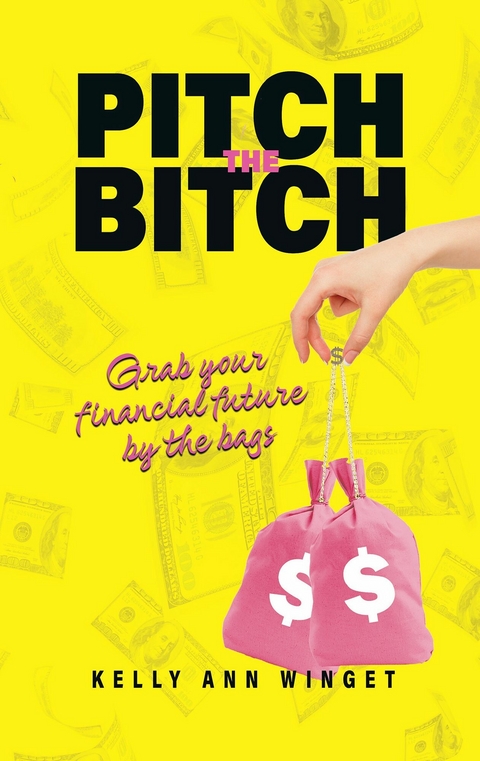
Pitch the Bitch (eBook)
142 Seiten
Bookbaby (Verlag)
978-1-6678-9733-2 (ISBN)
Kelly Ann Winget is the founder of the Dallas-Ft. Worth-based private equity company Alternative Wealth Partners. Kelly Ann has been in the alternative investment space for over a decade, and has helped companies raise almost $1B in creative capital. She currently manages several private equity funds on behalf of accredited investors, institutional partners, and family offices. Kelly Ann is on a mission to demystify generational wealth-building assets in order to make wealth more accessible to everyone. "e;Don't pitch the bitch"e; is a phrase popularized by the movie Boiler Room (2000), advising stockbrokers not to try to sell to women. Pitch the Bitch walks through the female experience in the investment world, on both sides of the financial transaction. Kelly Ann Winget recounts her journey-from selling car washes as a teenager to her career today as the only millennial, LGBTQ+ manager of a solo-female-founded private equity fund-to help women understand why the investment wealth gap exists and how to close it.
CHAPTER ONE
The Myth of “Don’t Pitch the Bitch”
In the 2000 American crime drama Boiler Room, protagonist Seth Davis lands what he thinks is a great entry job as a stockbroker trainee. During orientation, senior broker Greg Weinstein gives him what he considers standard advice: “Now, there’s two rules you have to remember as a trainee. Number one, we don’t pitch the bitch here.”
Davis, confused, answers, “What?”
Weinstein explains, “We don’t sell stock to women. I don’t care who it is, we don’t do it. Nancy Sinatra calls, you tell her you’re sorry. They’re a constant pain in the ass and you’re never going to hear the end of it, all right?”
Davis looks at Weinstein, incredulous.
“They’re going to call you every fucking day wanting to know why the stock is dropping,” Weinstein continues. “And God forbid the stock should go up, you’re going to hear from them every fucking fifteen minutes. It’s just not worth it. Don’t pitch the bitch.”
I understand why Davis was incredulous—the first time I heard the phrase used in my presence, back in 2013, that was exactly how I felt. It was shocking that such a backward slogan was still circulating among respectable finance professionals (respectable being the term in question, of course). But the guy who said it had three daughters. Even if he was making a joke—and to be fair, everyone in the room was laughing—it wasn’t funny. We weren’t in a movie. I wasn’t about to call him on it because he was one of the three owners of the company.
The room itself was a parody of the Olde Boys Club. I’d been around oil and gas companies for years, and this one was typical: stuffy, heavy oak furniture, gaudy paintings everywhere, and a unique touch—fish tanks. That place had fish tanks in every room, and these weren’t just ordinary fish tanks. They were $150,000+ fish tanks stocked with aquatic creatures that went for more than $1,000 each at the exotic fish store that one of the company’s partners owned. Those fish tanks were my next clue that something wasn’t quite right at the firm.
There were several weekends when one of those expensive fish would jump out of the tank, and on Monday, it would be lying dead on the floor. I didn’t know if the guy forgot to close the tank or if the tank was just the wrong size or what, but every Monday, another stinking dead fish appeared. And then, there’d be a new one, exactly like the one that had just jumped to his death. And this went on for weeks. I thought, this has to be the silliest place I’ve ever been.
It was my first time working with an oil & gas investment company. My job was to funnel the sales team a list of investors, run reports on what was and was not working in their own boiler room—no different, really, from the one in the movie—and then, develop teams based on their closing skills. You know, if Sam in sales took the first cold call and then tossed it to Mark the manager, who passed it on to Chris, the closer, and all together they had a 90 percent average of closing a deal, then that was a great team. The sales happened in an honest-to-God boiler room not that different from the one in the movie. A group of guys sat around cold calling all day, selling mineral rights. The price of oil had skyrocketed, and mineral rights were an easy sell. Even though I was new there, I wasn’t new to the industry. I knew the price of oil was going to fall, and it wasn’t going to work out for the investors in the long-term.
I’d worked in marketing and sales before, but this was my first-time raising capital. But when I see something that’s wrong, I have a hard time leaving it alone. I trusted my instincts. Something was wrong. Very wrong. So, I asked some questions, but they didn’t want me asking questions, they wanted me to make baseball cards with statistics about the salespeople.
So, they let me go.
Soon enough, the price per barrel of oil plummeted. When it hit $40 a barrel, that company closed. The owners with the “don’t pitch the bitch” remark? They set up an office out of the back of the exotic fish store.
That kind of thing made me realize I’d be better off opening my own business. But I wasn’t quite ready yet.
Over the next several years, I ran into different situations. I consulted on investor relations, capital raising, deal structure and operations for companies with “the next best thing since sliced bread” in tech, real estate, medical devices, energy, etc. The personalities behind most of these companies weren’t for the weak-hearted. They were crude, delusional and closed-minded. But boys will be boys, and they raised a lot of money… from boys.
They weren’t all bad. One firm was run by someone I still admire today. He was raised by a single mother, had daughters and granddaughters, he got it. He could be difficult—some called him abrasive, and they wouldn’t be wrong—but he was smart, and his largest, most loyal investors were women. I learned a lot from him. The problem there was that we were too alike to work together, he told me I needed my own firm and my own fund. He wasn’t wrong, but I wasn’t quite ready.
The Bitch is Winning
Here’s a little-known fact: Studies show that women get better investment returns than men.
In 2021, Fidelity Investments (the fifth largest investment company in the world) sponsored a thorough study of women investors, which was completed by an independent research firm. The summary in the report stated that over a ten-year period, female investors earned, on average, 0.4 percentage points more annually than their male counterparts.1 The New York Times reacted this way: “That may not seem like a lot, but over a few decades it can add up to tens of thousands of dollars or more.”2 The Times theorized that one reason is that men fall victim to overconfidence, whereas women investors are more cautious.3
Lorna Kapusta, then head of women investors and customer engagement at Fidelity, responded that the lesson is to “invest like a woman.”
According to the research, women’s superior returns are due to the way they trade—less frequently. In the study of 2400 investors, half female and half male, the women bought and sold 50 percent less than the male investors. Vanguard discovered a similar pattern over the same ten years, involving retirement accounts: at least 50 percent more men traded in them than women did every year during that time.
Frequent trades simply don’t result in strong returns, as proven in 2000 by Brad M. Barber and Terrance Odean, two professors at, respectively, the Graduate School of Management, University of California (UC) Davis, and the Haas School of Business at UC Berkeley. In the period they studied, 1991 to 1996, those who traded the most earned annual returns of 6.5 percent less than the stock market overall.
Individual investors who hold common stocks directly pay a tremendous performance penalty for active trading. Of 66,465 households with accounts at a large discount broker from 1991 to 1996, those that traded most earned an annual return of 11.4 percent, while the market returned 17.9 percent.4
Their conclusions? “Overconfidence can explain high trading levels and the resulting poor performance of individual investors. Our central message is that trading is hazardous to your wealth.”5
The following year, Professors Barber and Odean addressed gender and investing habits in a different paper, this one entitled “Boys Will Be Boys.” They learned in their research that from 1991 to 1997, women also traded more frequently than was wise, i.e., their trading resulted in net returns that were lower by 1.72 percentage points per year compared to the overall market. However, men suffered by 2.65 percentage points over the same period.5
The problem? According to William J. Bernstein, a neurologist who studied what could be termed the “Boys Will Be Boys” effect, it’s testosterone, which makes men less risk averse. In other words, testosterone grows muscle mass, but shrinks investment returns.
On the other hand, women could use a little extra confidence. Fidelity surveys showed in 2017 that only 9 percent of women believed they could do better than men as investors, and in 2021, only 14 percent of women expressed confidence regarding saving and investing. Despite doing better than their male counterparts, a full two-thirds of the female respondents in the 2021 survey described being anxious and hesitant when making investment decisions.
Historically, it’s been assumed that women make the budgets and men make the investments, perhaps because they were the primary earners or just felt better suited to the task. Also, the predominantly white male financial industry connected with husbands and paid little, if any, attention to wives. But more cautious investing may also stem from the fact that women are conditioned by society to be perfect, never measuring up to unrealistic standards, the last thing a woman needs is for her husband to blame her for poor investment results. Or she has a different goal—more on that in Chapter Two.
Or it could be one more holdover from Larry Summers’s unfortunate 2005 claim that, for biological reasons, girls just aren’t good at math. That statement may have cost him the presidency at Harvard, but it sure didn’t hurt his...
| Erscheint lt. Verlag | 2.5.2023 |
|---|---|
| Sprache | englisch |
| Themenwelt | Wirtschaft |
| ISBN-10 | 1-6678-9733-0 / 1667897330 |
| ISBN-13 | 978-1-6678-9733-2 / 9781667897332 |
| Informationen gemäß Produktsicherheitsverordnung (GPSR) | |
| Haben Sie eine Frage zum Produkt? |
 EPUB (Ohne DRM)
Größe: 3,5 MB
Digital Rights Management: ohne DRM
Dieses eBook enthält kein DRM oder Kopierschutz. Eine Weitergabe an Dritte ist jedoch rechtlich nicht zulässig, weil Sie beim Kauf nur die Rechte an der persönlichen Nutzung erwerben.
Dateiformat: EPUB (Electronic Publication)
EPUB ist ein offener Standard für eBooks und eignet sich besonders zur Darstellung von Belletristik und Sachbüchern. Der Fließtext wird dynamisch an die Display- und Schriftgröße angepasst. Auch für mobile Lesegeräte ist EPUB daher gut geeignet.
Systemvoraussetzungen:
PC/Mac: Mit einem PC oder Mac können Sie dieses eBook lesen. Sie benötigen dafür die kostenlose Software Adobe Digital Editions.
eReader: Dieses eBook kann mit (fast) allen eBook-Readern gelesen werden. Mit dem amazon-Kindle ist es aber nicht kompatibel.
Smartphone/Tablet: Egal ob Apple oder Android, dieses eBook können Sie lesen. Sie benötigen dafür eine kostenlose App.
Geräteliste und zusätzliche Hinweise
Buying eBooks from abroad
For tax law reasons we can sell eBooks just within Germany and Switzerland. Regrettably we cannot fulfill eBook-orders from other countries.
aus dem Bereich