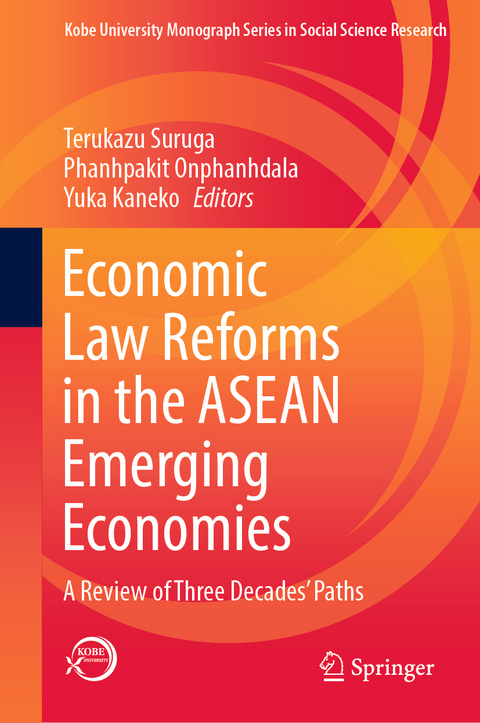
Economic Law Reforms in the ASEAN Emerging Economies
Springer Verlag, Singapore
9789819915552 (ISBN)
The first stage is illustrated by the ASEAN-style utilization of foreign investments as reflected in all investment laws and policies of CLMV countries in the 1990s, which featured entry control (as “sticks”) and investment incentives (as “carrots”). Those controls and incentives were the means to induce investors to assume various performance requirements to contribute to industrial policies. The second stage witnessed a shift toward enhanced liberalization as an endeavor toward the WTO accession during the 2000s, as seen in the integrated investment laws that appealed for the national treatment of foreign investors. At the same time, those investment laws emphasized the substantive provisions (e.g., fair and equitable treatment and indirect expropriation) and procedural protections (e.g., provision of Investor–State Dispute Resolution mechanisms) as an appeal for stabilization of the investment climate. The third stage of legal policy, as evidenced by the recent amendments to the investment laws, is newly focused on environmental and social considerations, which seems to be an indispensable response to the increasing social protests against the negative impacts of investment promotion. Simultaneously, the means of administrative controls over investors, established in the first stage, are uniquely utilized for the realization of new goals.
Terukazu Suruga obtained a Ph.D. in economics at Osaka University, Japan. He is now professor emeritus at Kobe University. He has held several visiting positions at institutions including Washington University, Flinders University, Beijing University, the Mongolian Market Research Institute, KIMEP University, and National University of Laos. He has published numerous papers on foreign direct investment (FDI), development economics, and labor economics. He has written Labour and Employment Society in Laos (in Japanese) and has edited Changing Employment Practices and Female Labor Force (in Japanese). Phanhpakit Onphanhdala obtained a Ph.D. in economics in 2008 from Kobe University, Japan, where he worked during 2008–2011, and at the National University of Laos during 2011–2019. He was the deputy director of the Research Center under the National Institute for Economic Research, Lao PDR, during 2019–2020. Currently, he is a senior economist and independent researcher. His researchinterests include labor market analysis, FDI and trade, agribusiness, logistics, and economic integration. Yuka Kaneko, LL.D., is a professor and the deputy executive director at the Center for Social Systems Innovation, Kobe University, Japan. She is specialized in Asian comparative law, law and development, law and society, and disaster law. Her edited books include Asian Law in Disasters: Toward a Human-Centered Recovery (Routledge, 2016), Civil Law Reforms in Post-Colonial Asia: Beyond Western Capitalism (Springer, 2019), Land Law and Disputes in Asia: In Search for an Alternative Development (Routledge, 2021), Build Back Better: Issues of Asian Disaster Recovery (Springer, 2021), Insolvency Law Reforms in the ASEAN Emerging Economies: Consequences of the Donor Model Designed for Economic Crises (Springer, 2022) and Reallocation of Social Risks in a Pandemic: Changing Law and Contractual Relations of Asian SMEs under COVID-19 (Springer, 2022). She is a member of the Board ofDirectors of the Japanese Association of Sociology of Law, and also a member of the Editors-in-Chief of the Asian Journal of Law & Society.
Foreign Direct Investment Inflow and Investment Climate in ASEAN Least Developed Countries.- Policy Choices in the Economic Law Reforms of ASEAN Emerging Economies: A Comparative Perspective.- Comparative Approach to ASEAN Competition Policy and Law.- Characteristics of Labour Dispute Resolution in the Four ASEAN Least Developed Countries.- Dispute Resolution Systems in Vietnam: A Typical Example of the Southeast Asian Way- Asset Preservation Procedures and Compulsory Execution as the Basic Framework for Debt Recovery in the ASEAN Least Developed Countries: An Interim Report on the Law and Economic Development.- Status of the Reform of Laos’ Real Property System and a Perspective on Legal Development Support: A Fundamental Consideration of Phases 1 and 2 of the Lao Land Titling Project.- Foreign Direct Investment and Inflow Climate in Laos by Industry.
| Erscheinungsdatum | 03.06.2023 |
|---|---|
| Reihe/Serie | Kobe University Monograph Series in Social Science Research |
| Zusatzinfo | 4 Illustrations, color; 30 Illustrations, black and white |
| Verlagsort | Singapore |
| Sprache | englisch |
| Maße | 155 x 235 mm |
| Themenwelt | Recht / Steuern ► Allgemeines / Lexika |
| Recht / Steuern ► EU / Internationales Recht | |
| Wirtschaft ► Volkswirtschaftslehre | |
| Schlagworte | ASEAN Economic Law • ASEAN Late Developing Countries • CLMV Countries • Foreign Investment Law • Harmonization of Regional Law • Law and Development • Legal Dispute Resolution |
| ISBN-13 | 9789819915552 / 9789819915552 |
| Zustand | Neuware |
| Informationen gemäß Produktsicherheitsverordnung (GPSR) | |
| Haben Sie eine Frage zum Produkt? |
aus dem Bereich