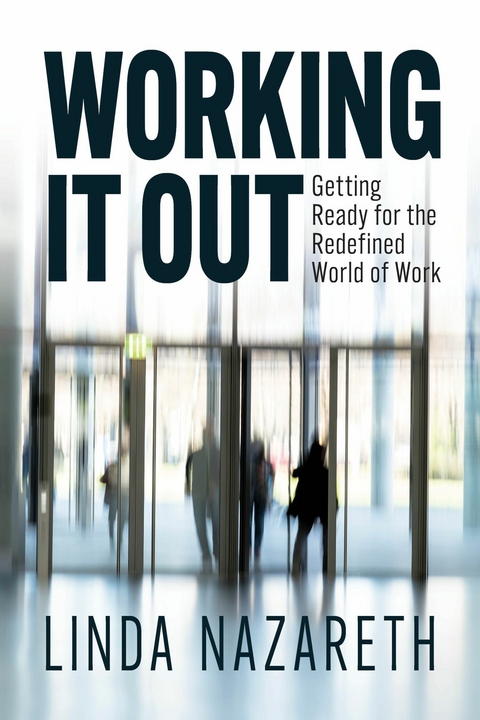
Working It Out (eBook)
182 Seiten
Bookbaby (Verlag)
978-1-6678-8462-2 (ISBN)
It is a watershed moment, a time when everything is on the table and we can choose our own destiny. In the wake of a pandemic that showed us that work can be done a lot more places than in an office, individuals and organizations are making decisions that will shape the future of work for decades to come. It is not just about where we work, however. On a planet that is experiencing a climate emergency with an aging population and robots that are getting smarter by the minute, everything is in flux. Everything needs to be reimagined to accommodate the changes, and that includes work. In Working it Out: How to Be Ready for the Redefined Future of Work, economist Linda Nazareth draws on her decades of analyzing the labour market to articulate the issues changing how we work and then sketch out the future that lies ahead of us. From looking at how offices might change to noting that workers already have shifted their values, she looks at the issues that will shape work and with an eye to helping her readers stay ahead of the changes.
Chapter 1
Lessons from the Great Resignation
There are a lot of business catch phrases out there, but during the second year of the pandemic, one in particular struck a nerve: “the Great Resignation.”
You can picture it in your mind, and the visual will lend itself to a documentary when someone gets around to making one: across the United States, across Canada, across the world, workers just Having Had Enough (this could potentially be its title; the statement is certainly fitting based on statistics). Going into their supervisors’ offices and telling them a thing or two before finishing off their impassioned tirades with, “I quit!” Gathering their things into cardboard boxes, shaking hands with their colleagues, and leaving for better things, a spring in their step. Or what they hope are better things, anyway. Because if the pandemic has taught us anything, it’s that life is short. When we take that lesson and apply it to our work lives, it’s easy to see that this short life shouldn’t be spent at a place of employment we hate, being supervised by someone who may or may not have the skills necessary to perform that function. And so: That’s it. I’m gone. I’ve found something better. Hopefully.
Whether or not the Great Resignation turns out to be a lasting phenomenon, in 2021 and 2022 it was certainly a wake-up call for businesses. Suddenly, many realized they were losing the workers they had—and finding it hard to attract the new ones they wanted. Partly a product of the economy, partly of tapping into something related to what workers were feeling in a pandemic-scarred world, this trend represents one of the pandemic’s most significant impacts on the workforce to date. It could and should have a lasting impact. The Great Resignation was and is something of a report card for organizations, and for many it delivered failing grades. Across the board, workers are not happy, and that can’t be good for anyone who wants to build a thriving business or economy.
The Rush to the Door
The term “the Great Resignation” was coined in 2021 by Anthony Klotz, an organizational psychologist and professor at Texas A&M University. He used it to describe the wave of people quitting their jobs at the end of the first year of the pandemic, when the previous twelve months of uncertainty had led people to rethink where, how, and why they wanted to work. At the time, the U.S. economy was springing back to life. Shutdowns had turned to re-openings, and the newly vaccinated were flooding restaurants and stores, where there was barely enough staff to serve them. At the same time, low interest rates and tons of government stimulus initiatives had sent the economy flying, and seemingly everyone was hiring. Workers with the right skills had their pick of jobs, and whether you were a waitress or a systems analyst, it seemed like a good time to try out a new one—especially if you hated your boss (and apparently a lot of people did). The Great Resignation was on.
The official statistics go some way to capturing the disruption. The “I quit!”s started in earnest early in 2021, and in the United States, 48 million people quit their jobs during the year as a whole, a record number. The numbers were not as clear in Canada: as of the beginning of 2022, job churn did not seem much different than was normal before the pandemic. But in Canada and around the globe, the idea of the Great Resignation caught the imagination. Every media outlet had stories of workers being treated poorly and wanting to quit, and every coffee shop full of disgruntled workers did as well. As the months went on, there seemed to be no let-up in the number of people considering their options and looking for something better. A study released by consulting company Willis Towers Watson in the spring of 2022 found that 44 percent of employees were “job seekers” and 33 percent had actively looked for work in the fourth quarter of 2021.
Statistics aside, the anecdotal evidence was overwhelming. Whatever the reason, people seemed not to like the jobs they’d gone into the pandemic with very much, and that situation didn’t change once the health crisis hit full force. Perhaps it makes sense: workers, like all of us, had been through a dramatic episode. And that can change a person’s perceptions about everything, work included. The consulting group McKinsey & Company surveyed workers in September 2021, noting that eighteen months into pandemic, workers were tired and some felt as though they were actually grieving a loss. Forty percent of respondents said they were at least somewhat likely to quit their current jobs in the next three to six months, with the findings holding across the five countries surveyed (Australia, Canada, Singapore, the United Kingdom, and the United States) and across the range of industries. Workers in the leisure and hospitality industries were most likely to plan on quitting, but the healthcare sector and those in white-collar jobs were not far behind. Even among educators—the group least likely to quit—almost one-third reported that they were somewhat likely to do so.
Some of what we saw during the pandemic was simply a reaction to practical circumstances; at least in the early part of the crisis, women were the most likely to quit because of childcare issues. Schools, in many cases, had pivoted to online learning, and someone had to be home with kids to supervise the studying or at least to provide the childcare that would normally have been covered during the day. Data from human resources services company LifeWorks shows that of those who resigned in Canada, 16 percent did so because of caregiving responsibilities, with parents more than twice as likely than non-parents to have quit. Some of those leaving were lower-paid workers in the hospitality or service industries whose work hours had been eliminated or drastically cut by the pandemic and who did not rush back to work when things reopened.
There is also an argument to be made that people were resigning simply because there were great opportunities elsewhere. After a rocky patch during the first lockdowns in early 2020, by mid-2020 and 2021 much of the world found itself in an economic boom, if a fairly unusual one. Governments were spending wildly to stimulate economies, which worked fine, especially when paired with rock-bottom interest rates. Housing markets roared, people borrowed to buy cars and do home improvements, and both the public and private sectors found themselves in need of workers, particularly highly skilled workers. An unhappy employee at a tech company could peruse the listings on LinkedIn and find a raft of opportunities, or just touch base with friends at other companies and learn that, yes, they were hiring. If the grass looked greener somewhere else, there was nothing stopping them from trying it out.
There was a generational aspect to the resignations as well. Utilizing a global dataset of nine million employees spanning 4,000 companies across industries and levels, global analytics firm Visier identified two key trends when it came to quitting. First, they found that resignation rates were highest among mid-career workers, those between the ages of 30 and 45. This group saw an increase in resignations of more than 20 percent between 2021 and 2022, in contrast to the group of those aged 20 to 25 in which resignations fell, as they did among workers aged 60 to 70.
Writing in Harvard Business Review, Visier’s VP of people analytics Ian Cook identified several reasons why the Great Resignation was being driven by this mid-career group. First, he noted that with so many working remotely, there were fewer opportunities to train entry-level workers, and it was mid-career workers who were likely the most in demand over the time period, meaning that they were quitting their current jobs for new opportunities elsewhere. As well, there is the likelihood that mid-career workers were the ones who might have felt the most stressed in their organizations, and so at some point reached a breaking point and quit.
If all of this is true, and the Great Resignation is to some extent driven by special factors and by the business cycle, it would seem to follow that things will sort themselves out once the economy cools, which inevitably will happen as stimulative economic policies are removed. But that line of thinking misses the point. It fails to deal with the root of the problem, which is simply that many workers were unhappy before the pandemic and continue to be unhappy now. These workers may take a step back from quitting if the unemployment rate rises, but that doesn’t change the underlying dissatisfaction. The bottom line is this: if organizations do not deal with the reasons why their employees are unhappy, they will no doubt be forced to reckon with that unhappiness again and again.
A Lasting Imprint
So why are people in the workforce so unhappy? The strong economy and stress of the pandemic might have been the straw that broke the camel’s (or worker’s) back, but the roots of the Great Resignation go back a lot farther than 2020. Unhappy workers and bad management are not exactly new trends, and in the decades before the pandemic, they were the ones taking hold.
Although wonderful, positive corporate cultures exist, they are not nearly as prevalent as anyone would like. Toxic cultures can be found in every sector and are a prime reason why workers are eager to quit and try other organizations. These workers may tell people that they got a better monetary offer someplace else, but survey after survey show that people quit not just over money but also because they are unhappy with management....
| Erscheint lt. Verlag | 2.1.2023 |
|---|---|
| Sprache | englisch |
| Themenwelt | Wirtschaft |
| ISBN-10 | 1-6678-8462-X / 166788462X |
| ISBN-13 | 978-1-6678-8462-2 / 9781667884622 |
| Informationen gemäß Produktsicherheitsverordnung (GPSR) | |
| Haben Sie eine Frage zum Produkt? |
 EPUB (Ohne DRM)
Größe: 528 KB
Digital Rights Management: ohne DRM
Dieses eBook enthält kein DRM oder Kopierschutz. Eine Weitergabe an Dritte ist jedoch rechtlich nicht zulässig, weil Sie beim Kauf nur die Rechte an der persönlichen Nutzung erwerben.
Dateiformat: EPUB (Electronic Publication)
EPUB ist ein offener Standard für eBooks und eignet sich besonders zur Darstellung von Belletristik und Sachbüchern. Der Fließtext wird dynamisch an die Display- und Schriftgröße angepasst. Auch für mobile Lesegeräte ist EPUB daher gut geeignet.
Systemvoraussetzungen:
PC/Mac: Mit einem PC oder Mac können Sie dieses eBook lesen. Sie benötigen dafür die kostenlose Software Adobe Digital Editions.
eReader: Dieses eBook kann mit (fast) allen eBook-Readern gelesen werden. Mit dem amazon-Kindle ist es aber nicht kompatibel.
Smartphone/Tablet: Egal ob Apple oder Android, dieses eBook können Sie lesen. Sie benötigen dafür eine kostenlose App.
Geräteliste und zusätzliche Hinweise
Buying eBooks from abroad
For tax law reasons we can sell eBooks just within Germany and Switzerland. Regrettably we cannot fulfill eBook-orders from other countries.
aus dem Bereich