


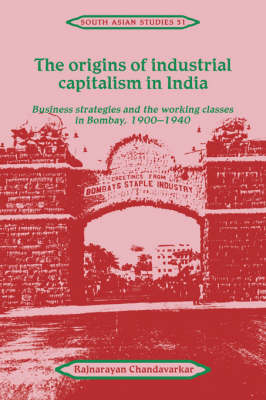
The Origins of Industrial Capitalism in India
Business Strategies and the Working Classes in Bombay, 1900–1940
Seiten
1994
Cambridge University Press (Verlag)
978-0-521-41496-8 (ISBN)
Cambridge University Press (Verlag)
978-0-521-41496-8 (ISBN)
The first major study of the relationship between labour and capital in India's economic development in the early twentieth-century. The author considers the spread of capitalism and the growth of the cotton textile industry.
Rajnarayan Chandavarkar presents the first major study of the relationship between labour and capital in India's economic development in the early twentieth-century. He explores the emergence of capitalism in the region, the development of the cotton textile industry, its particular problems in the 1920s and 1930s and the mill owners' and the state's responses to them. The author also investigates how a labour force was formed in Bombay - its rural roots, urban networks, industrial organisation and the way in which it shaped capitalist strategies. In a subject dominated by the assumption of unities, Rajnarayan Chandavarkar convincingly demonstrates the fragmentation of class, on the side of both capital and labour. Their interaction sometimes exacerbated their internal differences. But, the author also asks on what terms, to what ends, and under what circumstances solidarities could be forged between workers.
Rajnarayan Chandavarkar presents the first major study of the relationship between labour and capital in India's economic development in the early twentieth-century. He explores the emergence of capitalism in the region, the development of the cotton textile industry, its particular problems in the 1920s and 1930s and the mill owners' and the state's responses to them. The author also investigates how a labour force was formed in Bombay - its rural roots, urban networks, industrial organisation and the way in which it shaped capitalist strategies. In a subject dominated by the assumption of unities, Rajnarayan Chandavarkar convincingly demonstrates the fragmentation of class, on the side of both capital and labour. Their interaction sometimes exacerbated their internal differences. But, the author also asks on what terms, to what ends, and under what circumstances solidarities could be forged between workers.
1. Problems and perspectives; 2. The setting: Bombay city and its hinterland; 3. The structure and development of the labour market; 4. Migration and the rural connections of Bombay's workers; 5. Girangaon: the social organization of the working class neighbourhoods; 6. The development of the cotton textile industry: a historical context; 7. The workplace: labour and the organization of production in the cotton textile industry; 8. Rationalizing work, standardizing labour: the limits of reform in the cotton textile industry; 9. Epilogue: workers politics, class caste and nation.
| Erscheint lt. Verlag | 10.3.1994 |
|---|---|
| Reihe/Serie | Cambridge South Asian Studies |
| Verlagsort | Cambridge |
| Sprache | englisch |
| Maße | 160 x 235 mm |
| Gewicht | 928 g |
| Themenwelt | Geschichte ► Allgemeine Geschichte ► Neuzeit (bis 1918) |
| Geisteswissenschaften ► Geschichte ► Regional- / Ländergeschichte | |
| Wirtschaft ► Volkswirtschaftslehre | |
| ISBN-10 | 0-521-41496-2 / 0521414962 |
| ISBN-13 | 978-0-521-41496-8 / 9780521414968 |
| Zustand | Neuware |
| Informationen gemäß Produktsicherheitsverordnung (GPSR) | |
| Haben Sie eine Frage zum Produkt? |
Mehr entdecken
aus dem Bereich


aus dem Bereich
Geschichte einer wilden Handlung
Buch | Hardcover (2024)
C.H.Beck (Verlag)
CHF 47,60


