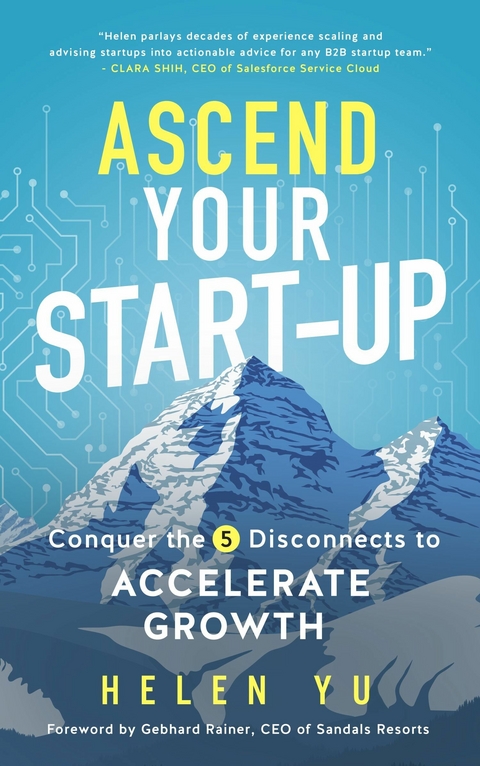
Ascend Your Start-Up (eBook)
100 Seiten
Blackstone Publishing (Verlag)
978-1-64146-631-8 (ISBN)
Introduction
The first thing I noticed about Jebbit co-founders Jonathan Lacoste and Tom Coburn was their maturity and dedication to their business despite looking so young. Both are extremely bright with high emotional intelligence. Jonathan could have been a young Brad Pitt or an earnest-looking Neil Armstrong, tall in stature with an easy-going smile. Tom might have been coming over on a Friday night to play video games. In fact, on Jebbit’s site, Tom’s bio picture features him holding up his favorite game, Settlers of Catan, which he states he “will play for hours.”
They were young, but they were fierce.
Underneath their youthful exuberance was a mature sensibility. I wondered where this aura of being “older” came from and learned that Jonathan had been a nationally ranked ice hockey goaltender—and the youngest goaltender to win a game in the North American Hockey League (NAHL) at the age of sixteen.
Both gentlemen took a risky plunge, even for founders. The one-time classmates dropped out of Boston College to start Jebbit in 2012. Both would become founders of the first-ever declared data SaaS platform. CNBC recognized Jebbit as one of the top 25 most promising companies in the world.1 Forbes put both co-founders on its 30 Under 30 list, and the company would later attract more than $20 million in investor funding.
Still, there was something wise in these young founders. In one media interview, Jonathan was asked what advice he would give his 20-year-old self. Jonathan responded: “Be more patient. Be more thankful.” He didn’t have to go back that far—his “twenty-year-old self” had been around for just five years at that point.
The Journey Ahead
Here’s the story. In 2016, Tom had reached out to Steve Lucas, the newly appointed CEO of Marketo after it had been acquired by Vista Equity. Tom shared with him that Jebbit had a common customer with Marketo and would like to discuss potential collaboration opportunities. I gave these founders big props for having the guts to reach out and explore collaboration with a $300 million global company. Jebbit had about 20 employees at the time. Steve’s answer was to the point: “Anything customer-related is Helen.”
Fortuitously, I had to travel to Boston the following week. We met at their college dorm-like offices over coffee.
“We have a joint customer. How can we further collaborate?” Tom said. His “ask” was the first step to open up a tremendous opportunity for Jebbit. That’s one of many reasons I admire both Jonathan and Tom. They are brilliant, yes, but many founders are brilliant technologists and visionaries on a grand scale. These traits alone are not enough. No, Jonathan and Tom had something more.
They had an insatiable hunger to learn. They were never arrogant. In every conversation, they always told me what they didn’t know. Not a single moment did they come off as knowing all the answers. To learn, one must be an active listener and turn information into actionable insight. They did this in spades. Most founders are curious learners, but not all listen, bringing back fresh ideas to their team and then taking action.
There is no perfect DNA for a founder. Each person comes out of the gate with a unique set of experiences and beliefs, talents and expertise, likes and dislikes. As founder of my own consulting firm, Tigon Advisory, I am no exception.
I’ve studied this question for many years. The answer became the basis for my own business and the realization that the missing pieces—the disconnects—are what holds us back in life.
I talked straight with Tom. “Before we jump into that customer and how to collaborate, could you share the Jebbit story with me, and what your top challenges are?”
Through that first one-hour conversation, I learned an incredible amount about Jebbit—and about Tom. I asked a ton of questions and was quite touched by Tom’s self-awareness of what skills he did not have. He listened really well, and was thoughtful when responding to my questions. I realized how much growth potential Jebbit has and how much I could help by leveraging my decades of experience.
It was difficult. My role was not to hand over answers because the answers were inside them. My goal was to tease them out through exploration. So, I did this by challenging them with questions like:
What is your longer-term vision?
Who is your ideal customer profile?
Does your solution solve the problem your ideal customers have?
Will you stay with these verticals, or will you expand?
Are you willing to pivot if you need to, or are you married to the original idea?
I spent the next two years as an advisor to Jebbit. We spent most of that time unpacking their go-to-market strategy, which meant one thing: asking a lot of questions.
The Milestones
Exploring questions is much more important to a founder than having ready-made answers handed to them (which is precisely why Ascend Your Start-Up is a decision framework made up of, you guessed it, questions). Assumptions are the greatest enemy for a start-up founder.
With that said, this is not a book that will teach you how to write a business plan, a product launch plan, an investor pitch deck, or any strategic document. The questions outlined in this decision framework cannot be Googled or found in one place for the simple reason that many of these questions pull back the curtain and reflect the unspoken challenges faced by founders. You will dive into what keeps founders up at one in the morning rather than how best to pitch an investor or write a great job description. You will see the most common disconnects, sometimes as simple as thinking of things out of order, like waiting to focus on brand rather than instilling it into your product, that add to the statistic that 90 percent of start-ups fail.2
Tom and Jonathan have a lot of shared values; they are hard-working, open to new ideas, and humble. They assembled a good team of advisors as they grew, and this continues today. They took on the challenging questions and sought to find answers. Jonathan would get up early and be in the library by seven in the morning oftentimes. Tom sometimes called at ten at night with questions when he was just wrapping up work. They were young, yes, but they were truly fierce in their hunger for knowledge.
There was a micro-moment, though, that was particularly telling. The founders were in a tough spot. When they started in 2011, there were 100 marketing technology companies. Five years later, when we met at their offices in Boston, there were 7,000 MarTech (Marketing Technology) companies. How do you set yourself apart from the competition?
One late summer evening, they called me and asked a crucial question: “At what point do you need a customer success team, and how do you structure your organization to scale?” They had an RFP with a major e-retailer. Up to that point, they had historically served smaller customers and didn’t have a pricing structure for a large, publicly held company. They had to pivot. Soon after, I found myself sitting with Jonathan in an office lobby in San Francisco. We went through the customer journey in different phases of growth. We talked about the importance of aligning with big players: Salesforce, Adobe, and Marketo. They had the capability to partner with large MarTech companies to increase conversion rates, and they did. Integrations with big players fueled their growth.
They realized, after much soul-searching, they had to swim in a different lane to reach the same destination. What would you have done in their position? How easily could you have abandoned everything you knew to dramatically reduce your number of clients while completely renovating your pricing model? In a way, this massive pivot was like leaving one’s homeland and building a new life in another country. But hard things can oftentimes be the right things.
The Roadmap
Jonathan and Tom’s story shows what successful leaders look like. Both admitted to me that they knew the hard road ahead, but were devoted to pivoting from MarTech to data declaration because they could stand out and gain market share in ways they never could before. That’s how they differentiated themselves from a thousand other companies.
Micro-moments are the key steps to achieving a milestone. You must seize those moments. In this book, you will learn about many, many micro-moments of growth. You might not be able to see how critical they are when you look at them individually, but they set the tone on how you drive growth forward. Tom and Jonathan’s spirit and gut brought them to the mountain. But that is not enough for you to make the climb. You must pick the right Sherpa and guide to help you on your journey (after all, you don’t know what you don’t know and it could be dangerous), be over-prepared to the point of exhaustion, and be willing to go backward at the right moment in order to move your company forward.
You might think that after working with Tom and Jonathan and other founders that I got super-motivated to write a book that would save them all from sleepless nights and needless pain. Not true. At the onset of writing Ascend Your Start-Up, I realized that it was completely impossible to write one book for flawlessly scaling the start-up mountain. No one book will ever cover every footstep of a founder’s ascent. The reason is not for lack of knowledge on the part of any one author, but rather that each climb is different.
What Does it Take...
| Erscheint lt. Verlag | 25.5.2021 |
|---|---|
| Co-Autor | Gebhard Rainer |
| Sprache | englisch |
| Themenwelt | Wirtschaft ► Betriebswirtschaft / Management ► Unternehmensführung / Management |
| ISBN-10 | 1-64146-631-6 / 1641466316 |
| ISBN-13 | 978-1-64146-631-8 / 9781641466318 |
| Informationen gemäß Produktsicherheitsverordnung (GPSR) | |
| Haben Sie eine Frage zum Produkt? |
 EPUB (Wasserzeichen)
Größe: 2,2 MB
DRM: Digitales Wasserzeichen
Dieses eBook enthält ein digitales Wasserzeichen und ist damit für Sie personalisiert. Bei einer missbräuchlichen Weitergabe des eBooks an Dritte ist eine Rückverfolgung an die Quelle möglich.
Dateiformat: EPUB (Electronic Publication)
EPUB ist ein offener Standard für eBooks und eignet sich besonders zur Darstellung von Belletristik und Sachbüchern. Der Fließtext wird dynamisch an die Display- und Schriftgröße angepasst. Auch für mobile Lesegeräte ist EPUB daher gut geeignet.
Systemvoraussetzungen:
PC/Mac: Mit einem PC oder Mac können Sie dieses eBook lesen. Sie benötigen dafür die kostenlose Software Adobe Digital Editions.
eReader: Dieses eBook kann mit (fast) allen eBook-Readern gelesen werden. Mit dem amazon-Kindle ist es aber nicht kompatibel.
Smartphone/Tablet: Egal ob Apple oder Android, dieses eBook können Sie lesen. Sie benötigen dafür eine kostenlose App.
Geräteliste und zusätzliche Hinweise
Buying eBooks from abroad
For tax law reasons we can sell eBooks just within Germany and Switzerland. Regrettably we cannot fulfill eBook-orders from other countries.
aus dem Bereich