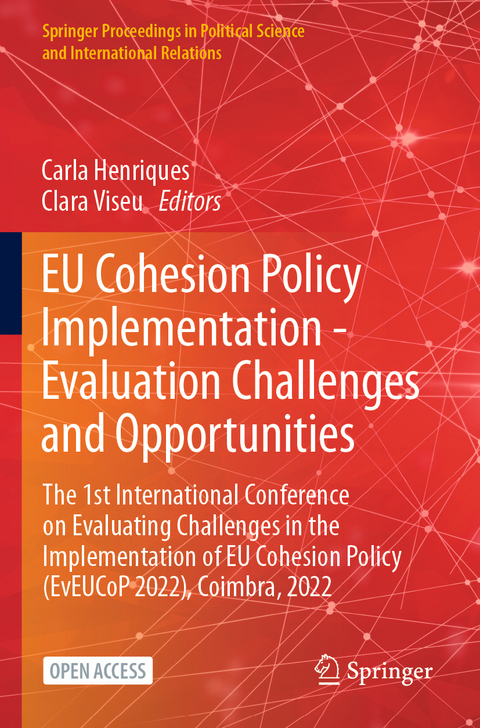
EU Cohesion Policy Implementation - Evaluation Challenges and Opportunities
Springer International Publishing (Verlag)
978-3-031-18163-4 (ISBN)
During the 2014-2020 programmatic period, member states were required to undertake assessments to evaluate the efficacy, efficiency, and impact of each operational program. Such evaluations are generally concerned with the compliance of projects and activities with programmatic priorities, as well as with funds' absorption capacity and refer to ex-ante and ex-post assessments. Hence, this book proposes the use of novel methodologies addressing the mid-term and terminal assessments that enable performing the efficiency appraisal of the operational programs and that can support decision-makers in the selection of projects that should be awarded for funding.
Carla Henriques is an assistant professor at the Polytechnic of Coimbra, Coimbra Business School (Portugal), and a faculty member of the Energy for Sustainability Initiative—UC, where she supervises M.Scs. and Ph.Ds, an integrated researcher at INESC Coimbra and a collaborator researcher at CeBER at the faculty of Economics of the University of Coimbra. She holds a Ph.D. in Electrical and Computer Engineering from the Faculty of Sciences of the University of Coimbra, in the branch of Optimization and Systems Theory, and a Ph.D. in Economics and Business from the Faculty of Economics and Business from the University of Malaga (Spain) in the branch of Economics of Education. Clara Viseu is an assistant professor at the Polytechnic Institute of Coimbra, Coimbra Business School (Portugal), and a collaborator researcher at the CMA-UBI, as well as an associate member at the CICF-IPCA. She holds a Ph.D. in Mathematics from the University of Beira Interior (Portugal) and a Master’s degree in Probability and Statistics from the University of Lisboa (Portugal).
Part I. Mid-term/terminal assessment: Data Envelopment Analysis approaches.- Chapter 1. Evaluating the reasons behind the inefficient implementation of ERDF devoted to R&I in SMEs (Carla Henriques).- Chapter 2. Are ERDF devoted to boosting ICT in SMEs inefficient? Insights through different DEA models (Carla Henriques).- Chapter 3. Are ERDF devoted to boosting ICT in SMEs inefficient? Further insights through the joint use of DEA with SFA models (Carla Henriques).- Chapter 4. Python implementation of the Value-Based DEA method (António Trigo).- Chapter 5. Are ERDF efficient in strengthening the switch to a Low-Carbon Economy? Some Insights with Value-Based Data Envelopment Analysis (Maria Gouveia).- Part II. Ex-post assessment: Meta-analysis.- Chapter 6. Firm competitiveness, specialization, and employment growth: territorial level Relationships (Federico Fantechi).- Chapter 7. The youth guarantee in Eastern Europe. A systematic review(Gabriela Neagu).- Part III. Methodologies for supporting the selection of projects.- Chapter 8. Smart and Sustainable Scheduling of Charging Events for Electric Buses (Padraigh Jarvis).- Chapter 9. Multiple impacts of energy efficiency technologies in Portugal (Marcos Tenente).- Part IV. Case studies.- Chapter 10. EU Operational Programmes Reporting: From Basics to Practices (Ana Amaro).- Chapter 11. European structural and investment funds 2021-2027: prediction analysis based on machine learning models (Victor Santos).- Chapter 12. Technology serving justice (Ana Paula Lopes).
| Erscheinungsdatum | 02.12.2022 |
|---|---|
| Reihe/Serie | Springer Proceedings in Political Science and International Relations |
| Zusatzinfo | XII, 193 p. 52 illus., 46 illus. in color. |
| Verlagsort | Cham |
| Sprache | englisch |
| Maße | 155 x 235 mm |
| Gewicht | 326 g |
| Themenwelt | Sozialwissenschaften ► Politik / Verwaltung ► Staat / Verwaltung |
| Wirtschaft ► Volkswirtschaftslehre ► Makroökonomie | |
| Schlagworte | Data envelopment analysis • DEA Models • Eastern Europe • energy efficiency • erdf • European regional development funds • European structural and investment funds • European Union Policy • Implementation of EU funds • Information and Communication Technologies • Low-carbon economy • Machine Learning Models • Meta-analysis • open access • Research and Innovation • Small and Mid-Sized Enterprises • Smart specialization • Youth |
| ISBN-10 | 3-031-18163-8 / 3031181638 |
| ISBN-13 | 978-3-031-18163-4 / 9783031181634 |
| Zustand | Neuware |
| Informationen gemäß Produktsicherheitsverordnung (GPSR) | |
| Haben Sie eine Frage zum Produkt? |
aus dem Bereich