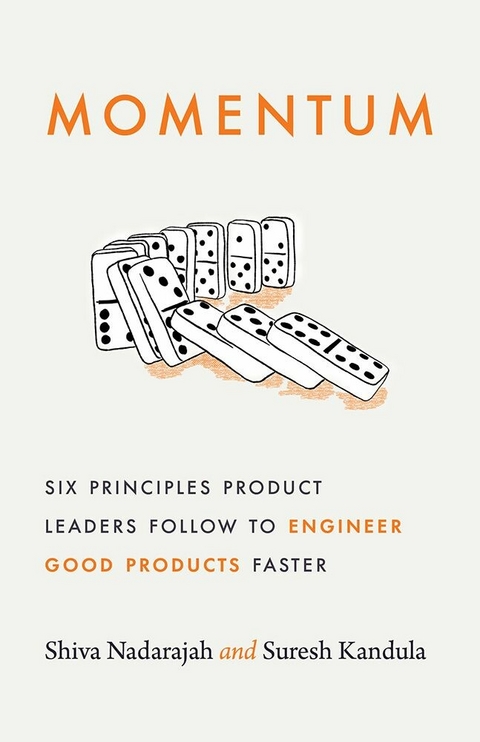
Momentum (eBook)
230 Seiten
Bookbaby (Verlag)
978-1-5445-2902-8 (ISBN)
Momentum | mo*men*tum | (noun): strength or force gained by motion or by a series of events As a leader in product engineering, the impact you make is determined by the momentum you sustain. You strive to maximize the use of information, rally your team, and remain agile, all at the same time. But you also face obstacles capable of slowing you down at almost every turn. How are you going to build products your customers want before they want them? How do you modernize your infrastructure and gain traction? As a large enterprise, how are you going to keep gaining traction? In Momentum, product engineers and organizational experts Shiva Nadarajah and Suresh Kandula provide you with the six principles every product leader must incorporate to engineer good products faster. The result of more than forty years of combined experience, their framework offers insightful solutions to issues every product leader faces. Shiva and Suresh give you tools, techniques, and templates for each principle so you can customize an approach that serves your needs and those of your organization. With real examples and actionable takeaways, this book is your practical guide for upgrading your product engineering discipline and consistently staying ahead of the curve.
Introduction
“Ideas are easy. It’s the execution that’s hard.”
—Jeff Bezos
Imagine a product manager, an architect, and an engineering team lead—collectively, a product leadership team—have gathered informally to debrief and vent their frustrations about recent events and the direction in which their organization is heading. The product manager walks through feedback from the latest customer survey, which indicates dissatisfaction with a new product, and is dismayed to report that a recent news article has highlighted a competitor’s success with a similar product. The architect details the Herculean effort put forth by the production team to roll out a new feature—only to receive similarly disappointing results, certainly disproportionate to the additional strain on the team. The engineering team lead, who is new to the organization and who, therefore, has the benefit of relative objectivity, states that he finds it astonishing that there was such a delay and degree of difficulty in releasing a capability into production, given the extent of the enterprise’s considerable resources.
They argue in circles as to the cause—is it the legacy architecture, an ancient mainframe, outdated modes of delivery or an incorrect code delivery approach, lack of automation, a waterfall methodology instead of Agile, or simply having teams set up inefficiently? Whatever the cause (or causes), they can all agree on one conclusion: if this pace continues into future quarters, their organization is not going to survive in the marketplace. Startups are faster, and digital natives are able to innovate and deliver more quickly, but large enterprises are generally unable to keep pace. Customers have noticed that other more cutting-edge solutions exist elsewhere—and the internal teams have also noted that their organization is behind the innovation curve.
They know they need to find a better way to deliver a better customer experience. They know they need better architecture. They know they need more momentum, but coming to this solution only presents another problem—one which leaves the product leadership team paralyzed—and that is the problem of not knowing where to begin.
Momentum
No matter the specific role, any member of a product leadership team can recognize when their organization is not having the impact in the marketplace it should be having. The symptoms of that problem may include seeing competitors or new entrants in the market rolling out new capabilities and innovations faster than they are, being unable to meet customer expectations of types of products or flexibility within existing products, lack of growth compared to industry standards, and an exodus of both customers and internal team members. As satisfaction drops, there is a secondary impact in revenue, profit, and other metrics of the health of an organization. Talented employees are going to do what’s best for their careers and make the move to a company where innovation happens much faster, leading to problems with attrition.
This becomes a multidimensional engineering and organizational challenge, and a product leadership team is unlikely to know where to begin or how to structure their change initiative to balance the dichotomy of being comprehensive but also expedient.
Within financial services, as an example, this challenge of lack of momentum is quite visible. According to a McKinsey study, on average only 30 percent of an organization’s technology spend is directed toward new business capability-oriented development, whereas 70 percent is consumed by re-engineering, support activities, and infrastructure maintenance.1 As a byproduct of this, smaller, nimbler competitors have flourished, with annual private equity funding growing 10X from roughly $4 billion in 2010 to $40 billion in 2020. Enterprises attempt to match this investment with their own spending; as an example, retail banking spent $20 billion on digital technology in 2017. Yet, dollar for dollar, large well-funded enterprises lag in getting new capabilities out to the market and are unable to match the momentum of their new digitally native competitors.
But what does momentum mean? Momentum is measured as the product of the mass and velocity of a moving body. In the context of business, momentum refers to the amount of impact an organization creates, along with the speed at which they create that impact. An organization is not going to focus solely on how fast they can create something; this is not about speed for speed’s sake because misdirected hustle or quickly rolling out the wrong features is counterproductive. Instead, momentum acknowledges the importance of speed, but it must be combined with impact—doing business the right way, holistically in terms of both the customer and the organization, with the right architecture, right operational metrics, and right principles. Momentum is a powerful force in any organization. When leaders direct it correctly, they can start to see positive feedback that drives their momentum even higher!
Figure 1: Six Principles
Our Momentum Methodology
Through our experiences and research, distilled from interviews with executives, product managers, analysts, and engineers, we have identified the six principles that most impact a product team’s momentum, aiding them on their transformation journey to evolve into agile, resilient, product-oriented organizations rooted in a customer-centric view. If the reader follows the principles outlined in this book, they will begin to make the step change necessary to get their teams on a path to be more customer-centric, make better engineering decisions about their business, modernize their architecture more efficiently, extract more value out of their data, and be able to better structure teams to drive more momentum in an agile way.
The reader will also learn:
- How to infuse product management thinking throughout their teams (not just product owners)
- How to build an effective enterprise architecture roadmap
- How to extract the most value from their data
- How to evaluate the organizational structure and its effectiveness, and select the right framework that can unlock human potential
- How to build and manage a resilient technical delivery pipeline
- How to avoid stall and set their teams up to constantly evolve and grow
These six principles are interconnected, and this book serves not only as information about the principles themselves, but also gives a method of how to approach them. This framework allows teams to see the broader picture and manage the interdependencies across the principles. Product leaders need framing in order to have holistic conversations with their teams; this framework provides a structured way to approach change discussions with the proper perspective.
Absent this framework, it is all too common for teams to find themselves mired in myopic conversations, focused on a particular issue absent of the larger context of that product team’s momentum. For example, triggered by a vendor mandate to cease supporting a particular off-the-shelf product, a team may go down the rabbit hole of reacting to that urgent risk and pursuing a swap option in isolation. When perhaps, with the benefit of a framework, the team may either have had a proactive strategy in place or could route a path forward in the context of the product’s broader data strategy.
For large financial services organizations, change tends to be reactive—a result of new regulatory requirements, burning issues, end of life technology, scalability risks, or slow delivery infrastructure. The principles allow a constant evaluation of these risks and introduce a methodical way of dealing with risk and change. With this framework in place, the team will be able to place issues in the context of the factors that drive product momentum and discuss approaches in relation to all six principle areas, always keeping focus on the impact to the business.
The interconnected nature of complex product delivery issues cannot be solved in isolation. A product leadership team trying to retire a mainframe also has organizational challenges to consider. They will have ambitions to integrate new technologies beyond moving away from the mainframe to enrich customer experience. They must be mindful of the business capabilities they’re ultimately delivering, as well as what that trend line looks like. Finally, they need a sense of how reliable their new solution is going to be. Even the seemingly ring-fenced case of shutting off a mainframe shows how these principles are interconnected.
Leading with business needs acts as a forcing function to help cut through this web. Product leadership teams shouldn’t attempt to solve the technology problem, the data problem, or the people problem; they should instead solve the business problem. With a top-down view of what’s working and what’s not, they can explain to their management, in business terms, the root cause of the problem to be solved, as well as the magnitude of the issue from the perspective of cost, reputational risk, and customer voice, all tied back to the business case. This framework is not just a method to madness in terms of managing or a way of solving one single problem; it’s a way to have a discussion in order to determine the overall business problem that needs to be resolved.
This framework also...
| Erscheint lt. Verlag | 28.6.2022 |
|---|---|
| Sprache | englisch |
| Themenwelt | Wirtschaft ► Betriebswirtschaft / Management ► Unternehmensführung / Management |
| ISBN-10 | 1-5445-2902-3 / 1544529023 |
| ISBN-13 | 978-1-5445-2902-8 / 9781544529028 |
| Informationen gemäß Produktsicherheitsverordnung (GPSR) | |
| Haben Sie eine Frage zum Produkt? |
 EPUB (Ohne DRM)
Größe: 5,1 MB
Digital Rights Management: ohne DRM
Dieses eBook enthält kein DRM oder Kopierschutz. Eine Weitergabe an Dritte ist jedoch rechtlich nicht zulässig, weil Sie beim Kauf nur die Rechte an der persönlichen Nutzung erwerben.
Dateiformat: EPUB (Electronic Publication)
EPUB ist ein offener Standard für eBooks und eignet sich besonders zur Darstellung von Belletristik und Sachbüchern. Der Fließtext wird dynamisch an die Display- und Schriftgröße angepasst. Auch für mobile Lesegeräte ist EPUB daher gut geeignet.
Systemvoraussetzungen:
PC/Mac: Mit einem PC oder Mac können Sie dieses eBook lesen. Sie benötigen dafür die kostenlose Software Adobe Digital Editions.
eReader: Dieses eBook kann mit (fast) allen eBook-Readern gelesen werden. Mit dem amazon-Kindle ist es aber nicht kompatibel.
Smartphone/Tablet: Egal ob Apple oder Android, dieses eBook können Sie lesen. Sie benötigen dafür eine kostenlose App.
Geräteliste und zusätzliche Hinweise
Buying eBooks from abroad
For tax law reasons we can sell eBooks just within Germany and Switzerland. Regrettably we cannot fulfill eBook-orders from other countries.
EPUB (Adobe DRM)Kopierschutz: Adobe-DRM
Adobe-DRM ist ein Kopierschutz, der das eBook vor Mißbrauch schützen soll. Dabei wird das eBook bereits beim Download auf Ihre persönliche Adobe-ID autorisiert. Lesen können Sie das eBook dann nur auf den Geräten, welche ebenfalls auf Ihre Adobe-ID registriert sind.
Details zum Adobe-DRM
Dateiformat: EPUB (Electronic Publication)
EPUB ist ein offener Standard für eBooks und eignet sich besonders zur Darstellung von Belletristik und Sachbüchern. Der Fließtext wird dynamisch an die Display- und Schriftgröße angepasst. Auch für mobile Lesegeräte ist EPUB daher gut geeignet.
Systemvoraussetzungen:
PC/Mac: Mit einem PC oder Mac können Sie dieses eBook lesen. Sie benötigen eine
eReader: Dieses eBook kann mit (fast) allen eBook-Readern gelesen werden. Mit dem amazon-Kindle ist es aber nicht kompatibel.
Smartphone/Tablet: Egal ob Apple oder Android, dieses eBook können Sie lesen. Sie benötigen eine
Geräteliste und zusätzliche Hinweise
Buying eBooks from abroad
For tax law reasons we can sell eBooks just within Germany and Switzerland. Regrettably we cannot fulfill eBook-orders from other countries.
aus dem Bereich