


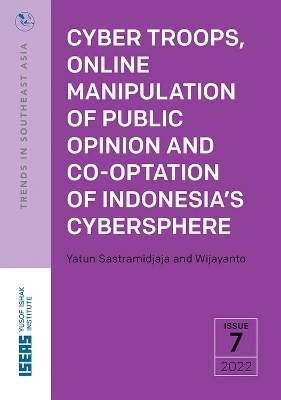
Cyber Troops, Online Manipulation of Public Opinion and Co-Optation of Indonesia's Cybersphere
Seiten
2022
Iseas (Verlag)
978-981-5011-49-4 (ISBN)
Iseas (Verlag)
978-981-5011-49-4 (ISBN)
- Titel nicht im Sortiment
- Artikel merken
The ever more systematic use of cyber troops - and the considerable resources spent on such operations - indicates increasing co-optation of Indonesia's cybersphere for elite interests. This threatens to undermine the quality of public debate and democracy in Indonesia.
Organized propaganda and public opinion manipulation are increasing in Indonesia's cybersphere. Specifically, since 2019, there has been a marked rise of cyber troop campaigns that serve to mobilize public consensus for controversial government policies.
Cyber troop operations played a crucial role in three controversial events in which public opinion had been initially critical of the government policy at issue. These were, first, the revision of the Law on the Corruption Eradication Commission in September 2019; second, the launch of the New Normal policy during the COVID-19 pandemic in May 2020; and third, the passing of the Omnibus Law for Job Creation in October 2020.
In all three cases, there is clear evidence of cyber troops manipulating public opinion in support of government policy. In all three cases, the cyber troops manufactured consent by flooding social media with narratives that promoted the governing elite's agenda, often using deceptive messages and disinformation that were amplified by numerous "buzzer" and "bot" accounts. Thereby they effectively drowned out oppositional discourses on social media and neutralized dissent, especially as mainstream media simultaneously echoed the cyber troops' narratives.
The ever more systematic use of cyber troops—and the considerable resources spent on such operations—indicates increasing co-optation of Indonesia's cybersphere for elite interests. This threatens to undermine the quality of public debate and democracy in Indonesia because cyber troop operations not only feed public opinion with disinformation but also prevent citizens from scrutinizing and evaluating the governing elite's behaviour and policy-making processes, which further exacerbates Indonesia's ongoing democratic regression.
Organized propaganda and public opinion manipulation are increasing in Indonesia's cybersphere. Specifically, since 2019, there has been a marked rise of cyber troop campaigns that serve to mobilize public consensus for controversial government policies.
Cyber troop operations played a crucial role in three controversial events in which public opinion had been initially critical of the government policy at issue. These were, first, the revision of the Law on the Corruption Eradication Commission in September 2019; second, the launch of the New Normal policy during the COVID-19 pandemic in May 2020; and third, the passing of the Omnibus Law for Job Creation in October 2020.
In all three cases, there is clear evidence of cyber troops manipulating public opinion in support of government policy. In all three cases, the cyber troops manufactured consent by flooding social media with narratives that promoted the governing elite's agenda, often using deceptive messages and disinformation that were amplified by numerous "buzzer" and "bot" accounts. Thereby they effectively drowned out oppositional discourses on social media and neutralized dissent, especially as mainstream media simultaneously echoed the cyber troops' narratives.
The ever more systematic use of cyber troops—and the considerable resources spent on such operations—indicates increasing co-optation of Indonesia's cybersphere for elite interests. This threatens to undermine the quality of public debate and democracy in Indonesia because cyber troop operations not only feed public opinion with disinformation but also prevent citizens from scrutinizing and evaluating the governing elite's behaviour and policy-making processes, which further exacerbates Indonesia's ongoing democratic regression.
| Erscheinungsdatum | 30.08.2022 |
|---|---|
| Reihe/Serie | Trends in Southeast Asia |
| Sprache | englisch |
| Gewicht | 333 g |
| Themenwelt | Mathematik / Informatik ► Informatik ► Web / Internet |
| Sozialwissenschaften ► Politik / Verwaltung ► Politische Theorie | |
| Wirtschaft ► Betriebswirtschaft / Management ► Wirtschaftsinformatik | |
| ISBN-10 | 981-5011-49-9 / 9815011499 |
| ISBN-13 | 978-981-5011-49-4 / 9789815011494 |
| Zustand | Neuware |
| Informationen gemäß Produktsicherheitsverordnung (GPSR) | |
| Haben Sie eine Frage zum Produkt? |
Mehr entdecken
aus dem Bereich



aus dem Bereich
Handbuch für die Praxis
Buch | Hardcover (2023)
O'Reilly (Verlag)
CHF 55,85
Von den Grundlagen über die rechtlichen Aspekte bis zur praktischen …
Buch | Softcover (2025)
O'Reilly (Verlag)
CHF 55,85
Methoden und Praxis für Strategie, PR, Marketing, Change und Social …
Buch (2024)
Hanser (Verlag)
CHF 55,95


