


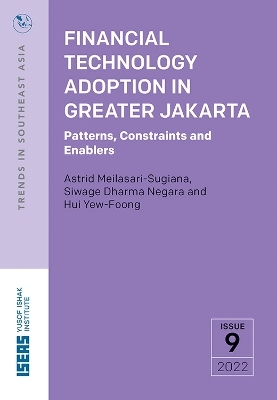
Financial Technology Adoption in Greater Jakarta
Patterns, Constraints and Enablers
Seiten
2023
Iseas (Verlag)
978-981-5011-54-8 (ISBN)
Iseas (Verlag)
978-981-5011-54-8 (ISBN)
- Titel nicht im Sortiment
- Artikel merken
Reports the findings of an online survey conducted in November-December 2021 on Indonesians' experience and perception of fintech tools, focusing on fintech adoption in the Greater Jakarta region, which besides Jakarta, includes Bogor, Depok, Tangerang and Bekasi.
This article reports the findings of an online survey conducted in November–December 2021 on Indonesians' experience and perception of fintech tools, focusing on fintech adoption in the Greater Jakarta region, which besides Jakarta, includes Bogor, Depok, Tangerang and Bekasi.
One key finding is that, in the Greater Jakarta region, socio-economic status as measured by income is not a key determinant of fintech adoption. This is likely due to the more developed and mature ICT infrastructure in the Greater Jakarta region, which makes fintech tools readily accessible.
However, the kinds of fintech tools that are more likely to be used—M-banking, E-wallet, Online Lending, Investment, Donations, and so on—are influenced by factors such as income, education, gender, age and occupation, suggesting that different fintech tools appeal to different groups in society according to their needs and resources.
Psychological factors that are important in the adoption of fintech include having many choices in the needed financial services and feeling in control. While fintech users are concerned about data leaks and fraud, this does not deter them from using fintech.
It may be anticipated that with the deepening of ICT infrastructure and public education on the safe use of fintech, fintech usage in Indonesia will continue to spread throughout the country.
This article reports the findings of an online survey conducted in November–December 2021 on Indonesians' experience and perception of fintech tools, focusing on fintech adoption in the Greater Jakarta region, which besides Jakarta, includes Bogor, Depok, Tangerang and Bekasi.
One key finding is that, in the Greater Jakarta region, socio-economic status as measured by income is not a key determinant of fintech adoption. This is likely due to the more developed and mature ICT infrastructure in the Greater Jakarta region, which makes fintech tools readily accessible.
However, the kinds of fintech tools that are more likely to be used—M-banking, E-wallet, Online Lending, Investment, Donations, and so on—are influenced by factors such as income, education, gender, age and occupation, suggesting that different fintech tools appeal to different groups in society according to their needs and resources.
Psychological factors that are important in the adoption of fintech include having many choices in the needed financial services and feeling in control. While fintech users are concerned about data leaks and fraud, this does not deter them from using fintech.
It may be anticipated that with the deepening of ICT infrastructure and public education on the safe use of fintech, fintech usage in Indonesia will continue to spread throughout the country.
| Erscheinungsdatum | 30.08.2022 |
|---|---|
| Reihe/Serie | Trends in Southeast Asia |
| Sprache | englisch |
| Gewicht | 333 g |
| Themenwelt | Wirtschaft ► Allgemeines / Lexika |
| Wirtschaft ► Betriebswirtschaft / Management ► Wirtschaftsinformatik | |
| Wirtschaft ► Volkswirtschaftslehre | |
| ISBN-10 | 981-5011-54-5 / 9815011545 |
| ISBN-13 | 978-981-5011-54-8 / 9789815011548 |
| Zustand | Neuware |
| Informationen gemäß Produktsicherheitsverordnung (GPSR) | |
| Haben Sie eine Frage zum Produkt? |
Mehr entdecken
aus dem Bereich

aus dem Bereich
IEC 62443 einfach erklärt
Buch | Softcover (2024)
VDE VERLAG
CHF 58,75


